
Online Notary Training: Your 2026 Guide to Certification
 Mahmudul Hasan Rafi·
You’re probably in one of two places right now. You either want a flexible, tech-enabled service business that doesn’t depend on foot traffic, or you already teach professional training and you’ve spotted a demand spike around online notarization.
Both groups run into the same problem. The rules sound technical, the state requirements feel fragmented, and most explanations assume you already know the difference between an eNotary, IPEN, and RON.
That confusion is normal. Online notary training sits at the intersection of law, identity verification, digital signatures, and small-business operations. Once you break it down into plain language, the path gets much easier to follow.
The Rising Demand for Online Notaries in 2026
A common scenario looks like this. Someone already works in real estate support, legal admin, loan signing, insurance, or another document-heavy role. They want work that travels better, fits around family or client schedules, and makes sense in a digital-first economy.
That’s where remote online notarization enters the picture. Instead of waiting for a signer to appear in person, an authorized notary uses a compliant platform to verify identity, witness signatures, and complete the notarial act remotely.

Why this field has real momentum
This isn’t a niche experiment anymore. The remote online notarization market is projected to reach $1.8 billion by 2027, and some analyses cited in a CUNY Pressbooks overview report that fraud involving notarized documents dropped by over 50% in some cases because RON platforms use video recording, biometric checks, and government ID verification as part of the process and training framework (CUNY Pressbooks on the future of remote online notarization).
That combination matters. Professionals want convenience. Regulators want accountability. Clients want a process they can complete without driving across town or mailing time-sensitive paperwork back and forth.
Practical rule: If a profession becomes easier for clients and easier to audit for regulators, demand usually follows.
Why training matters more than people expect
Many newcomers think online notary work is just traditional notarization on Zoom. It isn’t. The legal act stays familiar, but the method changes. You need to understand platform rules, identity proofing, electronic seals, recording obligations, and the difference between what your state allows versus what your software can do.
For aspiring notaries, training is what turns a vague opportunity into a compliant service.
For educators, this creates a second opportunity. People don’t just need help passing a course. They need help choosing the right path, avoiding technical mistakes, and turning authorization into a functioning service business.
Who benefits most
Online notary training tends to appeal to readers who want one of these outcomes:
- A flexible credentialed service: Useful for people leaving office-based roles or adding a second income stream.
- A digital upgrade to existing work: Especially relevant for signing agents, legal support staff, and admin professionals.
- A new training niche: Course creators can serve a market that needs both compliance education and practical business guidance.
The strongest reason to pay attention is simple. This profession is becoming part of normal digital operations, not an unusual exception.
Understanding Remote Online Notarization
People get confused because three related terms are often treated like they mean the same thing. They don’t.
A simple way to think about the three models
Use this analogy.
A traditional notarization is like meeting someone in person at an office desk. Paper documents, physical presence, wet signatures, physical stamp.
An in-person electronic notarization, often called IPEN or eNotary, is like sitting with someone in the same room but signing on a tablet instead of paper. The signer is still physically present. The document and seal are electronic.
A remote online notarization, or RON, is like a secure video meeting built for legal identity verification. The signer appears remotely through an approved audio-visual platform, and the notary completes the act using approved digital tools.
What changes in RON and what stays the same
The core duty doesn’t change. A notary still has to confirm identity, assess willingness, and complete the notarial act correctly.
What changes is the method. RON adds a compliance layer that includes secure video, digital identity checks, electronic signatures, and an electronic record of what happened during the session.
Here’s the easiest comparison:
| Type | Signer location | Document format | Notary tools |
|---|---|---|---|
| Traditional | In the same room | Paper | Physical stamp and journal |
| IPEN | In the same room | Electronic | Electronic seal and signature |
| RON | Remote | Electronic | Secure audio-video platform, electronic seal, digital certificate, electronic journal |
The technology behind the process
Most readers first hear terms like credential analysis, KBA, tamper-evident seal, and digital certificate, then tune out. Keep it practical.
A compliant RON workflow usually includes:
- Secure live audio-video communication: The notary and signer must interact in real time.
- Identity verification tools: These may include credential analysis of an ID and other state-accepted identity proofing steps.
- Electronic signature support: The signer and notary complete the document digitally.
- Tamper-evident protections: The system should reveal whether the document changed after notarization.
- Electronic recordkeeping: A compliant journal and, where required, retained session evidence.
Think of RON as notarization plus a built-in audit trail.
Where beginners usually get stuck
The biggest misunderstanding is assuming any webcam and PDF tool will work. They won’t. A compliant notarization session isn’t just a video call with a signature attached. It has to meet your state’s standards and your platform’s standards at the same time.
Another point of confusion is assuming IPEN automatically qualifies you for RON work. It doesn’t. They overlap, but they aren’t interchangeable.
Why educators should care about the distinctions
If you create training, your curriculum either earns trust or loses it. Learners need a clear decision tree:
- Are they starting as a traditional notary?
- Does their state authorize IPEN, RON, or both?
- Do they need a state-approved course?
- Do they need a separate exam or vendor approval?
When a course skips these distinctions, students leave with vocabulary but not clarity. That’s why good online notary training starts with a mental model before it touches statutes or software.
Navigating State Legal and Training Requirements
The fastest way to get lost is to look for a universal checklist. Notary law is state-specific, and online notary law is even more so.
Still, the overall path is more predictable than it looks once you know what to look for.
Start with your commissioning authority
Your primary source is usually your state’s Secretary of State, commissioning office, or equivalent notary regulator. Don’t begin with a vendor demo or a social media post. Begin with the agency that authorizes notaries in your state.
By 2023, over 40 U.S. states had authorized RON, and the path from traditional commission to full RON authorization can take up to six weeks, according to the National Notary Association’s overview of becoming a remote online notary. That same source notes historical exam pass rates averaging 70 to 80%, with online training resources improving first-time pass rates by 15% post-2020 (National Notary Association guidance on becoming a remote online notary).
That should reassure you. The process has rigor, but it isn’t designed to be impossible.
The common requirements most applicants will see
Even though details vary, many states follow a familiar sequence.
Get your traditional notary commission first
In many states, RON is an added authorization, not a substitute for your base commission.Complete state-approved training
Online notary training becomes mandatory in practice through this instruction. The course usually covers state law, platform use, identity procedures, and compliance rules.Pass an exam if your state requires one
Some states require testing. Others focus on course completion and application review.Secure your tools and approvals
That often includes an electronic seal, digital certificate, and a state-accepted platform or vendor relationship.Submit your RON application
This step may require proof of training, proof of technology, and other supporting documents.
Bonds and insurance confuse a lot of people
A surety bond protects the public if a notary violates legal duties covered by the bond. It isn’t the same as personal insurance for the notary.
Errors and Omissions insurance, often called E&O insurance, protects the notary from certain claims arising from mistakes. Whether it’s required depends on the state and the type of authorization involved.
If you teach this topic, don’t present those items as interchangeable. They serve different purposes, and students need that distinction early.
If a state checklist mentions both a bond and E&O coverage, treat them as separate compliance decisions, not one bundled item.
A simple framework for checking your state’s rules
Use this checklist when researching your jurisdiction:
- Confirm eligibility: Are you required to already hold a traditional commission?
- Find approved education: Does the state specify approved training providers?
- Check testing rules: Is there an exam, and is it proctored or embedded in the course?
- Review technology conditions: Does the state require platform approval, notification, or vendor registration?
- Verify insurance and bond language: Don’t assume optional means unnecessary.
- Inspect renewal timing: Some states align RON authorization with your core notary commission.
If you teach compliance or continuing education, it also helps to understand how formal training hours fit into regulated learning pathways. This overview of what CEUs are and how they’re used in structured training gives useful context for packaging professional education in a way learners recognize.
What entrepreneurs should notice
Most prospective notaries don’t fail because the law is unreadable. They fail because they jump between websites, confuse one state’s rules with another’s, or buy tools before confirming what their state accepts.
That creates an opening for better education. The strongest training products don’t just explain the law. They teach students how to verify the law for themselves.
The Essential Tech Stack for Online Notaries
Online notary work becomes much less intimidating when you treat the technology as a toolkit instead of a mystery.
You don’t need to be a cryptography expert. You do need to know what each tool does, why regulators care about it, and where mistakes usually happen.

The five tools that matter most
A working setup usually includes these components:
- A reliable computer with camera and microphone: RON depends on live audio-visual interaction that’s stable and clear.
- An approved notarization platform: Identity checks, document presentation, signing, and session handling occur here.
- An electronic seal: This is your digital notary stamp, configured to meet state and platform standards.
- A digital certificate: This ties your electronic notarization acts to a secure cryptographic identity.
- An electronic journal: This records the act and preserves the audit trail required for compliance.
What a digital certificate actually does
A digital certificate proves that the notarial signature came from you and helps show whether a document was altered afterward. In practical terms, it supports authenticity and document integrity.
The technical side matters because states and providers care about non-repudiation and tamper evidence. The National Notary Association’s eNotary guidance describes training that covers tamper-evident seals using PKI private keys with a 2048-bit RSA minimum, along with electronic journals recoverable for up to 10 years. That same guidance notes that improper seal application can contribute to 15 to 25% rejection rates in electronic filings (National Notary Association guidance on becoming an electronic notary).
That’s why setup details matter. A seal isn’t decoration. It’s a compliance device.
What this means in day-to-day practice
If your electronic seal is applied incorrectly, the filing may be rejected. If your journal isn’t preserved correctly, you may struggle to defend the validity of the act later. If your digital certificate expires or is mismatched, your workflow can break at exactly the wrong time.
Here’s a practical translation of the jargon:
| Term | Plain meaning | Why you care |
|---|---|---|
| Digital certificate | Your secure electronic identity | Supports trust in your signature |
| Tamper-evident seal | A seal that helps reveal later changes | Protects document integrity |
| Electronic journal | A searchable record of the notarization | Supports compliance and review |
| Audio-video record | Evidence of the remote session | Helps document what happened |
Security isn’t optional
Notaries handle sensitive personal and legal information. Good habits matter as much as the software itself. If you want a strong operational baseline, this guide to data security best practices is worth reviewing alongside your state’s technical rules.
For course creators, this is also where content packaging becomes important. If you’re delivering software walkthroughs, assessments, and interactive modules, understanding what a SCORM file is helps when you need standardized e-learning content that tracks learner progress consistently.
A notary’s tech stack should do two jobs at once. It must help you complete the act correctly, and it must help you prove later that you completed it correctly.
Your Step-by-Step Path to Becoming an Online Notary
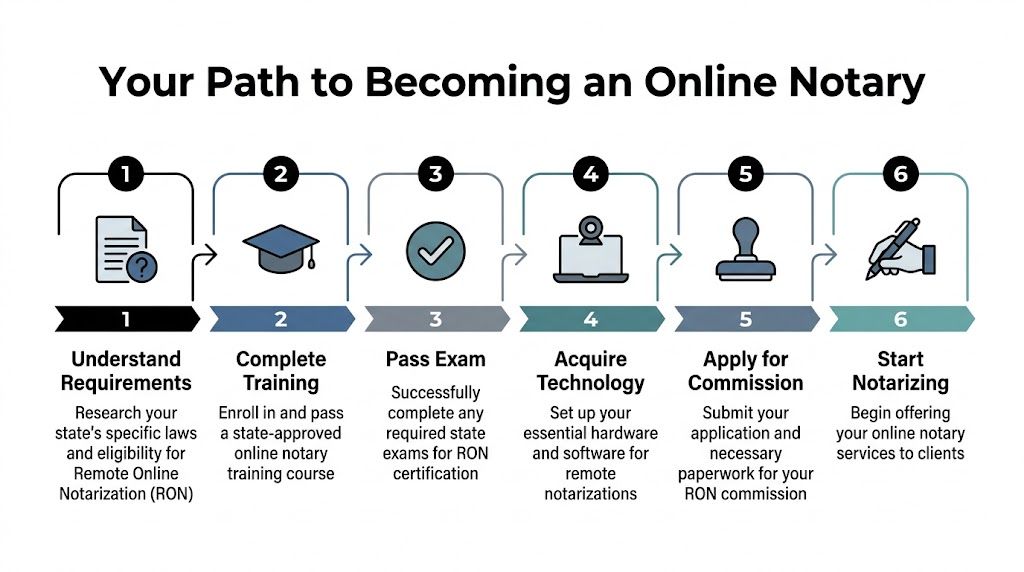
It is generally more effective to use a single roadmap than a pile of regulations. Keep this sequence in front of you and work through it in order.
Start with the legal foundation. Add training. Then add tools. Finally, complete your authorization and launch your service.
Step 1 Understand your state’s entry point
Some readers are already commissioned notaries. Others aren’t. That distinction changes everything.
If you don’t yet hold a traditional notary commission, begin there. In many states, online authorization sits on top of your existing commission. If you skip this and start buying digital tools first, you can waste time and money.
Make a one-page checklist for your state with these items:
- Base commission status
- RON eligibility
- Required training
- Exam rules
- Technology approval
- Application materials
Step 2 Choose a state-appropriate training provider
Your course should match your state’s legal requirements, not just your preferred learning style. Approved providers usually cover state law, identity procedures, recordkeeping, and platform use.
When evaluating a provider, ask practical questions:
- Does it clearly identify the states it serves?
- Does it explain whether the course is mandatory or preparatory?
- Does it include exam preparation if your state tests?
- Does it cover actual workflow, not just legal theory?
A good training experience reduces hesitation. It also helps you avoid the beginner mistake of memorizing terminology without understanding the order of operations.
Step 3 Complete any required exam
If your state requires an exam, treat it as a compliance check, not an academic contest. Read the state materials, complete the assigned training carefully, and focus on process accuracy.
Many candidates overcomplicate things. You usually don’t need to master every edge case before you sit the test. You need a reliable grasp of the acts you’re authorized to perform, the identity rules, the recordkeeping duties, and the prohibited conduct.
The strongest exam preparation is procedural. Know what you must do before, during, and after the notarization.
Step 4 Set up your tools before you apply
Don’t leave technology until the end. Many applications require proof that you’ve selected or secured compliant tools.
Your pre-application setup often includes:
- Electronic seal
- Digital certificate
- Approved or accepted platform
- Journal system
- Audio-video capable workstation
Test your setup as if you were the client. Check camera angle, sound quality, browser compatibility, document upload flow, and how your seal appears on a completed record.
Here’s a useful walkthrough to review before you move deeper into the process:
Step 5 File your application carefully
This stage is administrative, but small omissions can slow everything down. Review your forms line by line and confirm that the names on your training documents, commission records, and technology documents match.
Before submission, verify:
- Training completion proof: Certificate or official evidence of course completion.
- Exam completion proof: If the state requires it, include what the regulator asks for.
- Technology disclosures: Some states want platform or vendor details.
- Insurance or bond documents: Include them only as required, but include them correctly.
If your state accepts digital submission, save a full copy of everything you upload. If it requires mail submission, keep copies and tracking records.
Step 6 Practice your workflow before seeing your first client
Authorization doesn’t mean fluency. It means permission.
Run mock sessions. Use a friend or colleague as a test signer if your platform allows a practice environment. Focus on greeting, identity sequence, signer instructions, seal placement, journal completion, and session closeout.
A short rehearsal helps you catch practical issues such as:
- speaking too fast during identity checks
- forgetting to confirm document completeness
- struggling to direct the signer through the platform
- misplacing or misapplying the notarial certificate
Step 7 Decide how you’ll offer the service
Aspiring notaries transition into operators. Think about availability, service area rules, target client types, and how you’ll explain the process to first-time signers.
Many new notaries do better when they start with a narrow audience, such as:
| Audience | Why it works for beginners |
|---|---|
| Real estate support clients | Document-heavy and process-driven |
| Estate planning clients | Strong need for convenience |
| General public requests | Broad demand, but more education needed |
Your best early asset is clarity. A simple page or profile that explains what documents you can handle, how clients prepare, and what they should expect removes friction before the appointment starts.
Step 8 Keep your authorization active and your records clean
Online notary work isn’t a one-time setup. You need to track renewals, software access, certificate validity, and any changes to state rules.
Build a recurring compliance habit:
- Check expiration dates: Commission, digital certificate, insurance, and platform access.
- Review state updates: Notary rules can shift, and platform practices may change with them.
- Audit your records: Make sure your journal and supporting materials remain accessible and complete.
This is the part experienced compliance professionals take seriously. The work isn’t just performing the act. The work is maintaining a system that holds up when someone reviews it later.
How to Create and Sell Compliant Notary Training Courses
The training market has an obvious gap. Many programs help people qualify, but they don’t help them operate.
That matters because authorization alone doesn’t answer the questions learners ask once the certificate arrives. How do I package services? How do I explain remote notarization to clients? How do I choose a niche? How do I handle state-by-state complexity if I teach this topic?
Build for the gap between certification and income
A verified market gap already exists. Some notary training options don’t provide a business framework for scaling beyond hourly service, creating room for a Notary Business Bootcamp style offering that combines compliance with go-to-market strategy and helps bridge the space between certification and sustainable income (National Notary Association training page highlighting the business guidance gap).
That means edupreneurs have room to design better offers, such as:
- State compliance modules: Clear walkthroughs for specific jurisdictions.
- Workflow labs: Simulated sessions that show how to handle common scenarios.
- Client acquisition lessons: Website basics, intake forms, communication templates, and positioning.
- Specialization tracks: Real estate, estate planning, general notary work, or hybrid service models.
What a stronger course offer looks like
A weak course says, “Here are the rules.”
A strong course says, “Here are the rules, here’s how they work in practice, here’s how to stay compliant, and here’s how to turn that authorization into a service people can understand and book.”
That second model works better because notary learners usually want both confidence and execution.
Students rarely ask for “more content.” They ask for fewer blind spots.
Design your curriculum around decisions, not lectures
If you’re building a course business, organize content around the choices learners must make.
For example:
| Course segment | Learner question |
|---|---|
| Eligibility and commissioning | Can I even apply in my state? |
| RON versus IPEN | Which authorization path do I need? |
| Technology setup | What tools do I need before I start? |
| Session workflow | What do I say and do during an appointment? |
| Service design | How do I turn this into a real offer? |
This structure also makes your training easier to update. You can revise a state-specific module without rebuilding the whole library.
If your teaching model includes live workshops or cohort sessions, webinar follow-up becomes part of the student experience. In that setup, knowing how to preserve discussion context can be useful, especially if you want searchable learner questions after class. This guide on importing webinar chat logs is a practical reference for turning live session conversations into reusable course support material.
Productize the training, not just the expertise
Many educators know the subject well but package it poorly. They sell one long course, one price point, and one learner path.
A better approach is layered:
- Foundational compliance course: For new notaries.
- State-specific add-ons: For fragmented jurisdictions.
- Exam prep product: If the state uses testing.
- Business bootcamp: For learners who want clients, not just credentials.
- Instructor marketplace model: If you want experts from different states to contribute specialized modules.
If you’re mapping out the commercial side, this guide on how to sell online courses is helpful for thinking through pricing, packaging, and delivery from an edupreneur’s point of view.
The key business lesson is simple. Notary education becomes more valuable when it solves the operational questions that legal training alone leaves unanswered.
Frequently Asked Questions About Online Notary Training
Is RON the same as electronic notarization
No. Electronic notarization can happen with the signer physically present, which is commonly described as IPEN or eNotary. RON happens with the signer appearing remotely through a compliant audio-video platform. Both use electronic tools, but physical presence is the dividing line.
How long does online notary training usually take
The exact timing depends on your state. In many cases, the broader path includes your traditional notary commission first, then RON-specific training, setup, and approval. Some states require only a few hours of training, while the full path to authorization can take weeks because training is only one part of the process.
Can online notaries earn meaningful income
Yes, but income depends on state rules, your client mix, and how you package services. The verified examples available in the source material show that some trained RON notaries in Arizona reported $11,000 in 30 days or $75 to $200 per hour in case-study style examples tied to Loan Signing System graduates, as summarized in the CUNY Pressbooks overview already referenced earlier in this article. Treat those as examples, not guarantees.
Can my training or certification transfer across states
That’s one of the biggest pain points in this field. Existing state-specific programs often don’t explain portability well, which creates confusion around whether a credential, course, or workflow applies elsewhere. That’s why there’s growing value in training built around multi-state compliance and the Revised Uniform Law on Notarial Acts, or RULONA, to help learners understand how credentials function across jurisdictions (overview of the certification portability gap and RULONA teaching opportunity).
Can I notarize for people in other states or countries
Possibly, but don’t assume broad permission. Your authority comes from your commissioning state, and your state’s rules determine what remote acts you may perform and under what conditions. Cross-border situations add another layer of legal and practical review, especially when document acceptance rules differ.
What should a good online notary training course include
Look for a course that covers:
- State-specific law: Not generic national summaries.
- Identity procedures: Including what happens when verification fails.
- Tool setup: Seal, certificate, platform, and journal.
- Workflow practice: Not just legal definitions.
- Recordkeeping and renewals: So you can stay compliant after approval.
The best training leaves you able to perform the act, document the act, and explain the act to a client without guessing.
If you’re an edupreneur, training company, or organization planning to launch professional education in this space, Mentor LMS gives you a self-hosted way to build and sell compliance courses, standalone exams, certificates, and even a multi-instructor marketplace without monthly platform lock-in. It’s a strong fit for notary training businesses that want full ownership of their course catalog, branding, and revenue model.