
How to Sell Online Courses in 2026: A Definitive Guide
 Mahmudul Hasan Rafi·
Selling an online course successfully takes more than just great content. I've seen countless creators build amazing courses that nobody buys. The real secret lies in a repeatable plan built on four key areas: creating a course that solves a genuine problem, smart pricing, a sales system that actually converts, and focusing your marketing where it counts.
Your Roadmap to Selling Courses in a Crowded Market
Let's be honest, the online course space is packed. But that's a good thing—it means people are actively buying. Success isn't about being the loudest voice in the room; it’s about having a smart strategy. This guide is your roadmap, designed to help you build a real business that attracts the right people and turns them into happy students.
We're going to skip the fluff and get straight to what works. Forget building a digital product that just sits on a virtual shelf. We're focused on creating an experience that solves a painful problem for a specific audience—the kind of solution they're actively searching for.
The Core of a Thriving Course Business
This plan is built on tactics that have been tested and proven in the real world. We'll walk through exactly how to:
Validate Your Idea First: Before you write a single lesson, you need to know if people will actually pay for your course. I'll show you how to confirm there's a hungry market, so you don't waste months building something nobody wants.
Price for Value, Not Your Time: Stop guessing what your course is worth. We'll dive into pricing strategies like tiered packages and payment plans that maximize your revenue. I learned that after raising a course price from $97 to $147, total revenue increased by 28%. It’s all about perceived value.
Build a Sales Funnel That Works on Autopilot: I'm going to break down a real-world sales funnel that boosted course sales by 3.1x. You'll see how adding a lead magnet and an automated email sequence took a landing page from a 3.8% conversion rate to an incredible 11.4%.
Focus Your Marketing Efforts: Don't spread yourself thin. Learn why email marketing and SEO are the two most reliable channels for long-term sales. My email list is by far my #1 performer, with well-timed campaigns converting at an incredible 8–15%.
Own Your Platform: We’ll explore the massive financial and creative advantages of owning your course platform versus renting space on a marketplace. This gives you complete control over your brand and your bottom line, with no surprise fees.
To get the full picture, it helps to understand where courses fit into the broader world of how to sell digital products online. Think of this guide as your step-by-step plan to get there.
Build the Course They're Already Asking For

Before you ever record a single video or write a lesson, we need to talk about the single biggest mistake I see course creators make: building a product in a vacuum. They spend months perfecting a course they think people want, only to launch to absolute silence. It’s a painful, and completely avoidable, experience.
We're going to sidestep that entirely. The secret isn't just sharing information—it's creating a clear path to a result that solves a real, frustrating problem. Today's students are savvy. They’re drowning in free YouTube tutorials and have a digital shelf full of courses they never finished. They don't want more information; they want transformation. This is exactly why problem-solving courses continue to thrive while generic ones fail.
Become a Pain Point Detective
Your best course idea is hiding in plain sight. It’s tucked away in the questions, frustrations, and desperate pleas for help your audience is already posting online. Your job is to find that pain and build the aspirin.
Put on your detective hat and head to the places where your people hang out.
- Reddit: Dive into subreddits related to your niche (think r/smallbusiness or r/freelancewriters). Search for posts that start with "How do I…?", "I'm stuck on…", or "Does anyone know how to…?". Those threads are pure gold.
- Quora: The entire site is a repository of problems looking for solutions. Search for your topic and pay close attention to the questions with tons of followers and answers. High engagement means high demand.
- Google Trends: Got a few ideas? Pop them into Google Trends. This simple tool will show you if people are actively searching for your topic. You want to see a stable or, even better, a rising trend line.
Don't guess what people want. Find out what they're already searching for and build that. The most successful courses solve a problem that is either specific, expensive, or urgent.
Map Out a Transformative Curriculum
Once you've locked onto a validated idea, it's time to build the roadmap for your students. A world-class course isn't an encyclopedia; it's a guided journey from Point A (where they are now, feeling stuck) to Point B (their desired outcome, feeling accomplished). If a student gets confused, they quit. It's that simple.
To create a logical flow, I always lean on proven instructional design frameworks. They provide a reliable structure so you're not just making it up as you go. We have a guide on how to use the ADDIE model for course development that walks you through a process used by professionals for decades.
This is where a visual curriculum builder, like the one inside Mentor LMS, becomes your best friend. You can literally drag and drop your lessons, organize them into modules, and see the entire student journey at a glance.
Make sure your curriculum is a mix of formats that keep people engaged and, more importantly, taking action:
- Bite-sized Videos: Keep them short and to the point. Under 10 minutes is the sweet spot.
- Check-in Quizzes: Use these to reinforce the most important points, not just to test memorization.
- Actionable Worksheets: Give students assignments that force them to apply what they’ve just learned. This is where the real learning happens.
- Drip-fed Content: Consider releasing your modules weekly. This prevents overwhelm and keeps the group moving forward together.
When you nail this combination—a validated problem and a results-focused curriculum—you’re not just creating a course. You’re building a high-value asset that people will be genuinely excited to invest in.
Smart Pricing and Bundling Strategies That Boost Revenue
Figuring out how to price your online course can be one of the most agonizing parts of the whole process. So many creators just end up guessing, and more often than not, they undervalue their work because they're afraid of scaring people away.
But let's be clear: smart pricing isn't about finding the lowest number. It's about confidently showing the value you offer and making it a no-brainer for the right person.
The biggest lesson I've learned from my pricing experiments is that price is rarely the main objection. When I focused more on value, bonuses, and guarantees instead of lowering the price, my revenue grew faster.
I learned this firsthand when I ran an experiment: I raised a course price from $97 to $147. My sales volume dropped slightly, but my total revenue shot up by 28%. That told me everything I needed to know—people will pay for value.
Setting Up Tiered Pricing and Payment Plans
One of the best ways to frame your course’s value is with tiered pricing. You've probably seen this as a "good-better-best" model, and it works because it taps directly into buyer psychology. Instead of asking, "Should I buy this?" your customer starts asking, "Which version is right for me?"
I use a three-tier structure (Basic / Pro / Premium) as my default today:
- Basic: The core course content, offered at an accessible price.
- Pro: The core course plus high-value bonuses like templates, a community, or live Q&A calls.
- Premium: Everything from the Pro tier, plus direct access through one-on-one coaching or a personalized audit.
What happens every time? The middle "Pro" tier becomes the runaway bestseller thanks to the classic good-better-best effect. It feels like the best deal, making it an easy choice for students who are serious about getting results.
Another game-changer is offering payment plans. For many people, it's not the total price that's the barrier—it's having to pay it all at once. When I added an option for 3 monthly payments to one of my courses, conversions jumped by a massive 41% compared to just the one-time payment option.
The Undeniable Power of Course Bundles
While tiers and payment plans are great for conversions, course bundles gave me the biggest revenue bump by far. Instead of just selling one-off courses, you can package related content into a complete, irresistible solution.
For instance, when I started offering a "Complete Digital Marketing Bundle" instead of selling courses individually, my average order value skyrocketed from $127 to $289.
Creating bundles in a platform like Mentor LMS is very easy. I usually:
- Group 3–5 related courses together.
- Offer a 30–40% discount on the total price.
- Give it a strong name and add a clear "what you'll get" list.
While coupons help (especially for launches), bundles create a much bigger lift because they increase the average order value rather than just discounting single courses. For me, the combination of bundles and occasional targeted coupons works best.
A Practical Framework for Course Pricing
The top creators aren't just winging it with their pricing. Recent online learning statistics show they are 2x more likely to offer subscriptions and 1.4x more likely to sell extras as upsells. But the real standout tactic is bundling, which they use three times more often than other methods.
To help you visualize how this can work for you, here’s a breakdown of the pricing experiments I've run and their outcomes.
Impact of Different Pricing and Bundling Strategies
A summary of real-world pricing experiments and their direct impact on sales and revenue, helping creators choose the best model for their courses.
| Pricing Strategy | Implementation Example | Observed Result |
|---|---|---|
| Price Increase | Raised a course from $97 to $147. | Revenue increased by 28%. |
| Tiered Pricing | Offered Basic / Pro / Premium versions. | The middle "Pro" tier became the most popular. |
| Payment Plan | Added a "3 monthly payments" option. | Conversions increased by 41%. |
| Bundling | Grouped 3 related courses with a 30% discount. | Average order value jumped from $127 to $289. |
This table shows that small, strategic changes can lead to huge wins. These aren't just theories; they're proven tactics that generate real revenue.
If you’re still feeling stuck on the numbers, a great starting point is to model a few different scenarios. Our LMS pricing calculator can help you do just that. By combining these strategies, you can finally price your course with confidence and build a much more profitable business.
Designing Your High-Conversion Sales Funnel
Having a brilliant course is a great start, but it’s only half the job. If you want to see consistent sales, you need a sales engine—a funnel that reliably turns curious visitors into paying students.
Too many creators simply publish a sales page, send out a single announcement email, and then hope for the best. I can tell you from experience, that's a recipe for disappointment.
When I first launched my "Digital Marketing for Small Businesses" course, I made that exact mistake. I had a simple sales page and a one-time email blast. The results were grim: a 3.8% landing page conversion rate and very low sales from cold traffic.
The game completely changed once I implemented a proper sales funnel strategy.
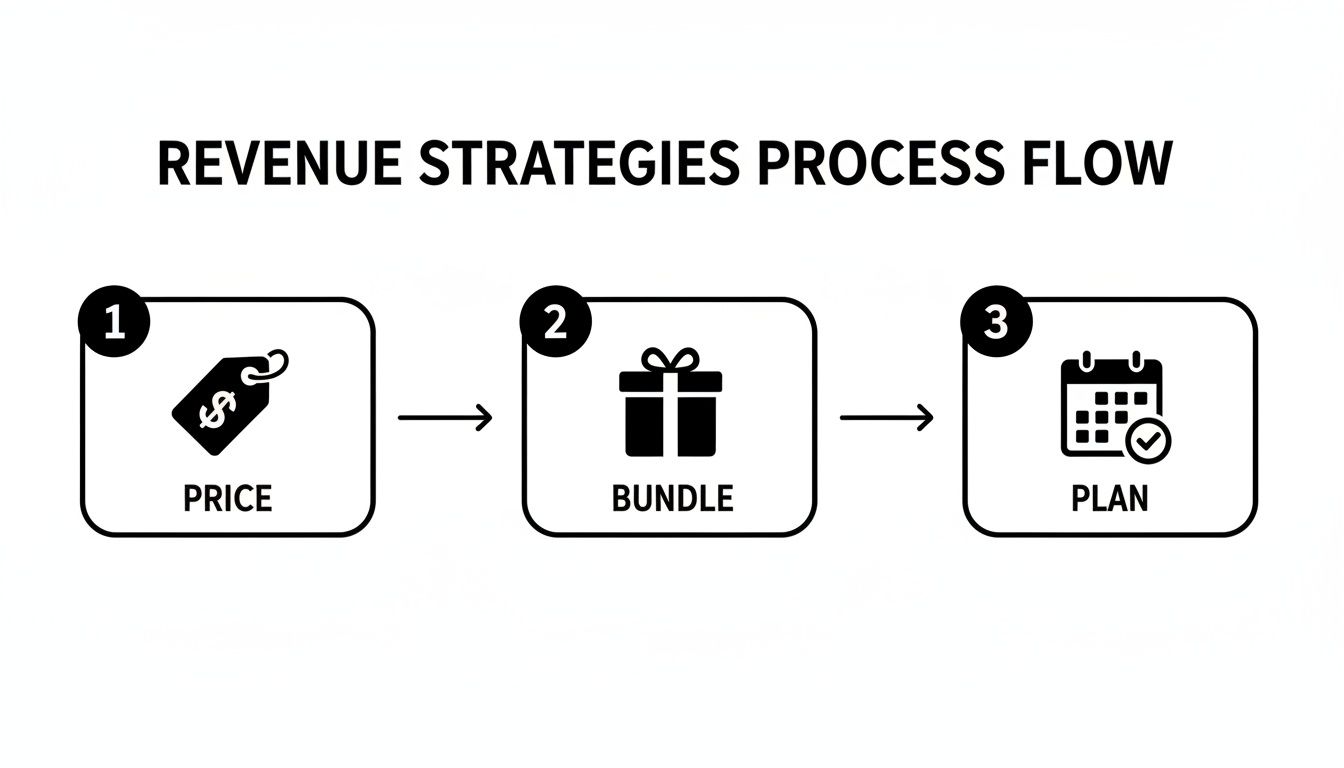
This process flow shows how smart revenue tactics—pricing, bundling, and offering payment plans—are woven directly into a high-conversion strategy. It’s not just about getting a "yes," but making that "yes" as easy and attractive as possible.
The Anatomy of a Winning Sales Funnel
My new approach was straightforward: capture leads with a valuable freebie, build a relationship, and only then ask for the sale. The impact was immediate and staggering. The landing page conversion rate jumped to 11.4%, the automated email sequence converted at 9.2%, and my total course sales for that launch increased by an incredible 3.1x.
Here's the simple but powerful model that made it happen:
- Lead Magnet: A free, high-value resource—like a checklist, template, or mini-course—that solves a small but urgent problem for your ideal student. This is the front door to your funnel.
- Automated Email Sequence: A series of emails triggered the moment someone downloads your lead magnet. This is your space to build trust and warm up your audience.
- Webinar-Style Sales Page: More than just a list of features, this page teaches something useful before transitioning into the course pitch.
This structure works so well because it smoothly guides a potential student from being "problem-aware" to "solution-aware," with your course positioned as the obvious next step.
Building Your Trust-Based Email Sequence
The single biggest improvement came from adding a 5-email nurture sequence. This is the heart of your entire funnel. It’s where you forge a genuine connection, demonstrate your expertise, and proactively address the doubts and objections holding your audience back.
With course campaign open rates averaging 44% and click-through rates around 3.7%, email is a channel you simply can't afford to ignore. You can dig into more creator metrics in this breakdown of course creator statistics.
Here's a proven 5-day email sequence you can adapt for your next launch:
- Email 1: The Welcome & Quick Win: Deliver the lead magnet you promised, but also include one powerful, actionable tip they can use right away. This delivers instant value and proves you’re the real deal.
- Email 2: The "Why" Story: Get personal. Share the story behind why you created the course. What struggle did you face? This builds an authentic connection and shows your audience you truly understand their pain points.
- Email 3: Bust a Common Myth: Tackle a common misconception in your niche head-on. By teaching something counterintuitive, you shatter their old beliefs and solidify your position as an authority.
- Email 4: The Case Study: Showcase a success story from a past student. Nothing is more powerful than proof. Paint a vivid picture of the transformation your course delivers.
- Email 5: The Pivot to the Pitch: Time to connect the dots. Explain that the lead magnet was just the first step and introduce your full course as the complete solution to their ultimate goal.
The most effective sales funnels don't feel like funnels at all. They feel like a helpful, guided journey where buying the course becomes the logical and exciting next step for the student.
This sequence methodically warms up your audience. By the time you introduce your offer, they already know you, trust your expertise, and see your course as the solution they've been looking for. This is how you move from sporadic sales to predictable, scalable revenue.
Getting Your Course in Front of the Right People
Alright, your course is built, and you've mapped out a brilliant sales funnel. Now comes the big question: how do you get people into that funnel?
This is where I see so many creators stumble. They get caught up in the hype and try to be everywhere at once—Facebook, Instagram, LinkedIn, TikTok, paid ads. The result? They spread themselves so thin that nothing actually works.
The most successful course creators I know don't do this. They're disciplined. They pour their energy into the two marketing channels that consistently deliver the best results for course sales: email marketing and content marketing with SEO.
While paid ads and social media posting can drive traffic, they usually have a lower ROI compared to email and SEO for my courses.
Email: The Unbeatable Sales Driver
If you only have the bandwidth to focus on one marketing channel, make it email. Period. It's by far the #1 performer for generating course sales.
Why? Because you’re not just shouting into the social media void. You are having a direct conversation with an audience that has already signaled they know, like, and trust you.
These aren't cold leads; they're people who voluntarily raised their hands and said, "Yes, I'm interested in what you have to say." This warm relationship is exactly why a well-timed email sequence can convert anywhere from 8% to 15% of your subscribers into buyers. No other channel even comes close.
The entire funnel we talked about earlier hinges on this. By offering a valuable freebie to capture an email address, you begin a relationship. Nurturing that relationship with an automated sequence builds the trust you need for a successful launch.
Content Marketing: Your 24/7 Sales Engine
If email is your high-powered launch rocket, think of content marketing as the long-term engine that runs quietly in the background, bringing you new leads and sales around the clock. This is your collection of blog posts, YouTube videos, and free guides that rank on Google.
Many of my best-selling courses get steady sales from people who find my blog posts or free lead magnets through Google search. The strategy isn't about going viral; it's about methodically solving the specific problems your ideal students are searching for.
Here’s how you can turn your content into a machine that sells your courses day and night:
- Solve a real problem. Instead of a generic post like "An Introduction to SEO," write something like "How to Get Your First 100 Visitors from Google." The second title offers a tangible outcome and attracts people who are ready for a solution.
- Make your content a gateway. Your best blog posts should naturally lead to a free download—a checklist, a template, or a mini-course. This simple exchange turns a passive reader into an active email subscriber, pulling them right into your sales funnel.
- Go for long-tail keywords. Forget trying to rank for a massive term like "digital marketing." Target more specific, niche phrases like "email marketing for small business owners." You'll attract a smaller but far more qualified audience.
The true magic of content marketing isn't just about getting traffic; it's about attracting the right traffic. By creating genuinely helpful, SEO-optimized content, you build an audience that already sees you as the go-to expert before you ever ask for the sale.
A blog, in particular, is a fantastic tool for this. It lets you attract readers with an actual attention span—the kind of people who often become your best and most engaged customers. Over time, you can implement proven ways to increase organic traffic and build a reliable stream of potential students.
A Tale of Two Marketing Strategies
Let's make this real. Imagine you're selling a course on "Graphic Design for Beginners."
The Paid Ad Approach: You decide to run Facebook ads targeting people interested in Canva. You spend $500 and get 1,000 clicks to your sales page. With a typical 1% conversion rate for cold traffic, you make 10 sales. Not bad, but you had to pay for every single one.
The Content + Email Approach: You write a detailed blog post titled "10 Canva Design Mistakes That Make You Look Unprofessional." At the end, you offer a free "Canva Design Checklist." Over the next six months, 5,000 people find your post through Google, and 1,000 of them download the checklist. Your automated 5-day email sequence converts 8% of them into buyers. That's 80 sales from one piece of content, with zero ad spend.
This isn't a fantasy scenario. It’s the playbook that works time and time again for selling courses online. By focusing on building your email list and creating problem-solving content, you build a truly sustainable business—one that doesn't depend on constantly feeding the paid advertising machine.
Choosing Your Platform: Why Ownership Is Your Biggest Advantage

Where you decide to host your online course is hands-down one of the most important financial decisions you’ll make. It’s a choice that dictates not just your costs, but your freedom, your brand, and the long-term value of what you’re building.
Many new creators get pulled toward popular SaaS (Software as a Service) platforms because they seem easy. What they don't realize is that they're stepping into a "rental" model. You're building your business on someone else's property, and that comes with some serious strings attached.
The Hidden Costs of Renting Your Platform
When you rent your course platform, you're signing up for recurring monthly fees that can easily run from $39 to over $399. These fees often increase as you get more students or need more features. On top of that, many platforms will take a cut of your hard-earned revenue.
But the real cost isn't just financial. You lose control. The platform owns the infrastructure, which means they can change the rules, limit your branding, and hold your student data hostage. If you ever want to leave, migrating your content and, more importantly, your community can be a nightmare.
The Power of True Ownership
Now, let's talk about a different approach: the "ownership model." This is what you get with a self-hosted solution like Mentor LMS. Instead of paying rent month after month, you make a one-time investment to own the platform itself.
Choosing a platform isn't just a technical decision; it's a business strategy. Owning your platform is the difference between building on rented land and building on your own property.
This completely changes the game. Here’s a direct look at how the two models stack up.
Mentor LMS (Self-Hosted) vs SaaS Platforms (e.g. Teachable, Kajabi)
| Feature | Mentor LMS (Ownership Model) | Typical SaaS Platform (Rental Model) |
|---|---|---|
| Business Model | One-time purchase. You own the software and host it on your own server. | Recurring monthly or annual subscription. You're "renting" access. |
| Platform Fees | Zero monthly fees. | $39 – $399+ per month, often scaling with your growth. |
| Transaction Fees | 0%. You only pay standard processor fees (Stripe/PayPal). | Often 0% – 10%, depending on your plan. |
| Data Ownership | 100% yours. Full control over student data, content, and analytics. | The platform controls the database. Exporting your data can be limited. |
| Branding & Customization | Unlimited. Complete freedom to design a unique brand experience. | Limited to the platform's templates and branding constraints. |
| Long-Term Cost | Lower. A single upfront investment pays for itself over time. | Significantly higher. Costs compound every single month, forever. |
As you can see, the ownership model is a strategic investment in your business's future.
With a platform you own, you gain the power to scale on your own terms. Want to launch a multi-instructor marketplace or integrate a specific tool? You can do it without asking for permission or paying for an expensive upgrade.
By making this smart, long-term choice, you’re not just selling a course; you’re building a valuable, independent business asset. If you're ready to take control, you can learn exactly how to build an online course website you truly own.
Common Questions (And Honest Answers) About Selling Courses
As you start your journey as a course creator, you're bound to run into a few questions. I've been there. Let's tackle some of the most common ones I hear from creators who are just getting started.
How Do I Know if My Course Idea Is Profitable?
The last thing you want to do is pour your heart into building a course that no one actually wants to buy. That's why validation is your best friend, and you need to do it before you record a single lesson.
Start with free tools like Google Trends to get a high-level view. Is the interest in your topic growing, or is it a passing fad? Then, go where your future students are already gathered. Dive into Reddit subs, Facebook groups, and LinkedIn communities. Look for the pain points—what questions are people asking over and over? If you see a pattern of complaints or confusion that your course can solve, you've likely found a profitable idea.
What's a Realistic Conversion Rate for an Online Course?
This really comes down to where your traffic is coming from. If you're running ads or getting clicks from social media, you're dealing with cold traffic. For these folks, who are just getting to know you, a 1-3% conversion rate is a pretty standard benchmark.
The real money, though, is in your email list. These are people who have raised their hand and shown interest. By warming them up with a solid email sequence that builds trust and answers their questions ahead of time, your conversion rates can jump significantly. It's not unheard of to see 8–15% conversion from an engaged email list during a launch.
The biggest breakthrough I had with my own course sales came after I added a simple 5-email nurture sequence. It was designed to build trust and tackle objections before I ever asked for the sale. That one change increased my sales by 3.1x in a single launch.
Should I Offer a Money-Back Guarantee?
Yes, without a doubt. A money-back guarantee is one of the most powerful tools you have for boosting sales because it completely removes the financial risk for a potential student. It’s a signal of confidence in your own material.
A 30-day, no-questions-asked guarantee is the gold standard in the course industry. Sure, a handful of people might ask for their money back, but the increase in sales from hesitant buyers almost always makes up for it. Think of it less as a potential loss and more as a powerful trust-building tool.
How Long Should My Online Course Be?
This is a classic case of quality over quantity. Your focus should be on delivering a specific transformation, not hitting an arbitrary number of video hours. People don't buy courses by the hour; they buy results.
Honestly, a tight, 2-hour course that gives someone a clear win is infinitely more valuable—and easier to sell—than a bloated 10-hour course filled with fluff. Keep every lesson laser-focused and actionable. Make it as short as you can while still delivering on the promise you made on your sales page.
Ready to take full control of your online course business? With Mentor LMS, you can build, market, and sell your courses on your own terms. Say goodbye to monthly fees and platform commissions—own your content, own your brand, and own your revenue. Learn more and get started today.