
What Is CEUs and How Do They Advance Your Career in 2026?
 Mahmudul Hasan Rafi·
If you've ever played a video game, you know all about leveling up with experience points. Continuing Education Units (CEUs) are the real-world equivalent for your professional career—a standardized way to measure and track your commitment to ongoing learning.
What Exactly Are Continuing Education Units?

A Continuing Education Unit, or CEU, is a nationally recognized unit for professional development and training outside of traditional college credit. In the context of a platform like Mentor LMS, CEUs are a standardized way to measure and reward professional development. They make courses more valuable for professionals who need to maintain licenses or meet workplace training requirements.
The system was designed to create a consistent benchmark across different industries. At its core, the math is simple: one CEU equals ten contact hours of structured learning.
So, what does that look like in practice? If a learner completes a course that takes them five hours to finish (including videos, quizzes, and assignments), they earn 0.5 CEUs. This straightforward conversion makes it easy for everyone—from the learner to their employer or licensing board—to understand the time and effort invested.
CEUs at a Glance
To put it all together, here’s a quick summary of what makes a CEU.
| Attribute | Description |
|---|---|
| Standard Unit | 1 CEU = 10 contact hours of structured learning. |
| Provider | Issued by qualified organizations and institutions that meet specific standards. |
| Purpose | To provide a uniform measure for non-credit professional education. |
| Record Keeping | Creates a permanent, transferable record of an individual's professional development. |
This simple framework brings much-needed clarity and consistency to the world of professional training.
Who Needs CEUs and Why?
For many professionals, earning CEUs isn't just a good idea—it's a requirement. People working in licensed or regulated fields absolutely depend on them to keep their credentials active. Without earning a set number of CEUs in each renewal cycle, they risk having their license or certification lapse.
This requirement is common for:
- Nurses and other healthcare professionals
- Teachers and educators
- Engineers
- Accountants
- Architects
- Project Managers (PMPs)
- HR specialists (SHRM-CP/SCP)
Why is it so critical? In these fields, change is constant. New technologies, updated regulations, and evolving best practices mean that knowledge can become outdated quickly. CEUs provide verifiable proof that a professional is staying current, competent, and compliant. They are the currency of career relevance, protecting your qualifications and documenting your growth.
Why Continuing Education Is No Longer Optional
Not so long ago, earning a degree or a professional certification felt like crossing the finish line of your education. Today, it’s really just the starting gun. The pace of change in almost every industry—driven by new tech, shifting regulations, and fierce competition—means that professional skills now have a much shorter shelf life. Continuous learning isn't just a nice-to-have; it's essential for staying in the game.
This isn’t just a feeling; the numbers tell the story loud and clear. The U.S. continuing education market was valued at a massive USD 66.91 billion in 2024 and is on track to hit USD 95.98 billion by 2030. That incredible growth is fueled by millions of professionals actively seeking ways to keep their skills sharp and their careers moving forward. You can dig deeper into how trends like AI are accelerating this in the full market report.
This reality elevates Continuing Education Units (CEUs) from a simple checkbox exercise to a genuinely valuable currency. For professionals, CEUs offer a structured, recognized way to prove they’re keeping up. And for course creators, this creates a huge opportunity to serve a motivated audience that is ready to invest in their growth.
The Real-World Pressures Driving Lifelong Learning
So, what’s really pushing this shift? It’s more than just a desire to learn new things. Professionals in fields from healthcare to project management are facing constant disruption.
Here are the main forces at play:
- Evolving Industry Standards: Best practices don’t stand still. A digital marketer or a teacher using five-year-old methods is already falling behind. Staying effective means adapting to new tools and strategies as they emerge.
- Regulatory Compliance: For many people in licensed professions—like nursing, accounting, or human resources—continuing education isn't optional. It’s a mandatory requirement to legally practice their trade.
- Technological Disruption: New software, AI, and automation are fundamentally changing jobs. Gaining skills in these new technologies is no longer just for getting a promotion; it’s about ensuring your role remains relevant.
Professionals are looking for flexible, online ways to earn credits without attending expensive in-person workshops. This has opened up a booming market for well-designed online courses that offer CEUs.
Proof That CEUs Drive Engagement
Wondering if offering CEUs actually makes a difference? The data speaks for itself.
Take Mentor LMS as an example. Last year, the platform issued a total of 1,850 CEUs across 28 different CEU-eligible courses. Over 620 learners successfully completed these courses and received their certificates with official CEU credits, a powerful indicator of the demand for certified learning.
The most popular courses were, unsurprisingly, in fields where skills need constant refreshing:
- Digital Marketing
- Project Management
- Teaching Skills
On average, each qualifying learner earned between 1.2 to 3.5 CEUs per course. This number has been growing steadily as more professionals look for flexible ways to earn credits. It’s clear that building CEUs into your courses isn’t just an added feature. It’s a core strategy for attracting serious learners and boosting completion rates.
Decoding CEUs, PDUs, CMEs, and Other Credits
The world of professional development is a classic alphabet soup. It's easy to get lost in a sea of acronyms, and while the CEU is a common benchmark, it’s far from the only game in town. Different fields have their own unique credits, each tailored to specific industry rules and governing bodies.
Understanding the differences is crucial. After all, you need to make sure you're chasing the right qualifications for your career. At their core, all these credits are built on the same foundation: verifying effective ongoing professional development. They all prove you're keeping your skills sharp, but that doesn't make them interchangeable.
Think of it like currency. A U.S. dollar, a Euro, and a Japanese Yen are all money, but they have different values and are only accepted in certain places. Professional credits work the same way—a CME credit won't help a lawyer, and a PDU is irrelevant to a nurse.
Comparing Professional Development Credits
So, what’s the real difference? It all comes down to the intended audience and the organization setting the standards. A credit’s value is tied directly to how well it’s recognized within a specific industry.
To clear things up, here’s a quick breakdown of the most common credit types, who they're for, and who’s in charge.
Comparing Professional Development Credits
This table breaks down the differences between CEUs and other common professional credit types.
| Credit Type | Primary Audience | Governing Body Example | Typical Value |
|---|---|---|---|
| CEU (Continuing Education Unit) | Nurses, Teachers, Engineers, HR | IACET | 1 CEU = 10 contact hours |
| PDU (Professional Development Unit) | Project Managers | Project Management Institute (PMI) | 1 PDU = 1 contact hour |
| CME (Continuing Medical Education) | Physicians, Medical Staff | ACCME | Varies by activity |
| CLE (Continuing Legal Education) | Lawyers, Paralegals | State Bar Associations | 1 CLE = 60 minutes |
As you can see, the "exchange rate" for your time varies quite a bit. A standard CEU is worth 10 contact hours, but a PDU for a project manager is earned hour-by-hour. This is simply because the Project Management Institute (PMI) has a different set of rules than IACET, the organization that standardized the CEU in the first place.
Why Specialization Matters
This level of specialization is a good thing. It ensures the training you receive is directly relevant to your day-to-day work and meets the strict standards set by your industry's licensing board.
For instance, a doctor needs CMEs that cover new clinical research, overseen by a body like the ACCME. A lawyer’s CLEs, on the other hand, have to cover changes in legislation or legal ethics, as required by their state bar association.
Choosing the right credit isn’t just about checking a box for compliance. It’s about making sure your investment of time and money pays off with knowledge that’s both useful and officially recognized. When in doubt, always double-check the specific credit requirements with your own governing body.
How to Offer CEUs That Professionals Actually Trust
If you're a course creator, offering Continuing Education Units can be a game-changer, drawing in dedicated professionals who need to maintain their licenses. But here’s the reality: just slapping a "CEU-eligible" sticker on your course won't cut it.
Professionals are rightfully skeptical. They won't risk their careers on credits from a questionable source. For your CEUs to hold any weight, they have to be built on a foundation of quality and credibility. The goal is to create a program so transparent and well-structured that learners feel completely confident its value will be recognized.
Build on a Foundation of Quality Assurance
So, how do you build that trust? It starts by proving your commitment to real educational integrity. This isn't about just checking boxes; it's about designing a learning experience that is verifiable from start to finish.
A framework for credible CEUs always includes these key elements:
- Clear Learning Objectives: Before anyone even clicks "enroll," they should know exactly what they'll be able to do after completing your course. These goals need to be specific, measurable, and tied directly to the skills you're teaching.
- Measurable Assessments: Trustworthy credits require proof of learning. All CEU-bearing courses should include proper assessment methods like quizzes and practical assignments that show a learner has truly grasped the material.
- Meticulous Record-Keeping: You have to keep detailed attendance and completion records for every single learner. That includes tracking their time spent, quiz scores, and assignment submissions. An LMS like Mentor LMS can automate this, giving you audit-proof records without the headache.
Getting these fundamentals right is what elevates your course from a simple video series to a verifiable educational achievement. To dig deeper into this, check out our guide on applying a proper instructional design principle to your content.
Adopt Industry-Recognized Standards
To give your CEUs immediate credibility, it's smart to align your program with guidelines from respected organizations. For instance, following the standards set by IACET (the International Association for Continuing Education & Training) provides a global benchmark for quality.
For higher-stakes professions, partnering with recognized industry bodies to get specific course approvals is a powerful strategy. It tells professionals that your course isn't just a self-proclaimed credit—it's a structured learning experience pre-approved by a group they already trust.
Of course, you'll need the right tools to deliver this high-quality training, which might include finding the best webinar software for small business if you plan to host live sessions. Finally, the certificate itself needs to be professional, stating the learner’s name, course title, completion date, the exact number of CEUs awarded, and your provider information for easy verification. This combination of high standards, strategic approvals, and professional documentation makes the CEUs trustworthy and easy for learners to submit for credit.
How to Automate Your CEU Program with an LMS
Setting up a credible CEU program is one thing, but running it is another. Without the right system, you can quickly find yourself buried in manual tracking, certificate creation, and endless administrative tasks. This is where a good Learning Management System (LMS) comes in—it’s the key to scaling your program without burning out.
Think of an LMS as your automated command center. It can handle the entire CEU process, from the moment a professional enrolls in a course to the second they download their certificate. This frees you up to focus on what you do best: creating great educational content.
An Actionable Workflow for Issuing CEUs
So, how do you make this happen? Here’s a simple, repeatable workflow for issuing CEUs in Mentor LMS that runs mostly on autopilot:
- Course Setup: When creating a course, calculate the CEU value (Total Hours ÷ 10 = CEU Value). Add this information clearly on the course sales page and inside the course description.
- Define Completion Requirements: Set strict completion criteria, such as 100% video progress, a passing score on a final quiz, and submission of any required assignments.
- Enable Automatic Tracking: The LMS automatically tracks learner progress and marks the course as “Completed” only when all criteria are met.
- Auto-Generate Certificates: Upon completion, the system auto-generates a professional certificate that includes the learner’s name, course title, date of completion, exact CEU value, and your provider information.
- Manage Issuance & Record Keeping: Learners can download their certificates instantly. A permanent record is also kept in the LMS for any future verification requests from employers or licensing boards.
This entire process saves you a lot of time while maintaining professionalism and accuracy.
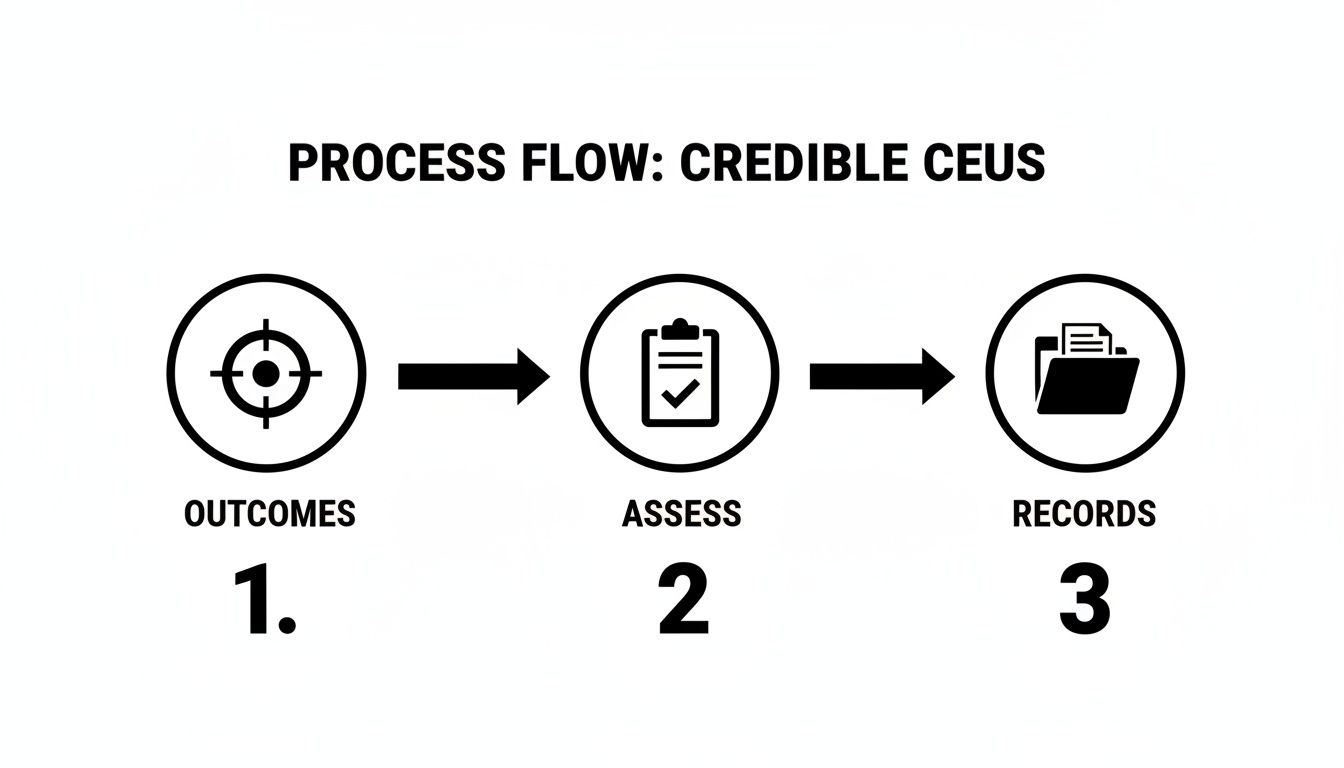
As you can see, a trustworthy CEU program isn't just about handing out credits. It’s about building a structured, defensible system that proves learning actually took place. When you integrate these steps, you create a program that’s not only efficient but also built on a solid foundation of quality and integrity.
The Measurable Impact of Offering CEU Courses

It’s one thing to talk about the theory of Continuing Education Units (CEUs), but the real question is always about the bottom line. Does offering formal credits actually move the needle? Does it get more students to not only sign up but finish your courses?
The numbers tell a compelling story. Yes, it absolutely does.
Integrating CEUs into your training doesn't just add a credential; it reframes your course as a vital career investment. For professionals who need to prove their ongoing development, that distinction makes all the difference.
A Look at the Real-World Results
You don't have to look far to see this in practice. On a platform like Mentor LMS, the data from last year alone speaks volumes. We saw 1,850 CEUs issued across 28 specially accredited courses. That’s a huge indicator of the demand from professionals who are actively hunting for this kind of training.
This isn't just a fluke. It reflects a growing shift where professionals are choosing high-quality, flexible online courses over having to travel for traditional, in-person workshops. Earning official credits from their home or office is a massive advantage for anyone with a packed schedule.
In fact, more than 620 learners successfully completed these programs and walked away with certificates validating their credits. The most in-demand courses were in dynamic fields where staying current is non-negotiable:
- Digital Marketing
- Project Management
- Teaching Skills
On average, each qualifying learner earned between 1.2 to 3.5 CEUs per course. This isn't just a simple box-ticking exercise; it shows that when verifiable credits are part of the deal, professionals are far more motivated to stick with the material and master it.
This kind of engagement is a direct result of the value learners place on recognized credentials. By offering courses that provide structured, validated learning, you tap into a market of highly driven professionals. Better yet, you can track all of this progress yourself—from completion rates to credit issuance—right from a powerful admin dashboard. The data makes it clear: offering CEUs isn't just a nice-to-have, it's a powerful engine for growth.
Your Top CEU Questions Answered
Once you start digging into the world of Continuing Education Units, a few practical questions almost always come up. Let's tackle some of the most common ones we hear from professionals and course creators alike.
Do Online Courses Count for CEUs?
Absolutely. It’s a common misconception that professional credits can only be earned in a physical classroom. These days, online courses are a completely legitimate and popular way to earn CEUs.
What really matters isn’t the format—it’s the quality and authorization behind the course. To be official, an online course must be offered by an accredited provider and meet their standards.
This usually means the course has:
- Clear and measurable learning objectives.
- Assessments like quizzes or projects to verify that learning happened.
- A reliable way to track a student’s progress and confirm they completed the material.
Modern learning platforms are built to handle all of this, making online CEUs a convenient and credible option for busy professionals.
How Do I Know if My Profession Requires CEUs?
The best way to get a definitive answer is to go straight to the source: the organization that issued your license or certification.
This will be your state licensing board or the professional organization that governs your field. A registered nurse, for instance, would check with their state's board of nursing. A project manager holding a PMP® certification would look to the Project Management Institute (PMI) for guidance.
These groups publish their official rules for maintaining your credentials, spelling out exactly how many credits you need and on what schedule.
What Is the Difference Between a CEU and a Contact Hour?
It helps to think of "contact hours" as the individual building blocks and the "CEU" as the final, recognized unit of measurement.
A contact hour is simply one 60-minute hour spent in an approved learning activity. It’s the raw time you put in.
A CEU, or Continuing Education Unit, is the standardized credit value assigned to that time. The universal formula, established by the IACET, is straightforward: 10 contact hours = 1.0 CEU. So, if you complete a 15-hour training program, you've earned 1.5 CEUs.
Ready to offer credible, automated CEUs that attract serious professionals? With Mentor LMS, you can build a complete system for issuing verified credits, from course setup and progress tracking to auto-generated certificates—all with a one-time purchase. Stop paying monthly fees and start building a valuable education business you own forever. Discover how Mentor LMS can automate your CEU program today.