
How Do You Get Sponsors on YouTube? A Playbook for Creators
 Mahmudul Hasan Rafi·
You publish useful tutorials every week. People watch to the end, leave thoughtful comments, and buy the products you recommend. But when you look at your revenue, most of it still depends on AdSense swings and course launches.
That’s where a lot of edupreneurs get stuck. They assume sponsorships are reserved for entertainment channels, giant creators, or people willing to interrupt every video with a generic ad read. In practice, the opposite can be true. A teacher with a focused audience of builders, operators, designers, or aspiring course creators can be more valuable to the right sponsor than a broad channel with bigger vanity metrics.
If you're asking how do you get sponsors on youtube, start with this: stop thinking like a creator chasing attention and start thinking like a niche publisher with a specific buyer audience. Software companies, LMS platforms, payment tools, newsletter products, hosting providers, and creator business tools don't just want reach. They want trust, intent, and a clean match between your viewers and their customers.
For edupreneurs, that’s the opening. Your audience usually comes with context. They aren’t just browsing. They’re trying to learn a skill, launch something, or improve a workflow. That makes your content commercially useful in a way many general channels can’t match.
Beyond AdSense Monetizing Your Expertise
If you teach online, your audience often looks small on paper and powerful in practice. A coding instructor, business educator, language coach, or course creator may not have viral numbers, but they usually have something sponsors care about more: viewers who take action.
That changes the sponsorship equation. Generic creator advice tends to focus on subscriber milestones. Edupreneurs should focus on value per viewer. A smaller audience that trusts your process, watches long tutorials, and buys tools is often easier to monetize than a much larger audience that only drops in for entertainment.
That’s also why it helps to understand how YouTube sponsorship works from the brand side. Sponsors aren’t buying your ego. They’re buying access to a specific group of people with a known problem, a known level of intent, and a creator they already trust.
Educational channels win sponsorships when they position themselves as a distribution channel to a narrow buyer group, not as a personality asking for a brand deal.
For course creators, this is a useful mental shift. Your niche authority is an asset. If you teach people how to package expertise, sell knowledge, or build digital products, brands can map your audience directly to their offers. That’s especially true if your viewers are already exploring tools related to platforms to sell digital products, payments, hosting, automation, or online education.
The big mistake is waiting until your channel feels “big enough.” Sponsorships usually start when your channel becomes clear enough. Clear audience. Clear outcomes. Clear fit for a sponsor.
Prepare Your Channel for Sponsorship Success
Before you send a single pitch, your channel has to answer one question fast: why should a brand trust this creator with its message?
A sponsor lands on your channel and scans for signs of professionalism. They check whether your content has a defined niche, whether your thumbnails and titles feel consistent, and whether your videos suggest a real audience relationship instead of random uploads chasing views.
Clean up your public storefront
Most creators think sponsorship prep starts with outreach. It doesn’t. It starts with your channel page.
Audit these pieces first:
- Channel banner and profile image. Make them look like a business, not a leftover from your early uploads.
- About tab. State who your content helps, what topics you cover, and what kinds of business inquiries you accept.
- Playlist structure. Group videos by problem type. A sponsor should be able to see themes like course creation, email marketing, online teaching, student retention, or software tutorials.
- Pinned videos and featured sections. Put your strongest proof first. Pick videos that show authority, not just views.
- Link hygiene. Make sure your website, newsletter, and key business profiles are current.
A good channel page reduces friction. Brands shouldn't need to guess what you do.
Get your analytics sponsor ready
The most important operational milestone is joining the YouTube Partner Program. Joining the YouTube Partner Program requires 1,000 subscribers and 4,000 watch hours as of 2023 updates, and it provides Studio analytics such as retention graphs that matter in sponsorship conversations, according to Adopter Media’s YouTube sponsorship requirements guide.
For edupreneurs, YouTube Studio is where your business case lives. Brands care about fit, not just topline numbers. They’ll look at:
- Audience location. Many sponsors prioritize regions where they actively sell, especially North America.
- Age and gender alignment. This matters when the brand has a defined customer profile.
- Retention patterns. Long watch sessions on tutorials signal intent and trust.
- Content consistency. Sponsors want creators who publish on a stable rhythm.
Practical rule: Never pitch from memory. Pull the current screenshots and numbers from YouTube Studio before you contact any brand.
If you teach course creation, software skills, or business systems, your analytics often reveal a buyer audience that’s attractive to sponsors. That’s where niche creators have an edge. A broad channel can promise reach. A focused channel can promise relevance.
Package your expertise, not just your videos
Think beyond “I post on YouTube.” Sponsors often care about your entire teaching ecosystem. If your videos lead into a newsletter, webinar, workshop, resource library, or tool stack, that matters. It shows your audience doesn’t just watch. They move.
Your channel should also make your business model obvious. If you teach people how to build digital education businesses, that naturally aligns with categories like website tools, creator software, payments, CRM platforms, or a white label LMS platform.
That doesn’t mean you mention those brands everywhere. It means your content architecture should make the fit visible.
What sponsors notice right away
Here’s the difference between a hobby channel and a sponsor-ready one:
| Signal | What a brand sees |
|---|---|
| Consistent niche | Predictable audience type |
| Strong playlists | Repeatable sponsorship context |
| Clear audience demographics | Easier targeting |
| Good retention | Stronger chance of message delivery |
| Professional business links | Lower operational friction |
Sponsors don't need perfection. They need clarity, reliability, and signs that you can represent a product well without confusing your audience.
Build a Professional Media Kit and Rate Card
A media kit is your sales document. A rate card is your pricing document. Many creators mash them together and make both weaker.
Your media kit should help a brand quickly understand your audience, your authority, and the kind of partnership you offer. Your rate card should tell them how you price that access. Keep them connected, but separate enough that you can tailor one without rewriting the other.
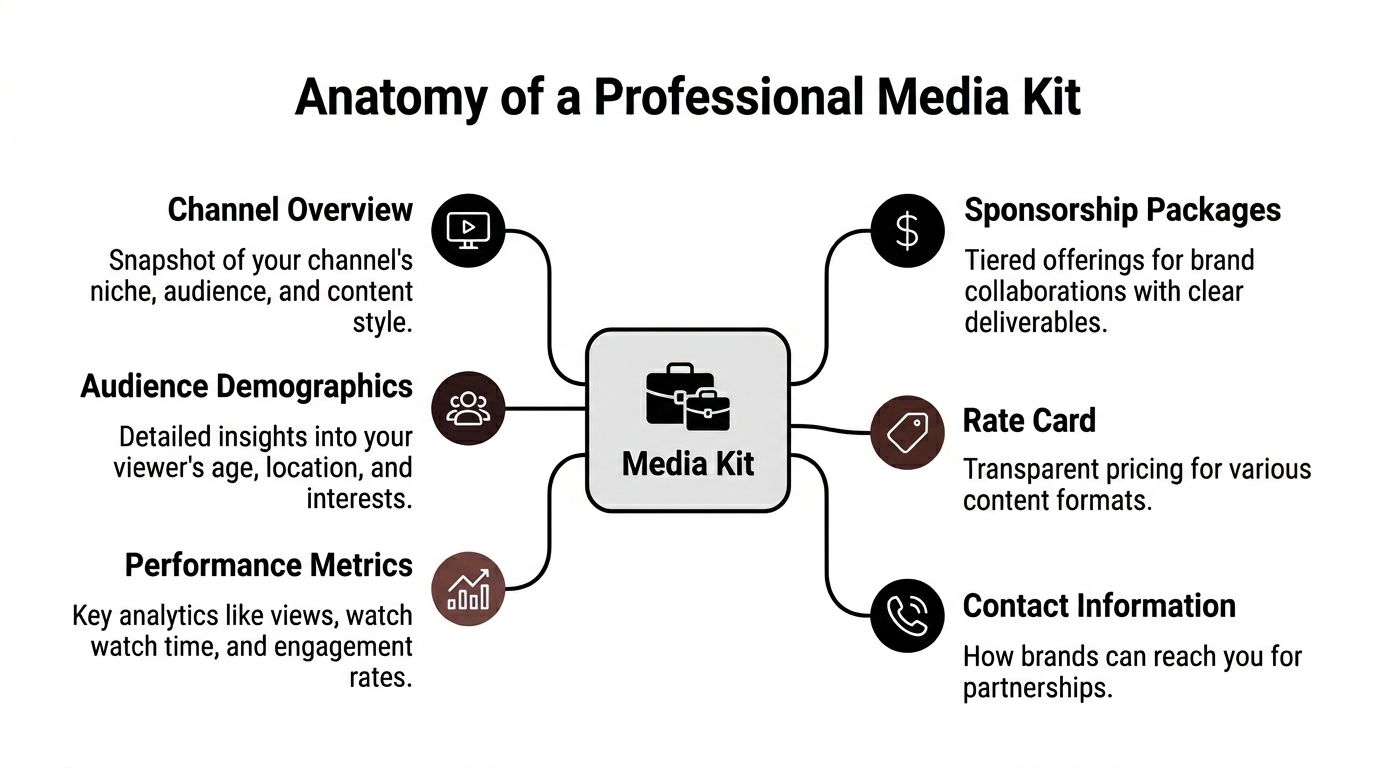
What goes in a strong media kit
A useful media kit is short, visual, and specific. It should make a sponsor think, “This creator understands both their audience and my problem.”
Include these six pieces
Who you are
A brief bio focused on your teaching niche and audience.What your channel covers
Core themes such as online courses, instructional design, creator business, software workflows, or student acquisition.Audience profile
The demographics and geography that matter to buyers.Performance proof
Average views, strong videos, retention screenshots, and evidence of engaged comments.Brand fit categories
The kinds of tools or services your audience already uses or needs.Contact details
A business email and simple next step for inquiries.
For edupreneurs, one of the strongest additions is audience intent language. Don’t just say your viewers are “interested in education.” Say they are course creators, coaches, trainers, consultants, or knowledge business operators who actively evaluate tools.
Build a rate card that supports negotiation
Pricing scares creators because they think there’s one correct number. There isn’t. There’s only a defensible range tied to audience quality, placement, deliverables, and commercial fit.
One of the clearest benchmarks available is this: channels with 10,000 highly engaged subscribers can command sponsorship rates of around $800 per video, while channels with 50,000 passive viewers might only earn $300, according to InfluenceFlow’s guide to YouTube sponsorship rates. That’s the clearest reminder that engagement beats size.
Your rate card should include:
- Video formats. Dedicated video, integrated mention, Shorts placement, or bundle.
- Placement type. Beginning, middle, or end of video.
- Package discounts. The same source notes examples like 10% off for 3+ videos.
- Audience notes. Geography, engagement quality, and niche relevance.
- Optional add-ons. Usage rights, newsletter mention, or community post if you offer them.
For educational creators, pricing usually improves when the integration is anchored to actual workflow relevance. A sponsor mention inside a tutorial about course setup, student onboarding, or creator operations is easier to justify than a random interruption.
A practical media kit outline
Use this as a working template:
Media Kit Template
Headline
“YouTube educator helping course creators build and sell knowledge products”Audience summary
Who they are, what they’re trying to achieve, and why they trust your recommendationsChannel proof
Core stats, retention snapshots, strongest content categoriesSponsorship formats
Mid-roll integration, tool walkthrough, sponsored tutorial segment, dedicated reviewBest-fit partners
LMS tools, payment processors, creator software, automation products, analytics toolsContact
Business email and expected reply window
Make one master version, then customize the top half for each brand. That simple edit usually performs better than sending the same PDF to everyone.
How to Find and Qualify the Right Brand Partners
Most creators waste time pitching brands that were never a fit. They chase logos they recognize instead of companies that actually need their audience.
For edupreneurs, the strongest sponsors usually sit close to the workflow you teach. Think software, LMS products, email tools, community platforms, payment systems, hosting, productivity suites, recording tools, and services that help people launch or run online education businesses.
Start with audience overlap, not brand fame
One useful benchmark from Sponsorship.so’s explanation of YouTube sponsorships is that creators can use tools like Sponsorship.so or Aspire IQ to find brands with at least an 80% audience overlap. The same source notes that channels at 50k subscribers often see a 1-in-10 pitch-to-deal ratio when outreach is targeted.
That matters because it shifts prospecting from guesswork to fit.
If you teach creators how to sell courses, a project management app may be too broad. An LMS, checkout tool, webinar platform, or payment gateway is often a better match because your viewers can use it immediately. The source even gives a useful personalization pattern: “Your Razorpay gateway aligns with my audience in 130+ countries.”
Three places to find realistic sponsors
Not every sourcing method performs the same way.
Marketplaces and matching tools
Use YouTube BrandConnect when eligible, and explore creator marketplaces or platforms like JoinBrands when you want deal flow and examples of how brands structure collaborations. These help, but they also put you in a competitive pool.
Competitor sponsor research
Study channels near your niche, not just above your niche. Look at who sponsors creators teaching adjacent topics such as design systems, no-code, business education, online teaching, or creator tools. If a brand sponsors one practical education channel, it may sponsor another with a slightly different audience segment.
Direct outreach
This is still the best route for edupreneurs. Direct outreach works well because your audience is usually easy to describe and easy for a software company to understand. Mid-market brands, especially, often respond better when the creator clearly explains buyer fit and content context.
The fastest way to improve your sponsor list is to remove any brand you wouldn’t recommend without payment.
Qualify partners before you pitch
A brand isn’t a good target just because it has a marketing budget. Use a simple filter:
- Product fit. Would your audience use this?
- Mission fit. Does the brand help your viewers make progress?
- Content fit. Can you integrate it naturally into a lesson, walkthrough, or case example?
- Reputation fit. Would promoting it strengthen or weaken trust?
- Budget fit. Does the company already work with creators or show signs of active sponsorship?
A bad sponsor can cost more than a missed deal. Educational channels run on credibility. If you recommend bloated tools, irrelevant subscriptions, or products you don’t use, viewers notice.
Here’s a good reference point on prospecting strategy in action:
Build a sponsor list by category
Instead of one giant spreadsheet, segment your list:
| Category | Example fit for edupreneurs |
|---|---|
| Course infrastructure | LMS, video hosting, certificate tools |
| Revenue stack | Payments, checkout, invoicing |
| Audience growth | Email, community, CRM |
| Operations | Scheduling, automation, project management |
| Teaching tools | Screen recording, webinars, assessments |
This changes your outreach quality. You stop asking, “Who might sponsor me?” and start asking, “Which company serves the exact people already watching my tutorials?”
Mastering the Sponsorship Pitch and Negotiation
A weak pitch asks for sponsorship. A strong pitch offers distribution, context, and audience fit.
That’s the core mindset shift. Brands don’t owe creators a response. They respond when the creator makes the partnership easy to evaluate and easy to imagine inside real content.
Why personalization matters more than polish
Anika Agrawal’s sponsorship methodology makes this point clearly. Generic pitches have a 70% rejection rate, while a proposal with a media kit detailing stats, demographics, and past collaborations can boost response rates by 40%. She also notes that many creators leave 30-50% of revenue on the table by not negotiating, based on the material in her YouTube methodology.
That matches what works in practice. Brands ignore vague praise and generic intros. They pay attention when you connect their product to a specific audience segment and a specific content context.
A pitch structure that gets replies
Keep your email short. The goal is not to explain your whole business. The goal is to make the next conversation obvious.
Use this structure:
Subject line
Partnership idea for [Brand] with my [audience type] YouTube channelOpening
Mention one specific reason the brand fits your audience.Audience snapshot
Describe who watches you and what they’re trying to achieve.Content angle
Suggest one or two natural integration ideas.Proof
Mention your media kit, relevant metrics, and any prior sponsor or product success.Call to action
Ask whether they’re open to discussing a test campaign or package.
Here’s a practical example:
Hi [Name],
I run a YouTube channel for course creators and edupreneurs building online education businesses. A large share of my audience is actively evaluating tools for course delivery, payments, and student management, which is why I thought [Brand] could be a strong fit.I’d love to propose a sponsorship around an upcoming tutorial focused on [relevant topic]. I can integrate [Brand] in a way that’s instructional and useful, not bolted on.
I’ve attached a media kit with audience demographics, channel performance, and collaboration formats. If it’s helpful, I can also send a simple package option for a test campaign.
Would you be open to a quick conversation?
Short. Specific. Commercial.
Don’t negotiate from fear
When a brand replies, many creators rush to accept the first offer because they’re relieved someone said yes. That’s where a lot of money disappears.
Negotiate around business terms, not just headline price:
- Placement. Mid-video integrations often carry more value than a quick end mention.
- Deliverables. Clarify exactly what the sponsor is buying.
- Usage rights. If the brand wants to reuse your content, price that separately.
- Exclusivity. If you can’t work with competitors, that has value.
- Reporting. Decide what you’ll share after the campaign.
- Payment timing. Confirm invoicing and payment windows in writing.
If a brand asks for more deliverables without increasing budget, they’re not “clarifying scope.” They’re lowering your effective rate.
Comparing sponsorship pricing models
| Pricing Model | How It Works | Best For | Pros | Cons |
|---|---|---|---|---|
| Flat Rate | One fee for a defined deliverable | Most edupreneur sponsorships | Simple, predictable, easy to invoice | Can underprice strong performance |
| CPV | Payment tied to video views | Channels with stable view patterns | Aligns price to exposure | Less control over final payout |
| Affiliate | Earn on tracked sales or signups | Products you strongly trust | Strong upside when audience intent is high | Revenue can be inconsistent |
| Hybrid | Lower base fee plus affiliate component | Software and tools with measurable conversion | Balances guaranteed income and upside | Needs careful tracking and terms |
For edupreneurs, hybrid deals often make sense when the product has clear buyer intent and the brand can track conversions. Flat-rate deals are still the easiest starting point because they remove ambiguity.
Counter with data, not emotion
When a brand offers less than you want, don’t react defensively. Anchor your reply in fit and business logic.
Try language like this:
Thanks for sharing the budget. Based on my audience fit, the planned integration, and the expected relevance of the topic, I’d be more comfortable at [your range]. If that’s outside scope, I can adjust the package and simplify deliverables.
That gives the brand options. It also signals that you understand pricing as a system, not a favor.
The strongest negotiation position comes from being willing to walk away from weak-fit sponsors. That protects your rates, but above all, it protects your audience.
Executing Sponsored Content and Proving ROI
Winning the deal is only the start. The true advantage comes after the video goes live.
Edupreneurs have an advantage here because educational content naturally supports product explanation. If the sponsor’s tool helps your audience achieve a clear outcome, your integration can feel like part of the lesson instead of a break from it.
Make the sponsorship useful inside the lesson
The best sponsored segments answer a real workflow question. If you’re teaching course creators how to launch a program, a sponsor mention about payments, curriculum delivery, or student management can fit naturally. If you teach software tutorials, a relevant tool can appear as part of the setup.
That’s much stronger than forcing a generic script into the middle of a lesson.
A few formats work especially well for educational channels:
- Integrated tutorial mention. The tool appears where it’s useful in the process.
- Mini workflow demo. Show one concrete action, not every feature.
- Resource stack placement. Position the sponsor as one tool in a broader system.
- Dedicated walkthrough. Best when the product itself is educationally relevant.
Handle disclosures cleanly
YouTube requires sponsorship disclosures through built-in tools and on-screen labeling. That’s not just compliance. It also helps preserve trust.
Viewers usually don’t mind sponsorships when the fit is obvious and the teaching stays strong. They object when the promotion feels hidden, irrelevant, or exaggerated.
A sponsored segment should sound like a recommendation from a practitioner, not a script from a brand manager.
Report the results brands actually care about
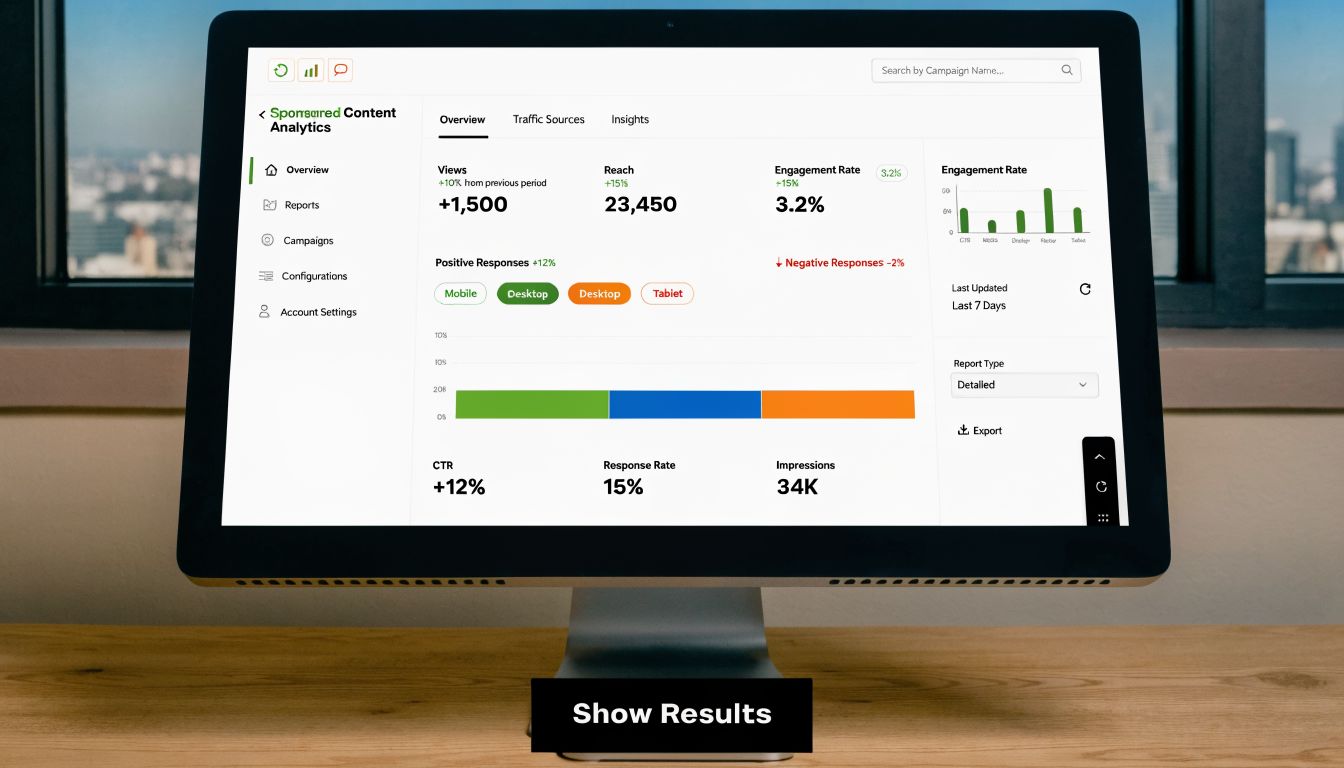
For educational creators, proving ROI goes beyond raw views. According to Podia’s article on YouTube sponsorships and brand deals, edupreneurs can use signals like 70-90% tutorial completion rates or positive comments about a tool to show deep engagement. The same source says this can support a higher value-per-view, often $0.05-$0.10 for educational content versus $0.01 for entertainment.
That’s useful because it matches how buyers behave on educational channels. They don’t just watch. They compare, evaluate, and act.
Your post-campaign report should include:
- Video performance. Views, watch behavior, and where the sponsor appeared.
- Click data. From tracked links or campaign URLs.
- Conversion signals. Promo code use or attributed actions when available.
- Audience response. Comments, sentiment, and questions about the product.
- Recommendation. Your view on whether a second campaign makes sense.
If you want a broader view of how brands evaluate outcomes, this ultimate guide to influencer marketing on YouTube for driving ROI is worth reviewing alongside your own reporting process.
Turn one campaign into a repeat relationship
The easiest sponsor to close is often the one that already worked with you.
That’s why your report should end with a recommendation, not just a recap. If the campaign fit well, suggest a follow-up angle such as a deeper tutorial, a comparison video, or a themed content package. Educational channels are well suited for this because your content often lives in series.
If your business also connects to selling courses, workshops, or training products, your sponsored content strategy should complement the broader journey your audience is already on. That same thinking applies when building your own monetization stack around how to sell online courses.
Common YouTube Sponsorship Questions Answered
Should you accept free products instead of cash
Usually, no. Product-only deals make sense only when the product is genuinely valuable to your business and you were going to pay for it anyway. For most edupreneurs, free access doesn’t replace the time, trust, and distribution value you’re providing.
What’s a realistic first sponsor for a smaller educational channel
Start with practical software or service companies that serve your exact viewer. Smaller channels often do better with focused tools than big household brands. A niche LMS company, creator tool, assessment platform, or payment product is often more realistic than a giant consumer brand.
What if a brand rejects your pitch
Don’t treat it like a verdict on your channel. Sometimes the timing is wrong, the budget is closed, or the campaign theme doesn’t match your content calendar. Keep the relationship warm, update your media kit, and follow up later with a better-fit angle.
Should you pitch agencies or brands directly
For edupreneurs, direct brand outreach is often better because you can explain audience fit in plain terms. Agencies can still be useful, but direct contact usually gives you more control over context and relationship building.
How many sponsors should you take
As few as needed to keep quality high. Educational channels lose influence when every video starts to feel rented out. A small number of strong-fit sponsors usually performs better than a long list of weak ones.
What matters most when learning how do you get sponsors on youtube
Clarity beats hype. A clear audience, a clean channel, a sharp media kit, and relevant sponsor fit will outperform generic creator hustle almost every time.
If you’re building a course business and want full control over how you sell, deliver, and scale your education products, Mentor LMS is built for that. It gives solo creators, marketplace operators, and training businesses a self-hosted LMS with one-time purchase ownership, no platform lock-in, and the flexibility to run courses, exams, certificates, multi-instructor programs, and custom learning experiences on your own terms.