
The Best Platforms to Sell Digital Products 2026
 Mahmudul Hasan Rafi·
You’ve probably already made the hard part. The product exists. Maybe it’s a course, a template pack, a paid newsletter, an exam product, or a bundle of digital downloads. Sales start coming in, and then the platform decision that felt small at the start begins to shape everything.
At first, convenience wins. A simple checkout page, built-in delivery, no setup friction. Then the trade-offs show up. Fees take a bigger bite than expected. The storefront starts to feel generic. You want better upsells, cleaner branding, more control over customers, or support for how your business works instead of how the platform wants it to work.
That’s where most lists of the best platforms to sell digital products stop being useful. They compare monthly plans and feature badges, but they rarely deal with the core question. What will this platform cost you to run, adapt, and outgrow?
Beyond the First Sale The Search for the Right Platform
A familiar scenario plays out after the first few successful launches. Revenue is coming in, customers are asking for bundles, upsells, and cleaner delivery, and the platform that felt fast at the start starts showing its limits.
Launch speed still matters. It is a smart priority during validation. But a selling platform is not just a checkout tool. It becomes part of your operating costs, your customer data strategy, your branding, and your ability to change how the business works a year from now.
That is why surface-level comparisons often miss the point. Monthly price and transaction fees matter, but total cost of ownership matters more. Time spent working around missing features counts. So does the cost of giving up customer experience control, accepting platform branding, or rebuilding everything later because the system cannot support your next stage. If discovery matters to your business, distribution tactics like AI optimization for making products more visible also connect back to platform choice, because some platforms give you far more control over pages, metadata, and how your offers are presented.
The platform decision is a scale decision
For a small catalog and early demand testing, lightweight SaaS tools can be a good trade. They remove setup work, handle delivery, and let creators start selling without touching hosting, updates, or integrations.
The trade-off shows up later.
A platform can be cheap at low volume and expensive at maturity. Fees keep stacking. Customization hits a wall. Customer data may be available, but not in the way you need. Even basic requests, such as a better post-purchase flow, a branded student area, or flexible bundling logic, can push you into higher plans, extra apps, or awkward workarounds.
I have seen this pattern more than once. Early on, convenience covers a lot of sins. Once a business has repeat buyers and a defined offer suite, convenience starts competing with margin and control.
Ownership is the other path. It asks for more responsibility up front, but it also changes the economics. You are not only choosing software. You are choosing who controls the storefront, the learning experience, the data, the design limits, and the pace of change.
Practical rule: Keep the simple SaaS setup while it helps you validate demand. Start planning your exit when platform fees, feature limits, or branding constraints begin to shape business decisions more than customer needs.
The Digital Product Platform Market in 2026
A creator can start on a hosted tool in an afternoon and still regret that decision a year later.
By 2026, the platform market is crowded in a predictable way. The options look different on the surface, but they usually fall into three groups with very different consequences for cost, control, and how hard it will be to switch later.

| Platform type | Typical examples | What you get | Main trade-off |
|---|---|---|---|
| Marketplace platforms | Amazon, Etsy, Creative Market | Built-in demand and simpler discovery | Limited brand control and dependence on marketplace rules |
| All-in-one SaaS platforms | Gumroad, Payhip, Podia, Teachable, Kajabi | Fast setup, hosted delivery, less technical work | Recurring fees, feature ceilings, and limited platform sovereignty |
| Self-hosted ownership models | Self-hosted LMS or ecommerce stack | Control over product, branding, checkout, and customer experience | You handle setup, maintenance, and more operational decisions |
Marketplaces are rented distribution
Marketplace platforms work best when discovery is the main problem. They put your product in front of existing demand, which is useful for ebooks, templates, design assets, music, and other straightforward downloads.
That reach comes with a familiar cost. You are selling inside someone else’s search results, review system, merchandising rules, and account policies. Payoneer’s marketplace analysis highlights Amazon’s scale, which explains why sellers keep showing up there even when margins and customer ownership are weaker than on a direct storefront.
For early testing, that can be a fair trade. For a business that plans to build repeat purchases, upsells, memberships, or a learning ecosystem, it usually is not the end state.
SaaS platforms are easy to buy and harder to outgrow cleanly
This is still the default path for independent creators, course sellers, coaches, and small education brands. Gumroad, Payhip, Podia, Teachable, Kajabi, Shopify, Stan Store, Beacons, and Lemon Squeezy all reduce setup work. You can upload a product, connect Stripe, and start selling fast.
The hidden issue is not the monthly fee by itself. It is total cost of ownership over time. A platform can look cheap at launch and become expensive once revenue grows, your catalog expands, or you need better checkout logic, branded student areas, affiliate controls, subscriptions, bundles, VAT handling, or deeper automations. The bill then shifts from one subscription to a stack of plan upgrades, apps, transaction fees, design compromises, and manual work.
That is why I judge SaaS tools less by onboarding speed and more by their graduation path. Can you export customers cleanly? Can you preserve URLs, content structure, and purchase access? Can you shape the experience around the business, or do you keep adapting the business to the platform?
If you want a clearer way to evaluate that cost over time, this breakdown of learning management system pricing and ownership cost is a useful reference.
A useful companion to platform choice is distribution strategy. If you’re trying to improve discovery in AI-driven environments, this guide to AI optimization for making products more visible is worth reading alongside your platform research.
Self-hosted systems make sense later than creators expect, and earlier than many platforms suggest
Self-hosted setups appeal to sellers who already know their offer structure, sales flow, and customer lifecycle. At that stage, the platform is no longer a checkout wrapper. It affects margins, data access, brand experience, product packaging, and how quickly the business can ship changes.
That does not mean self-hosted is automatically the right move. It asks for more responsibility. Hosting, updates, integrations, performance, and admin workflows need attention. But for established course businesses, memberships, academies, and digital product brands with repeat buyers, ownership often improves economics because the business stops paying ongoing premiums for permission to customize basic parts of the customer journey.
The practical divide in 2026 is simple. Marketplaces rent access. SaaS rents convenience. Self-hosted systems buy back control.
Key Criteria for Choosing Your Platform
A platform should fit the business you’re building, not just the product you’re launching. When creators compare tools only by monthly price, they miss the bigger costs hiding in payment fees, migration pain, missing features, and limits that appear later.
Total cost of ownership matters more than entry price
A free plan isn’t free if the fee structure punishes success. A paid plan isn’t expensive if it removes friction that would otherwise cost time, margin, or opportunity.
Look at platform cost in layers:
- Subscription cost if the platform charges monthly
- Transaction fees if the platform takes a cut of each sale
- Processor fees that sit underneath the platform
- Feature access costs when core capabilities are tied to higher tiers
- Migration cost if moving later means rebuilding pages, products, automations, and customer access
If you’re trying to reason through software economics in a more structured way, this breakdown of learning management system pricing is useful because it pushes beyond sticker price and into actual ownership cost.
Data ownership and portability decide how trapped you can become
This gets ignored until a creator wants to leave.
Ask plain questions. Can you export your customers cleanly? Can you move your content without rebuilding everything manually? Can you preserve your branding, domain structure, and student access when you switch? If the answer is partial or unclear, you don’t own as much of your business as you think.
Some platforms give you enough export access for basic portability. Others let you leave, but only after a painful rebuild. That’s still a lock-in mechanism, even if it isn’t advertised that way.
Scalability isn't about more traffic alone
A platform can handle more sales and still be the wrong fit.
Real scalability includes operational fit. Can you add instructors? Can you split revenue? Can you run memberships and standalone exams separately? Can you localize the interface, customize the student journey, or support multiple business models without duct-taping extra tools together?
Here’s where many creator SaaS products hit a ceiling. They scale in volume, but not in flexibility.
Growth problems often look like feature requests at first. Later, you realize they’re platform constraints.
Technical responsibility should match your team
Some founders should absolutely stay on SaaS longer. If you don’t have the time, budget, or support to manage a more flexible stack, convenience is a rational choice.
A self-hosted platform gives you more control, but you take on more responsibility too. That can include hosting decisions, updates, backups, integrations, and quality control. For a solo creator with one simple product, that may be unnecessary. For an agency, school, or mature edupreneur brand, it may be the right trade.
A mismatch here causes problems in both directions. Some people move to self-hosted too early and get bogged down in setup. Others stay on SaaS too long and keep paying for a model they’ve already outgrown.
Global readiness is no longer optional
Many platform roundups barely address international selling. That’s a serious omission.
According to Wise’s guide on selling digital products internationally, creators now have to think about international tax compliance in 130+ countries, and many popular platforms struggle in emerging markets. The same source also notes that recent OECD rules introduced a 15% global minimum tax, adding complexity that many non-US sellers can’t ignore.
When you evaluate global readiness, check for these basics:
- Payment flexibility for your region and your customers’ regions
- Multi-currency support if you sell internationally
- Tax handling for digital goods
- Payout logic if multiple instructors or partners are involved
- Localization options if your audience isn’t English-only
A lot of platforms look polished until international operations matter. Then the gaps show up fast.
SaaS vs Self-Hosted A Detailed Comparison
A platform can feel cheap at the start and expensive a year later.
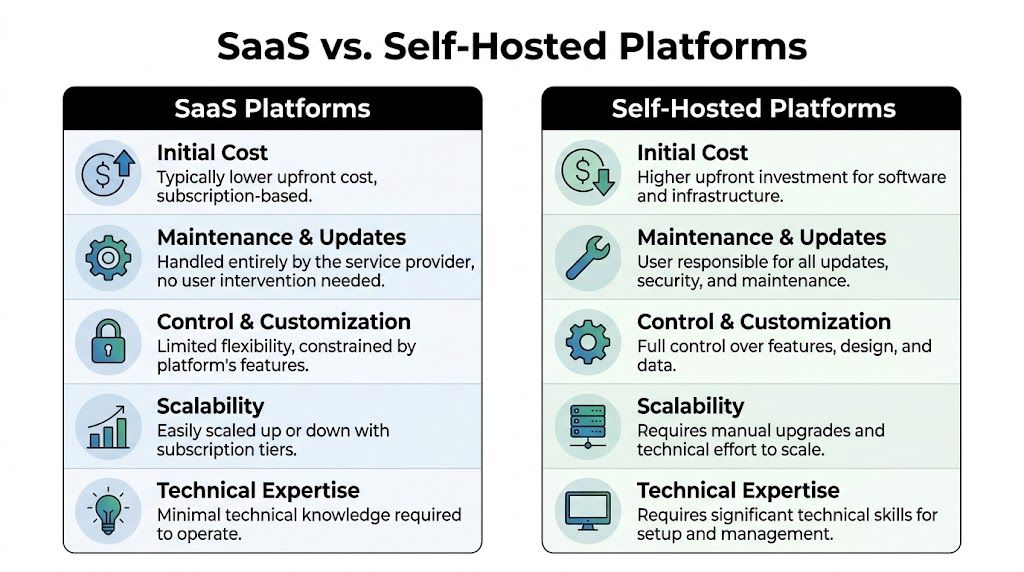
That usually happens because creators compare sticker price instead of total cost of ownership. The monthly plan matters, but so do transaction fees, add-on tools, design limits, migration pain, staff time, and the cost of building your business around rules you do not control.
Cost over time
SaaS platforms usually win the first-month decision. You can set up a product fast, avoid technical work, and start collecting payments without configuring your own stack.
The trade-off shows up once sales become predictable. Colorlib’s comparison of the best platforms to sell digital products highlights how differently these tools charge. Ko-fi keeps transaction fees at zero, Gumroad takes a flat cut, and Payhip shifts economics depending on the plan. That pricing can be reasonable during validation. It gets harder to justify when the platform keeps taking a meaningful share of revenue long after the setup work is paid for.
Self-hosted changes the cost profile. You pay for hosting, the software itself, and the time to set things up well. In return, you stop renting core business logic from a third party. For a creator with low volume, SaaS often stays cheaper in practice. For a business with steady sales, bundles, affiliates, instructors, or a growing course catalog, the long-run math often flips.
A good rule is simple. If your fee stack rises every month while your platform flexibility stays flat, you are probably paying for convenience you no longer need.
Ownership and control
This is the dividing line.
SaaS gives you a prebuilt operating model. That helps at the beginning because decisions are constrained for you. Checkout, product structure, student experience, and integrations are already defined. You can get to market quickly, but you are still building on rented ground.
Self-hosted gives you control over the environment, customer data, design logic, and feature priorities. That matters once your business stops looking like the default use case the SaaS company had in mind. A standard storefront is fine for a single ebook. It becomes restrictive when you need member-specific pricing, custom onboarding, cohort access rules, instructor dashboards, or region-specific payment flows.
Control also affects exit costs. Leaving a SaaS platform after years of growth is rarely smooth. Data exports can be incomplete, customer experience often has to be rebuilt, and automations that looked convenient can turn into migration debt.
Feature ceilings
Platform limits usually arrive gradually.
At first, a missing feature looks minor. You add a workaround, plug in another tool, or accept a slightly awkward workflow. Six months later, those compromises start eating margin and slowing the team down. I have seen this happen with checkout customization, bundle logic, multi-instructor payouts, localization, and content models that work for one product type but not for a broader catalog.
Common ceiling points include:
- Revenue-sharing constraints for instructor-led businesses
- Checkout restrictions that reduce upsell and cross-sell options
- Limited localization for multilingual customers
- Narrow integration options when your workflow falls outside the platform default
- Rigid product structures that make it harder to sell courses, downloads, memberships, and services together
Self-hosted platforms are not automatically better at all of this. They are better when your business needs adaptation. That is a different advantage.
If you are selling education products, this matters even more once delivery, progress tracking, access rules, and post-purchase experience become part of the product itself. A practical reference is this guide on how to sell online courses, because course businesses hit platform ceilings faster than simple download stores.
Maintenance and technical overhead
SaaS removes a lot of operational work. Hosting, security patches, uptime monitoring, and baseline support are bundled into the subscription. That is a real benefit, not a marketing line.
Self-hosted asks for more discipline. Someone needs to handle hosting choices, updates, backups, plugin quality, and testing before changes go live. For a solo creator with one small product, that can be unnecessary overhead.
But SaaS can create its own version of complexity. Many businesses end up stitching together checkout software, email tools, course delivery, community tools, automation platforms, analytics, and affiliate management just to get around product limits. On paper that still looks simple because each tool is subscription-based. In practice, it is an operational stack with more vendors, more failure points, and less control.
Which model fits which stage
| Business stage | SaaS fit | Self-hosted fit |
|---|---|---|
| First product launch | Strong | Usually too early |
| Early validation with limited audience | Strong | Sometimes reasonable if technical support already exists |
| Growing course or membership business | Mixed | Strong if branding, margins, or customization matter |
| Multi-instructor marketplace | Often restrictive | Usually a better fit |
| Agency, academy, or institution | Frequently limited | Usually stronger |
| Long-term margin and control | Weakens as complexity grows | Usually improves over time |
The useful question is not which model is better in the abstract. It is when the hidden costs of SaaS become higher than the added responsibility of self-hosting.
That is the graduation point.
Recommended Platforms for Specific Use Cases
The right platform depends less on industry labels and more on business shape. Two creators can both sell courses and still need completely different setups.

The solo creator who needs speed
This is the creator with one audience, one or two products, and no desire to wrestle with setup.
Ko-fi, Gumroad, and Payhip all make sense here, but for different reasons. Ko-fi is attractive when fee minimization matters. Gumroad is useful when simplicity matters more than margin. Payhip sits in the middle when you want more storefront structure without a heavier ecommerce stack.
The mistake at this stage is overbuilding.
A simple launch path often beats a perfect stack. Validate demand first. Learn what customers buy. Then decide whether your current platform is helping or just taking a cut.
The marketplace founder building with instructors
At this juncture, generic creator tools start to wobble.
A founder running a multi-instructor business needs more than product hosting. They need revenue sharing, instructor workflows, student management, and a way to operate without manual reconciliation every week. On the funnel side, ThriveCart’s platform guide highlights why advanced checkout tools matter at scale. ThriveCart costs $495 lifetime, has 0% ongoing transaction fees, includes cart abandonment recovery and EU VAT handling, and reports 20% to 40% conversion lifts from checkout testing.
That kind of checkout engine can pair well with an owned learning platform when your sales process is more complex than a standard course checkout.
For readers comparing broader options before narrowing down by use case, this roundup of best platforms to sell digital products is a useful secondary perspective.
The agency or developer building for clients
Agencies need different things than creators. White-labeling, customization, maintainability, and client handoff matter more than one-click convenience.
A hosted SaaS tool can work for a narrow client brief, especially if the client wants quick deployment and minimal technical responsibility. But agencies usually run into limits fast once custom branding, local payment methods, role-specific dashboards, or bespoke features enter scope.
That’s why many agencies eventually move toward self-hosted stacks. If your work includes course businesses, marketplaces, or client education products, this guide on how to sell online courses maps well to the business side of those builds.
The corporate training manager
Corporate training has a different priority stack. Governance, internal control, user roles, reporting, and integration usually outrank launch speed.
A consumer creator platform can work for simple pilot programs, but it often becomes awkward for internal training, partner education, or compliance-oriented delivery. The company typically wants control over branding, access logic, infrastructure, and long-term availability. Hosted simplicity loses appeal when training is operationally important.
In this use case, ownership is less about creator independence and more about institutional control.
The Case for Platform Sovereignty with Mentor LMS
The strongest argument for owning your platform isn’t ideology. It’s operational clarity.
If your digital product business is becoming more than a side project, recurring SaaS trade-offs get harder to justify. Monthly subscriptions continue. Transaction fees continue. Feature constraints continue. You can patch around them for a while, but eventually you realize you’re renting core business infrastructure.
That’s where a self-hosted system changes the equation.

What platform sovereignty actually means
It means your storefront, course experience, student data, payment logic, and product structure belong to you. You decide how the system evolves. You’re not waiting for a SaaS vendor to add a missing feature, remove a limitation, or change a pricing model that affects your margins.
For businesses that have already validated demand, that control becomes practical very quickly.
Mentor LMS is a self-hosted option built on Laravel and React for creators, agencies, and organizations that need either a solo course business or a multi-instructor marketplace. Its model is straightforward: one-time purchase, full source-code ownership, no monthly platform fee, and no platform revenue share. It supports role-based dashboards, certificates, standalone exams, coupons, tax handling, multilingual dashboards, and payments across 130+ countries through gateways including Stripe, PayPal, Razorpay, Paystack, Mollie, and SSLCommerz, based on the product information provided by Mentor LMS.
Who should seriously consider ownership
Self-hosted won’t be the right first move for everyone. It does become compelling for a specific group:
- Scaling edupreneurs who are tired of paying forever for software they’ve already outgrown
- Marketplace operators who need instructor commissions and payout management
- Agencies building white-label course or training systems for clients
- Organizations that need internal control over training infrastructure
A white-label deployment is often the tipping point. If that’s your direction, this guide to choosing a white-label LMS platform is worth reading because it frames the decision around brand control and operational ownership, not just feature lists.
The graduation point is simple. When your platform starts extracting more value than it creates, move closer to ownership.
The practical trade
You do take on more responsibility with self-hosted software. That’s real. But for the right business, it’s a better trade than ongoing fees plus restricted control.
This is especially true when your learning business needs more than one standard use case. If you want to run courses, exams, certificates, multiple instructors, localized dashboards, custom branding, and region-specific payments under one roof, sovereignty is less a luxury and more a stable operating model.
Frequently Asked Questions
What are the ongoing costs of self-hosted software
Monthly software fees are only one line item. With self-hosted software, the full cost usually includes hosting, your domain, payment processor fees, backups, security, and whatever help you need for updates or technical support.
That sounds heavier at first, but the cost structure is different. You are paying for infrastructure and maintenance in a system you control, rather than paying a platform subscription while also giving up margin, checkout flexibility, or customer ownership. For a small catalog, SaaS can still be cheaper. Once revenue, team complexity, or customization needs rise, total cost of ownership often shifts in favor of self-hosted.
How hard is it to migrate from a SaaS platform
Migration difficulty depends less on raw content volume and more on how much your business is tied to the old platform. Videos, downloads, and email lists are usually portable. The harder work is rebuilding bundles, automations, memberships, tax settings, affiliate rules, and checkout flows without breaking the customer experience.
Timing matters. A move is much easier when the business is stable but not overly entangled. If you wait until you have years of patches, workarounds, and platform-specific automations, the switching cost goes up fast.
Who handles support and updates on a self-hosted system
You do, or someone you hire does, unless your software vendor includes support and update access.
That is the trade for ownership. You take on more operational responsibility, but you also decide when to update, what to customize, which integrations to use, and how your customer experience works. For edupreneurs building a long-term business, that control is often worth more than the convenience of staying inside a rented platform with fixed limits.
If you're comparing the best platforms to sell digital products and you know your business is moving beyond a simple starter SaaS setup, take a close look at Mentor LMS. It’s a self-hosted LMS for creators, marketplaces, agencies, and training teams that want to own their platform instead of renting it indefinitely.