
Certificate in Holistic Health: Your 2026 Ultimate Guide
 Mahmudul Hasan Rafi·
Many people land on the phrase certificate in integrated health when they are in one of two places.
They are either tired of doing work that feels disconnected from real healing, or they already teach wellness in some form and want to package what they know into a credible program. Sometimes it is both. A nurse wants a broader lens. A yoga teacher wants structure. A health-minded professional wants to move from reading and experimenting into work that is organized, ethical, and teachable.
That is where a certificate can help. Not because a piece of paper changes your life on its own, but because a well-built program gives you sequence, boundaries, practice, and language you can use with real people.
The Rise of Integrated Well-being and Your Path to a New Career
Many readers start here after years in a role that pays the bills but leaves them flat. They care about food, stress, sleep, movement, and the way emotional strain shows up in the body. They want work that feels closer to prevention and whole-person care.
That instinct is not random. Interest in complementary health approaches has moved beyond the fringe. An NIH analysis reported a significant rise in the use of complementary health approaches, especially for pain management, with use at 42.3% in earlier surveys and much higher by 2022.
That matters for career decisions. When people keep asking for support with stress, pain, lifestyle habits, and sustainable behavior change, practitioners need training that crosses disciplines instead of treating each issue in isolation.
Why the certificate route makes sense
A certificate sits in a useful middle ground. It is more serious than casual self-study and more focused than going back for a broad degree when you only need practical skills.
For many adults, that matters more than prestige language. They need something they can start while working, apply quickly, and use to test whether this field fits them.
A good certificate in whole-person health serves three groups well:
- Career changers who want a structured entry point into wellness work
- Existing practitioners who want a broader framework for client support
- Educators and coaches who need a cleaner way to package and teach what they already do
The strongest reason to start is not trend-chasing. It is wanting a usable framework for helping people with the full picture of health.
What Is a Certificate in Integrated Well-being Exactly
A certificate in integrated well-being is understood as a specialist’s toolkit. It teaches a defined set of methods, principles, and professional habits around whole-person wellness. It does not try to replace a medical degree, therapy license, or other regulated qualification.
That distinction clears up most confusion.
What it is
A solid certificate gives you a structured path through the core ideas of integrated practice. That includes mind-body connection, lifestyle foundations, stress support, nutrition basics, communication skills, ethics, and practical application.
The key word is structured. Good programs sequence concepts so that students do not merely collect interesting ideas. They learn how to assess situations, stay in scope, and make reasonable recommendations within the limits of their training.
In practice, that means a certificate often helps people move from:
- Personal interest into methodical study
- Scattered knowledge into an organized framework
- Passion for wellness into a more credible professional offering
What it is not
It is not a shortcut to practice any modality that requires licensure.
It is not the same as being a physician, dietitian, psychotherapist, acupuncturist, or naturopath in jurisdictions that regulate those professions. It also does not guarantee that employers will value it equally across every setting.
That is why program fit matters greatly. Some students want personal enrichment. Others want a stepping stone toward coaching, education, or adding services to an existing practice.
The philosophy underneath the credential
Integrated well-being works from a simple but demanding premise. People are not a list of disconnected symptoms.
Sleep affects mood. Stress affects digestion. Food affects energy. Movement affects pain and resilience. Relationships, work conditions, culture, and belief systems shape health behavior. A certificate introduces students to that interconnected lens and then asks them to translate it into action.
Why many students choose this route first
A degree can be too broad for someone who needs immediate, practice-oriented training. Weekend workshops can be too thin. The certificate format solves that gap.
It gives enough depth to build competence, but it stays focused on application. For many learners, that is the right first commitment. It lets them test the field seriously without pretending they are doing something they are not trained to do.
If you cannot explain your scope clearly after training, the program was not practical enough.
A Look Inside an Integrated Well-being Certificate Curriculum
The best way to judge a certificate is to look inside it. Not the marketing headline. The curriculum.
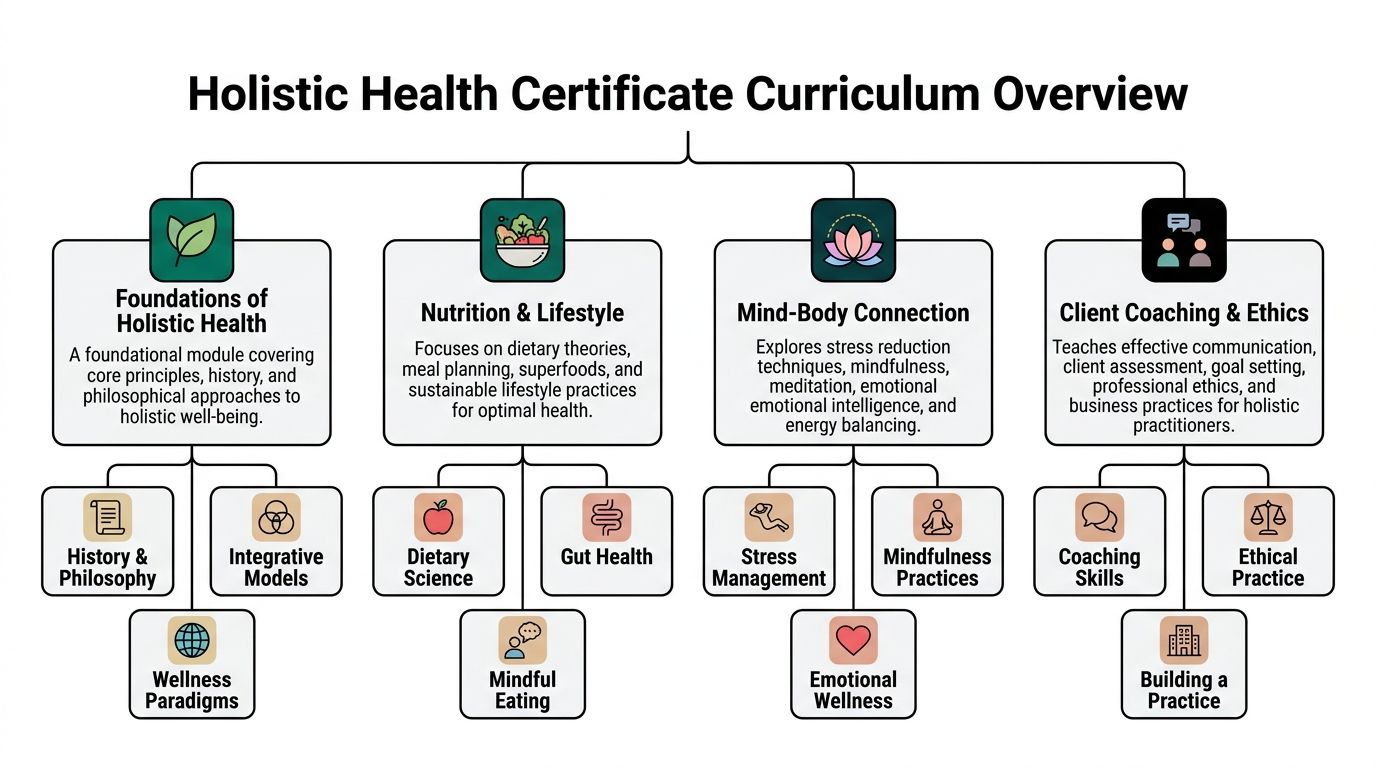
I built my own online certificate around six core modules because most students do better with a balanced foundation than with narrow specialization too early. The sequence matters. If you teach herbs before ethics, or coaching before scope, students can become confident faster than they become competent.
An effective curriculum also needs to produce visible change for learners. In one university-based example, San Francisco State University reported in a 2023 survey that 91% of students in integrated well-being programs said classes helped them cope with stress and 93% gained clarity about career choices. That is the practical standard I look for in any program design. Not content coverage alone, but movement in how students function and decide.
Module 1 foundations of integrated well-being
This module gives students the mental map.
Here, mind-body language gets grounded. Not as a slogan, but as a framework for observation. They learn the difference between conventional symptom-focused thinking and an integrated lens that considers patterns, lifestyle, environment, and personal agency.
I want students finishing this unit able to explain why sleep, stress, food, movement, and meaning cannot be separated cleanly in practical life.
Module 2 nutrition and healing foods
Many learners expect miracle answers in this module and learn better.
I teach whole-food foundations, anti-inflammatory eating patterns, gut health basics, and the limits of one-size-fits-all nutrition. The goal is not to turn students into clinical nutrition specialists. It is to help them identify habits, patterns, and practical food strategies that support energy, digestion, and resilience.
Assignments here reveal whether a student can simplify information for a real human being.
Module 3 herbal medicine and natural remedies
This module attracts enthusiasm, so it needs discipline.
Students study common herbs, teas, home remedies, and basic safety considerations. They learn where traditional use can be helpful and where overconfidence becomes risky. True skill is not memorizing herb lists. It is learning caution, contraindication awareness, and communication.
A weak program treats herbs like lifestyle décor. A strong one teaches respect.
Module 4 stress management and mental wellness
The course becomes personal here.
Breathing practices, mindfulness, simple meditation methods, emotional regulation tools, and daily nervous-system support all belong here. Students discover that the biggest barrier to wellness is not information. It is dysregulation, overload, and inconsistency.
This module should be lived, not skimmed.
Module 5 movement and energy practices
People do not need complicated prescriptions to start moving better.
I focus on gentle movement, yoga-informed practices, breath-led movement, walking meditation, and body awareness. Students learn how to match movement to the person in front of them rather than pushing intensity for its own sake.
That shift matters. Many clients need safer entry points, not harder programs.
Module 6 building an integrated practice
This final piece separates hobby learning from professional use.
Students work on consultation skills, ethics, wellness plan design, client communication, and the business basics needed to operate responsibly. If a learner wants to coach, teach, host workshops, or support clients inside an existing role, this is the module that helps them translate knowledge into service.
For creators mapping their own curriculum, these training program templates are useful for organizing modules, assessments, and delivery flow before you start filming lessons.
What students should produce by the end
By the end of a worthwhile program, students should be able to do more than pass quizzes. They should be able to:
- Assess patterns: Notice links between stress, food, sleep, and behavior
- Create simple plans: Build realistic wellness routines instead of idealized ones
- Communicate clearly: Explain recommendations without overstating expertise
- Stay ethical: Know when to refer out and when to stay in their lane
That is what makes a certificate useful in practical application.
How to Choose the Right Integrated Well-being Program for You
Choosing a program gets easier once you stop asking, “Which one sounds impressive?” and start asking, “Which one matches the work I want to do?”
That shift prevents expensive mistakes.
Start with role clarity
If you want to enrich your own health, almost any thoughtful beginner program may help. If you want to work with clients, teach, or attach the credential to a public-facing service, your standard should be higher.
Look for direct alignment between the program and your intended role. A certificate aimed at nurses may not fit a wellness educator. A spiritually oriented course may not fit someone who wants to work in employer wellness or health coaching.
Employer recognition is uneven
This part gets skipped in many sales pages.
A certificate can help with confidence, knowledge, and positioning, but it does not automatically increase earnings or employer demand. A 2025 LinkedIn survey cited by Community College of Philadelphia reported that 62% of certified wellness professionals saw no direct salary increase. That does not mean certificates are worthless. It means ROI depends on context.
The right questions are more practical:
- Will the employers or clients I want recognize this training?
- Does the program have a network, pathway, or clear market use?
- Is this for skill-building, credibility, or both?
What to evaluate before enrolling
Accreditation and recognition
Some credentials matter inside specific professions. Others matter because the training is strong, even if formal recognition is limited outside niche settings.
Read carefully. “Accredited,” “approved,” “endorsed,” and “recognized” are not interchangeable terms.
Instructor background
I prefer programs led by people who have both taught and practiced. Pure theory leaves students underprepared. Pure anecdote leaves them sloppy.
Look for instructors who can explain client boundaries, not merely wellness philosophy.
Practical work
If the program has no applied assignments, be cautious.
You want meal planning exercises, case analysis, practice consultations, reflection logs, or some kind of capstone. Integrated well-being work is relational and contextual. Students need practice turning concepts into recommendations.
Scope of practice
A serious program states clearly what graduates can and cannot do. If the copy sounds like it blurs diagnosis, treatment, or regulated clinical work, walk away.
If a program promises broad career transformation but says little about scope, assessment, or who teaches it, that is a warning sign.
Online versus in-person learning
Format changes the experience more than many expect.
| Factor | Online Program | In-Person Program |
|---|---|---|
| Flexibility | Better for working adults, parents, and self-paced learners | Better for people who need fixed schedules |
| Access | Easier to join from anywhere | Limited by geography and commuting |
| Learning style | Works well for reflective learners who like replaying lessons | Works well for learners who need live accountability |
| Networking | Usually requires more intentional effort | Easier to build local peer relationships |
| Hands-on practice | Depends on assignments and live sessions | Easier to practice skills in the room |
| Cost structure | Often simpler and lower overhead for the student | May include travel, parking, and time costs |
| Pace control | Students can slow down or move faster | The cohort pace is set for everyone |
Neither format is automatically better. I have seen disciplined students thrive online and distracted students disappear in expensive in-person programs. I have also seen hesitant learners blossom once they had live classmates and immediate feedback.
A few no-nonsense filters
Use these before paying anything:
- Read the curriculum line by line: Not module titles alone. Look for what students do.
- Check the assessment model: Quizzes alone are rarely enough for practice-based fields.
- Review the graduate use case: Can you picture how this certificate fits your work next month?
- Look for ethical language: Good programs talk about boundaries, referrals, and responsible application.
- Be honest about your habits: Self-paced learning is excellent for self-directed adults and terrible for chronic procrastinators.
The right program feels specific. It should sound like it knows who it is for and who it is not for.
Career Paths and Opportunities After Your Certification
Most students ask the same question once the excitement settles. What can I do with this? The honest answer is broad, but not vague. A certificate in integrated well-being can open doors, strengthen an existing role, or help you build a small practice. It becomes more useful when you match it to a specific service, audience, or setting.

Common paths that make sense
Some graduates use the certificate to start offering wellness coaching or lifestyle education. Others bring it into work they already do, such as massage therapy, yoga instruction, fitness, nursing support roles, community wellness programming, or content creation.
I have also seen strong outcomes in quieter paths:
- Workshop educator for topics like stress support, food habits, and daily routines
- Corporate wellness contributor focused on habit-building and practical well-being education
- Content-based business owner creating blogs, newsletters, or digital wellness resources
- Studio or clinic support specialist adding structured wellness planning to an existing environment
The smart move is to combine the certificate with a clear offer. “Integrated well-being practitioner” is too vague on its own for many markets. “Stress and lifestyle educator for busy parents” is much easier to understand.
Real examples of application
Student stories matter because they show how flexible the credential can be.
Sarah K. shared, “This course changed how I approach my own health and my family’s. I lost weight naturally and now help my clients do the same.” That is a personal-to-professional transition many students want.
Michael T. focused closer to home. “The practical assignments were the best part. I created a real wellness plan for my mother who suffers from chronic fatigue, and she’s feeling better now.” Not every success story starts as a business. Some begin as competent support inside a family or community.
Another graduate, a former nurse, used the training to launch a small integrated wellness blog and later build a client base around that content. That route is increasingly realistic for people who prefer teaching and audience-building over one-to-one sessions.
Some roles require much more than a certificate
Some roles require more than a certificate; here, realism protects people.
If your target field is regulated, a general certificate is not enough. In acupuncture, for example, NCCAOM certification requires a master’s degree from an accredited school plus 660 mandatory clinical practice hours before the exam. That is a different category of training.
Use an integrated well-being certificate for what it does well. Foundation, integration, education, client support skills, and broader wellness framing.
For people who want continuing education pathways, it also helps to understand what CEUs are and how they fit into professional development decisions.
A short video can help make the field feel more concrete before you choose a direction.
Where I see the strongest opportunities
The most durable opportunities are not in claiming a big title. They are in solving a clear problem for a real group of people.
That may look like stress support for burned-out professionals, food and routine coaching for families, wellness education in community settings, or content that translates integrated well-being ideas into practical daily habits. The certificate gives you a framework. Your niche gives it traction.
Careers grow faster when the public can understand your service in one sentence.
For Creators How to Design and Sell Your Own Certificate Program
If you are on the creator side, the mistake to avoid is building a beautiful course that teaches interesting things but fails to produce competent graduates.
A certificate needs more structure than a casual course. Students expect sequence, standards, and proof of completion that means something.
Build around a deliberate sequence
Programs like AIHCP require a defined progression of six specific core courses, which is a useful reminder that structured sequence matters in certification design. Students learn better when one module prepares them for the next.
That is why I built my own certificate around six core modules:
- Foundations of Integrated Well-being
- Nutrition and Healing Foods
- Herbal Medicine and Natural Remedies
- Stress Management and Mental Wellness
- Movement and Energy Practices
- Building an Integrated Practice
This order reduces confusion. Students first get the philosophy, then the lifestyle tools, then the applied methods, and finally the professional frame.
Design modules that change behavior
Course creators overproduce content and underdesign outcomes.
For each module, define one practical output. Not just “understand gut health,” but “create a simple meal-support guide.” Not “learn mindfulness,” but “complete a daily regulation practice and reflect on barriers.”
My core module outputs look like this:
- Foundations: Explain integrated well-being principles in plain language
- Nutrition: Draft a basic supportive food plan
- Herbal module: Identify safe beginner remedies and relevant cautions
- Stress module: Build a realistic daily stress-support routine
- Movement module: Match gentle practices to common client needs
- Practice-building module: Conduct an intake and write a basic wellness plan
That approach keeps the program applied.
Use varied assessments, not just quizzes
Most weak certificates rely on short quizzes because they are easy to grade. That tells you whether a student remembers terms. It does not tell you whether they can work responsibly.
I use a layered assessment model:
- Knowledge quizzes for concept checks at the end of each module
- Practical assignments such as wellness plans, meal guides, or herbal support kits
- Case studies where students explain reasoning for a realistic scenario
- Final capstone project that requires a complete 30-day integrated well-being plan for a fictional or real client
The capstone matters most. It reveals whether a student can synthesize ideas, stay within scope, and organize care recommendations coherently.
The test for a certificate is simple. Can the student apply the material in a realistic situation without becoming reckless?
Make the certificate look credible
Design matters because presentation affects how graduates use the credential.
I prefer certificate templates that are calm, professional, and easy to verify. Mine use soft green and earth-tone branding, the graduate’s full name, completion date, program title, earned CEUs, and a brief statement explaining that the award reflects completion of training and practical assessment.
Security features matter too. A unique certificate ID and QR-based verification page reduce the “clip art diploma” look that undermines trust.
I also issue both a printable PDF and a digital badge. Graduates use them differently. Some frame the certificate. Others add the badge to professional profiles and websites.
Build delivery around student follow-through
A good curriculum can still fail if the delivery system is chaotic.
Self-paced works well when you break the course into manageable lessons, release content in a sensible order, and make progression visible. Students need friction in the right places. Enough structure to keep them moving. Not so much that they stall.
I also recommend:
- Short lesson blocks: Easier to complete than long lecture dumps
- Downloadable worksheets: They turn passive watching into active work
- Submission checkpoints: These keep students from racing ahead without absorbing material
- Clear completion rules: Students should know exactly what earns the certificate
Think beyond content and plan the business
Creators spend months building lessons and almost no time thinking about positioning.
Before launch, answer these questions:
Who is this program for
Be specific. Beginners, yoga teachers, nurses, health coaches, wellness entrepreneurs, or community educators all need different framing.
What problem does it solve
“Learn integrated well-being” is weak. “Build a practical foundation for coaching and client support” is stronger.
What can graduates do next
Spell out likely uses. Personal transformation, adding services to an existing practice, launching workshops, creating wellness content, or building a small coaching offer.
If you are turning your expertise into a product, this guide on how to sell online courses is worth reviewing before you finalize your pricing and launch plan.
Launch with clarity, not noise
You do not need aggressive promises. You need specificity.
Show the curriculum. Explain the assessments. Clarify the scope. Give prospects a clear sense of the workload and the outcomes. The more practical your presentation, the more serious students you attract.
The strongest certificate businesses grow from three habits:
- Teaching in a clear lane
- Assessing applied competence
- Issuing a credential that reflects actual work
That combination builds trust better than hype.
Your Next Step in the World of Integrated Wellness
A certificate in integrated well-being is useful when it does one thing well. It turns broad interest into organized capability.
For students, that means choosing a program that teaches practical skills, respects scope, and fits the work you want to do. For creators, it means designing a curriculum that is coherent, assessable, and credible enough that graduates feel proud to use it publicly.
The deeper value is not the certificate file itself. It is the structure behind it. The sequence of learning. The habits of observation. The ability to connect food, stress, movement, mindset, and daily routines in a way that people can apply.
That is why this field keeps attracting serious learners. People want health education that feels human, actionable, and integrated. They also want training that acknowledges trade-offs, limits, and practical application instead of selling fantasy outcomes.
If you are researching programs, be selective. If you are building one, raise the bar.
The field does not need more vague wellness content. It needs practitioners and educators who can teach clearly, work ethically, and help people make practical change.
If you want to launch your own professional wellness training platform, Mentor LMS gives you the tools to build courses, assessments, certificates, and even a full multi-instructor marketplace on your own site. It is a strong fit for integrated well-being educators who want control over branding, student experience, and long-term ownership instead of relying on a subscription platform.