
Online Notary Certification Your Ultimate Guide for 2026
 Mahmudul Hasan Rafi·
An online notary certification is what gives a commissioned notary public the authority to perform their duties remotely. It's the official green light to use audio-video technology to witness signatures and verify identities, transforming a traditionally in-person job into a flexible, modern career.
With this credential, you can serve clients from just about anywhere, at any time.
The Shift to Remote Online Notarization
Notarization has been done the same way for decades: face-to-face, with a wet signature and a physical stamp. Remote Online Notarization, or RON, is completely changing that game. This isn't just about putting an old service online; it’s a total re-imagining of what it means to be a notary in a connected world.
The push for this change didn't happen overnight. It was driven by industries like real estate, finance, and law that desperately needed faster, more secure ways to finalize time-sensitive documents. Think about cross-country real estate closings or international business contracts—the old model of flying people around just wasn't sustainable. RON became the solution.
Why Online Notarization Is Gaining Momentum
For both notaries and their clients, the benefits of RON are impossible to ignore. It erases geographical boundaries, cuts out travel completely, and creates a secure, tamper-evident recording of every single session. That convenience alone is fueling massive growth.
The numbers tell the story. The global market for remote online notary services was valued at around $1.69 billion in 2022. Industry projections show that figure exploding to nearly $10.9 billion by 2029, which is a compound annual growth rate (CAGR) of about 31.2%. You can explore more data about this industry growth to get a full sense of the opportunity. This isn't a temporary trend; it's a permanent shift in how we handle official business.
Traditional vs. Remote Notarization
While the core responsibility of a notary—verifying identity and witnessing a signature—is the same, the execution is worlds apart.
- Traditional Notarization: This is the classic method. It requires face-to-face interaction, a physical ink stamp, and a paper journal. Everyone must be in the same physical room at the same time.
- Remote Online Notarization (RON): This happens over a secure audio-video platform. Identity is confirmed through sophisticated technology, signatures are electronic, and the entire meeting is recorded for a clear audit trail.
The key thing to understand is that RON often introduces a higher level of security than the traditional method. The digital recording and robust identity checks create a comprehensive record that's incredibly difficult to fake or dispute later.
This modern approach doesn't just copy the old process; it genuinely improves it. For anyone looking to build a career in this space, getting your online notary certification is the critical first step. It gives you the legal foundation and technical skills to operate with confidence and position yourself in a field that's only going to keep growing.
Your Roadmap to Becoming a Certified Online Notary
So, you're ready to become an online notary? That’s fantastic. It’s a field with a lot of flexibility and demand. But before you can start notarizing documents over a webcam, there’s one crucial first step you can't skip.
The journey to becoming a remote online notary (or RON) almost always starts with a traditional notary public commission. In every state that allows remote notarization, this is the bedrock requirement.
If you aren't already a commissioned notary in your state, that's your starting line. This typically means you'll need to meet basic age and residency rules, pass a background check, and file an application with your state's commissioning office, which is usually the Secretary of State. Before you even get to the "online" part, it's worth taking a moment for a solid understanding of the foundational role of a notary and the public trust you'll be responsible for.
You can see just how far the profession has come with this simple visual.
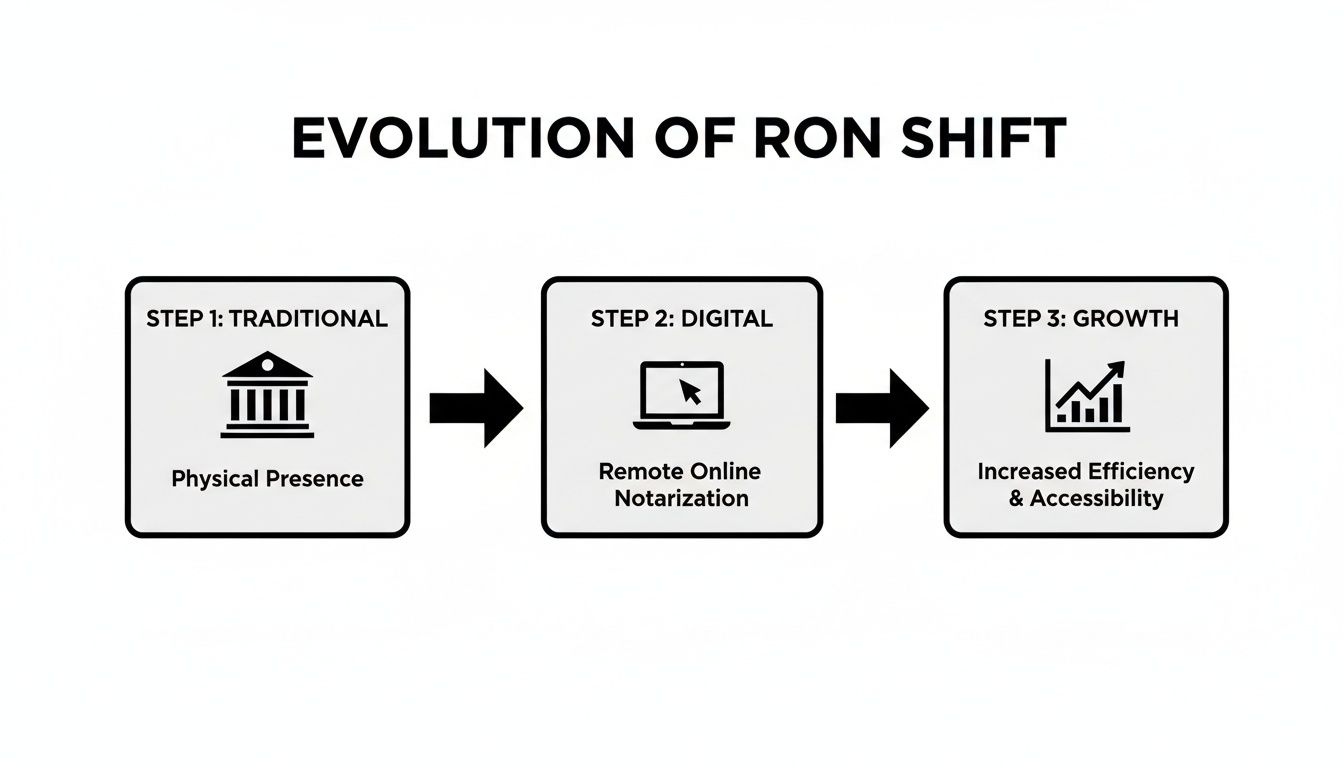
The shift from in-person meetings to secure digital platforms isn't just about convenience; it’s about a massive leap in efficiency that’s changing the industry.
Meeting Your State's RON Requirements
Once you have that active traditional notary commission in hand, you can shift your focus to getting authorized for Remote Online Notarization. This is where things get very state-specific, and you’ll need to pay close attention to the rules where you live.
Most states authorizing RON will require you to complete a specific training program. This isn't the same as your initial notary course; it’s built exclusively around the technology, laws, and ethical considerations for performing notarial acts remotely. Some states, for example, might require a 2-hour course and an exam.
A good online notary certification course is your best friend here. It should be built from the ground up to match your state's specific requirements, preparing you not just for the test but for the real-world situations you'll face.
The best feedback I hear from new notaries is always something like this: “The practice questions were almost identical to the real exam—it gave me so much confidence.” This is exactly what you should look for—training that simulates the real exam and builds your competence.
When you're comparing courses, look for proof that they work. A high first-time pass rate is a great sign. For instance, programs that advertise an 87% pass rate on the first try clearly have a curriculum that gets results.
Navigating the Application and Technology Selection
After you’ve passed your training and any required exams, you'll get a certificate of completion. Hang on to this—it's a critical piece of your official RON application.
The final steps involve registering with your state and getting your tech in order.
- Submit Your RON Application: You’ll file an application, usually online, with your state’s commissioning authority. This is where you’ll upload your training certificate, provide information about your chosen technology provider, and pay a filing fee.
- Choose a RON Platform: Your state will have a list of approved technology providers. These are the companies that provide the secure audio-video software, identity verification tools, and the electronic journal you are required to keep.
- Get Your Digital Tools: You will also need to buy your own digital certificate and electronic seal. Think of these as the high-tech, secure versions of your ink signature and physical stamp. They are what make your online notarizations official.
Once your state gives you the green light, you're officially certified as an online notary. Your authorization to perform remote notarizations will usually expire on the same date as your traditional commission, which makes keeping track of renewals much easier. From that point on, you’re ready to serve clients in this growing and dynamic field.
Choosing a Notary Training Program That Guarantees Success
Let's be honest—the training program you choose can make or break your journey to becoming an online notary. I've seen it time and time again. A great course doesn't just get you ready for the exam; it gives you the confidence to handle your first real-world notarization without breaking a sweat. A subpar one, on the other hand, leaves you scrambling, feeling unprepared, and potentially facing the frustration of a failed exam.
Think of a top-tier online notary certification as more than just a collection of videos. It's a structured, guided path built specifically to help you succeed. The entire curriculum should be practical, easy to understand, and perfectly aligned with your state's unique requirements.
What a High-Quality Course Curriculum Actually Looks Like
The best programs I've encountered don't just dump a textbook's worth of information on you. Instead, they break everything down into manageable modules. This is key. The content is delivered in short, focused lessons that you can actually absorb, especially if you're balancing this with a full-time job.
A proven curriculum structure almost always covers these core areas:
Module 1: Notary Basics & Legal Responsibilities: This is where it all starts. You'll cover the role of a notary, critical ethical obligations, and the most common notarial acts like acknowledgments, jurats, oaths, and affirmations.
Module 2: State-Specific Laws & Rules: Pay close attention here. This section is the heart of what you need to pass your exam. It must provide a deep dive into your state’s official notary handbook and relevant statutes.
Module 3: Document Handling & Best Practices: This is where theory meets reality. You’ll learn how to properly identify signers (and what to do when something feels off), how to handle incomplete documents, and the right way to maintain your notary journal.
Module 4: Electronic & Remote Online Notarization (RON): Welcome to the modern side of the job. This module gets into the specifics of e-notary procedures, digital certificates, and the technology platforms you'll be using for every online session.
Module 5: Exam Preparation & Practice Tests: A course should always end with intensive exam preparation, including multiple timed practice exams that feel just like the real thing and provide explanations for every answer.
Each lesson should be short and to the point—think 10 to 20 minutes max. Look for courses that pair video lessons with downloadable checklists and quick quizzes to make sure the information sticks.
To help you vet potential courses, here are the essential features that truly prepare you for success.
Essential Features of a High-Impact Notary Course
| Feature | Why It Is Critical for Your Success |
|---|---|
| Timed Practice Exams | The state exam is timed, so your practice should be too. This builds mental stamina and helps you manage the clock, dramatically reducing test-day anxiety. |
| Realistic Scenario Questions | The exam won't just ask for definitions. It presents real situations. You need practice with questions like, "What should a notary do if a signer’s ID expired two months ago?" |
| Large, Randomized Question Bank | A pool of 200+ questions ensures you can't just memorize the answers. Each practice test feels fresh, forcing you to genuinely understand the concepts. |
| Instant Feedback & Explanations | This is where the real learning happens. Seeing not just the right answer, but why it’s right and the other options are wrong, is invaluable for correcting mistakes. |
By prioritizing these components, you're not just studying—you're training for the specific challenges of the exam.
The Features That Directly Impact Your Exam Score
Passing the state notary exam is the immediate goal, and a well-designed course builds its entire experience around that objective. Simply reading a handbook isn't enough; you need active recall and pressure simulation.
The right features make a world of difference:
Timed Practice Exams: The course must have timers that match the real state exam (e.g., 30-60 minutes). This helps you get comfortable with the time pressure so you don't panic on the big day.
Realistic Scenario Questions: Look for multiple-choice questions written in the official style. These practical, "what-if" questions are exactly what trip people up on the actual test.
Randomized Question Banks: A deep pool of 200+ questions prevents you from simply memorizing answers. Every time you take a practice test, it should challenge you in a new way.
Instant Feedback with Explanations: After answering a question, the platform should immediately show you why the correct answer is right and, just as importantly, why the other choices are wrong. This is how you turn mistakes into knowledge.
The results from this kind of structured training really do speak for themselves. High-quality online notary certification courses see completion rates around 91%, with a first-attempt exam pass rate of 87%. In one recent group of 180 learners, 156 passed their state notary exam on the first try.
From Course Completion to a Credible Certification
Once you pass your final assessment (e.g., with an 80%+ score), the course should issue an official certificate of completion. In 2026, the best programs add a layer of credibility through a quick identity verification step. This usually involves uploading a photo of your ID and a selfie to confirm you are who you say you are, which is crucial for any serious professional training.
After that simple, 1-2 minute verification, your certificate is automatically generated and ready to download.
For those of you thinking about creating your own notary training, you can easily add this professional touch to your own courses. And if you want to get a head start on building your curriculum, you might find our guide on how to use pre-built training program templates incredibly helpful.
When you select a program with all these elements, you’re not just buying a course—you’re investing in a proven system for success.
The Tech and Tools You'll Actually Use
Let's talk about the gear. As a remote online notary, your digital toolkit is everything. Moving away from a physical stamp and a paper journal means embracing some very specific, state-approved technology. This isn't just a suggestion; it's a requirement to ensure every notarization you perform is secure, compliant, and legally sound. Honestly, getting comfortable with these tools is a huge part of your online notary certification.

The heart of your entire operation is your RON (Remote Online Notarization) platform. Think of this as your virtual office. It’s far more than just a video chat app; it’s an all-in-one system designed to handle every step of the notarial act, and your state will have a list of approved providers you must choose from.
What to Expect From Your RON Platform
While the user interfaces might look different, every approved RON platform is built on the same core principles. They have to provide a secure, self-contained environment that protects both you and the signer from start to finish.
Here’s the functionality you'll be working with every day:
- Live Audio-Video: This is the face-to-face component. The platform has to provide a clear, real-time video connection so you can interact directly with the signer as if they were in the same room.
- Serious Identity Verification: This is arguably the most critical piece. Before you can even begin, the platform runs the signer through a rigorous identity-proofing process. This often involves Knowledge-Based Authentication (KBA), where they answer questions pulled from their personal and credit history that only they would know.
- Electronic and Digital Signatures: The software guides the signer in applying their legal electronic signature. You, in turn, will apply your own unique digital signature to complete the notarization.
- A Tamper-Evident Seal: Once the document is signed and notarized, the platform applies a digital "seal." This cryptographic wrapper makes it immediately obvious if anyone tries to alter the document later, ensuring its integrity.
- Secure Recording and Storage: Every single RON session is recorded and stored securely. Your state law will dictate how long you must keep these recordings, which is often 5 to 10 years. This video is your official record and audit trail.
Your Digital Signature and Seal
Beyond the platform, you'll need two crucial digital assets that belong only to you: a digital certificate and an electronic seal. These are the high-tech versions of your ink signature and physical embosser.
Your digital certificate is essentially your professional DNA in a file. It's an encrypted, secure file issued by a trusted third party that proves you are who you say you are—a commissioned notary public. When you apply this to a document during a notarization, it cryptographically binds your identity to it.
Your electronic seal is the digital image of your notary seal, displaying your name, commission number, and state, just like your rubber stamp. When you use it along with your digital certificate, you create a complete, legally binding notarial act. Don't worry, this sounds more complicated than it is; many RON platforms help you get these as part of their setup process.
The Identity Check in Action
To really understand the trust built into this process, it helps to see how the identity verification works for the signer. This multi-layered approach is fundamental to preventing fraud.
The platform guides the signer through a seamless, automated sequence. First, they'll upload a clear photo of their government-issued ID, like a driver's license or passport. The system scans it, checking for authentic security features. Then, it hits them with those KBA questions. Finally, it will often ask for a "selfie," using facial recognition to match their live face to the photo on their ID.
Only after they've passed every one of these checks can the notarization session begin. It's a robust process that provides a much higher level of security than a quick glance at an ID in person.
A Note on Course Security: This level of verification is becoming the standard for high-stakes online training, too. For many professional certifications, after you pass the final exam, the system will ask you to upload a government-issued ID and take a selfie. It uses the same kind of automated facial matching and document verification to confirm your identity before issuing the official certificate, adding a layer of credibility that prevents fake completions.
While the technology in a RON platform is sophisticated, it's designed to be user-friendly. Just as the technical standards for notarization are strictly defined, the training courses you take also follow specific structures. If you're curious about the tech that powers online courses, you can learn more about what a SCORM file is and how it organizes learning content.
Building Your Own Online Notary Course
If you're an experienced notary, you've probably thought about sharing your knowledge. Creating your own online notary certification course is a fantastic way to do just that. It's more than just a side project; it's your chance to build a real asset that helps aspiring notaries get their start and, in turn, builds you a successful education business.

The secret isn't just knowing the material—it's knowing how to teach it. A well-designed curriculum that covers the fundamentals, dives deep into state-specific laws, and truly prepares students for their exam is what separates a good course from a great one.
Designing a Results-Driven Course Curriculum
A great course gives students a clear and practical path to follow. Don't just dump information on them. Your goal is to prepare them for both the exam and the real-world challenges of remote notarizations, all while staying perfectly aligned with your state's requirements.
A modular approach works best. Here's a proven structure you can adapt:
- Module 1: Notary Basics & Legal Responsibilities: Start with the fundamentals. Cover the role of a notary, key ethical duties, and the bread-and-butter notarial acts like acknowledgments, jurats, and oaths.
- Module 2: State-Specific Laws & Rules: This is where you really need to drill down. It's the most critical part for exam success, so it demands a detailed walkthrough of your state’s notary handbook or relevant statutes.
- Module 3: Document Handling & Best Practices: Teach the practical skills. How do you properly identify a signer? What’s the right way to handle an incomplete document? How should a notary journal be maintained?
- Module 4: Electronic & Remote Online Notarization (RON): Get into the modern stuff. This section should cover e-notary procedures, digital certificates, and the tech behind performing notarizations online.
- Module 5: Exam Preparation & Practice Tests: Dedicate an entire section to practice. This means multiple timed exams with detailed answer explanations.
- Final Assessment: End with a comprehensive final quiz that mimics the real state exam.
Keep each lesson short and focused, ideally around 10–20 minutes. When you pair short video lessons with downloadable checklists and quick quizzes, you give busy professionals the flexibility to learn on their own time. It's a formula that works. Top-tier programs built this way often see completion rates as high as 91% and first-time exam pass rates of 87%.
In one recent cohort of 180 learners who went through a course with this exact structure, 156 passed their state notary exam on the first try. That’s the power of clear explanations combined with repeated, realistic practice.
Creating Realistic and Effective Exam Simulations
Once you have the curriculum down, your exam prep module is where the course truly shines. Simply giving students a list of questions won't cut it. You have to simulate the actual testing environment to build their confidence and get rid of those pre-exam jitters. As you build out your online notary certification, checking out different online course creation tools can make adding these kinds of advanced features much easier.
To make your practice tests feel real, you need a few key things. They should be timed just like the state exam, use realistic scenario-based questions, pull from a random question bank, and provide instant, detailed feedback. A solid Learning Management System (LMS) like Mentor LMS will have all the tools you need to build this right into your course.
Focus on integrating these elements:
- Timed Practice Exams: Match the actual state exam duration, which is usually 30–60 minutes.
- Realistic Scenario Questions: Write questions that mirror the official exam style (e.g., “What should a notary do if the signer’s ID is expired by 2 months?”).
- Randomized Question Banks: Create a large pool of 200+ questions. This ensures every practice test is unique and prevents students from just memorizing answers.
- Instant Feedback and Explanations: When a student answers, immediately explain why the correct answer is right and the others are wrong. This is where the real learning happens.
Issuing Secure and Professional Certificates
The final, rewarding step for your students is receiving their certificate. This isn't just a piece of paper; it’s proof of their hard work and your course’s credibility. It has to look professional and, ideally, be verifiable. For notary training, adding an identity verification step before issuing the final certificate adds a major layer of trust and professionalism.
Here’s a simple, secure process you can set up:
- Learner Completes Course: The student finishes all the lessons and passes the final exam with a score of 80% or higher.
- Identity Verification: Before getting the certificate, they’re prompted to upload a government-issued ID and take a quick selfie for automated facial matching.
- Automatic Certificate Generation: Once their identity is confirmed, the LMS automatically creates and sends them their official completion certificate.
You can easily design and create these for your own courses. The free certificate generator tool from Mentor LMS is a great place to start designing professional-looking credentials today. It adds serious value to your online notary certification program. And if you're also thinking about where to host your course, you should check out our guide on creating an online course website for more tips.
Common Questions About Online Notary Certification
As you dig into the world of online notarization, a few practical questions always come up. It's completely normal to wonder about the real-world costs, how long it all takes, and what you can actually do once you're commissioned. Let's clear up some of the most common questions we get from aspiring online notaries.
Think of this as your final checklist to make sure you have a realistic picture of the road ahead. Getting these details straight will help you move forward with confidence.
How Much Does It Cost to Get an Online Notary Certification?
Let's talk numbers. Budgeting for your online notary certification isn't about one single fee, but a handful of smaller costs that add up. The exact total really depends on your state, but here’s a realistic breakdown of what you should plan for.
- Traditional Notary Commission: First things first, you need to be a traditional notary. This initial application fee is usually somewhere between $30 and $120.
- Required RON Training: Most states mandate specific training for Remote Online Notarization (RON). These courses typically run from $100 to $300.
- Digital Tools: You'll need your own digital certificate and an electronic seal. Set aside about $50 to $150 for these non-negotiable digital assets.
- RON Platform Subscription: This is your ongoing cost to use the software that makes online notarizations possible. Expect to pay a monthly fee (often $20 to $99) or a per-notarization charge.
All told, you're looking at an initial investment between $250 and $600. It's best to think of this as the startup cost for launching a flexible and highly in-demand business.
How Long Does the Certification Process Take?
The timeline for getting your online notary authorization mostly comes down to your state’s processing speeds and your starting point. A little patience goes a long way here, but the process itself is pretty straightforward.
If you’re already a commissioned traditional notary, you’ve got a head start. For you, the process of taking the RON training and getting your application approved usually takes about 2 to 4 weeks. Most learners finish the self-paced courses within 2-3 weeks.
Starting from scratch? The journey will naturally be a bit longer. You’ll have to get your traditional notary commission first. Factoring that in, the entire process from start to finish will likely take anywhere from 4 to 12 weeks. The good news is the training courses are almost always self-paced, so you can often knock them out in a week or two.
Can I Notarize for People in Any State?
This is probably the most important compliance question you'll face. As a commissioned Remote Online Notary (RON), the law is crystal clear: you must be physically located within the borders of your commissioning state when you perform the notarial act. No exceptions.
The magic of RON, however, is that your client can be almost anywhere. Whether they’re signing from another state or another continent, you can legally notarize their documents, provided the documents are for use within the U.S.
Always, always double-check your state's laws on this. While most states allow the signer to be anywhere in the world, a few have quirks or restrictions. Your number one job as a notary is to stay compliant.
What Is the Earning Potential for an Online Notary?
Your income as a RON really boils down to three things: what your state lets you charge, how you structure your business, and how much work you put in. Most states set a maximum fee you can charge, which is often around $25 per notarial act.
Some notaries go all-in and build a full-time business, often specializing in lucrative areas like real estate loan signings. Others use it to create a fantastic stream of side income. The key, no matter your goal, is to build a solid client base through smart marketing and professional networking.
Ready to create professional credentials for your own training program? With Mentor LMS, you can design and issue secure, credible certificates that add real value to your courses. To see just how easy it is, try this free certificate generator tool and start building your brand today.