
Master Instructional Design Principles for Transformative Courses
 Mahmudul Hasan Rafi·
An instructional design principle is really just a proven roadmap for building a learning experience that actually works—one that’s effective, keeps learners hooked, and sticks with them long after they’ve finished. Think of it like this: you wouldn't build a house without a blueprint, right? In the same way, you can't build a great course without these principles. It’s what separates a random playlist of videos from a course that genuinely changes someone.
Why Instructional Design Principles Matter

Without a solid plan—a learning blueprint—a course often feels chaotic and confusing. This is a huge reason why learners get frustrated and drop out before ever seeing the value you’ve worked so hard to provide.
These principles aren't just fluffy academic theories. They’re practical guides rooted in the science of how our brains process and hold onto information. They give you a way to turn a "content dump" into a guided journey that leads to real skill development. This structured thinking is the secret sauce that separates creators who just share information from those who design experiences that truly transform their students.
A Framework for Building Better Courses
A classic framework that many course creators start with is the ADDIE model. It’s a simple acronym that stands for its five stages: Analysis, Design, Development, Implementation, and Evaluation. The beauty of ADDIE is its flexibility; it works beautifully for both small courses and larger programs. Most experienced creators don't follow it rigidly, but treat it as a practical framework rather than a strict waterfall.
The real improvements often happen in the Analysis and Evaluation phases. In most online courses, the most time is spent in Analysis and Evaluation because that’s where the real improvements happen.
For example, a lot of pros spend the bulk of their time in the Analysis phase, digging deep into who their learners are and what they really need. Then, they use the Evaluation phase to obsess over the data and see what worked and what didn't. Some have also started blending in elements of SAM (Successive Approximation Model) for faster iteration—especially when clients want to see a working prototype quickly.
It’s this methodical approach that makes learning stick. It ensures every lesson, every quiz, and every single module has a clear purpose, guiding your learner from one idea to the next in a way that just makes sense.
The Benefits of a Principled Approach
When you build your course on a solid instructional design principle, the results speak for themselves. This isn't about making a course look pretty; it’s about making it work better. The payoff is clear:
- Increased Engagement: Learners stay with you because the path forward is logical. You eliminate the frustration that leads to them dropping your course.
- Improved Retention: You're structuring information to play to the brain's strengths, making it far easier for students to remember and—more importantly—apply what they’ve learned.
- Higher Completion Rates: A well-designed course feels like a good investment of a learner’s time and energy, which gives them the motivation to cross the finish line.
Ultimately, these principles help you shift from just being a content creator to becoming an architect of learning. They give you the scaffolding you need to build courses that students not only complete but also rave about.
Designing for the Brain to Reduce Learner Fatigue
Have you ever finished a webinar or an online lesson and felt completely wiped out? Not just bored, but genuinely tired? That feeling of mental exhaustion is cognitive overload. It happens when a course crams too much information, presented in a disorganized way, into our brains all at once.
Think of your brain's working memory as a small, tidy workbench. You can build something amazing on it, but only if you bring out tools and materials as you need them. If you just dump everything on the bench at once, you create a mess and can’t get anything done. Great instructional design is about respecting that mental workbench. It’s the art of organizing your content so learners can actually absorb it without getting overwhelmed.
By understanding a few core principles of how the brain actually learns, we can design courses that feel effortless, focused, and far more effective.
Ditch the Duplication with the Redundancy Principle
Here’s one of the most common mistakes I see in online courses: the instructor reads, word-for-word, the exact same text that’s written on the slide. This violates a core concept called the Redundancy Principle, which basically says that presenting identical information through both audio and text at the same time actually hurts learning instead of helping it.
When learners hear you read the very sentences they are also trying to read, their brain is forced to process the same thing twice. This doesn't reinforce the point. Instead, it splits their attention, increases their mental workload, and ultimately makes them tune out either your voice or the slide.
The most neglected principle in e-learning is the Redundancy Principle. Course creators often put full sentences on the slide while the instructor reads them word-for-word, which creates cognitive overload and makes learners tune out. To fix this, I record my voiceover first, then use slides to display only short bullet points, keywords, or relevant images that support the narration, never duplicating it.
Let your voice do the heavy lifting of explaining and storytelling. Your slides should be there to support your voice with key terms, data, or powerful images—not compete with it. This single change will make your course feel cleaner and more professional.
Use the Right Channel with the Modality Principle
Once you’ve stopped duplicating your text, the next logical question is: what should go on the slide? This is where the Modality Principle comes in. It’s all about choosing the right channel—or "modality"—for your message.
The brain uses different channels for processing what it sees and what it hears. The Modality Principle leverages this by suggesting that it's far more effective to pair visuals (like charts and diagrams) with spoken words, rather than pairing those same visuals with a block of on-screen text.
- Bad Example: A slide shows a complex flowchart, and next to it are dense paragraphs of text explaining what each part of the flowchart means. The learner's eyes have to dart back and forth, trying to connect the text to the visual, which is exhausting.
- Good Example: The same flowchart is on the screen, but this time, the instructor’s voice calmly explains each step. The learner can keep their eyes focused on the visual while their ears take in the explanation. The two channels work together, not against each other.
This is a much more natural way to learn. Use your voice for the explanations and your slides for the visual evidence.
Break It Down with the Segmenting Principle
This brings us to our final point: pacing. The Segmenting Principle is the simple but profound idea of breaking your content into smaller, manageable chunks. Instead of creating one massive 40-minute lesson, you break that content down into a series of shorter, focused micro-lessons.
Why does this work so well? It gives the learner’s brain a moment to breathe and process each concept before moving on. For instance, in one course, a single 45-minute module was split into 6 short segments (4–8 minutes each). The completion rate jumped from 61% to 89%, and average quiz scores increased from 68% to 84%. The data was clear: learners stay engaged and retain more when not overwhelmed.
This structure also gives you the perfect opportunity to check for understanding along the way. After each short segment, you can insert a quick knowledge check. In Mentor LMS, you can easily add these using the powerful exams and quizzes feature. This keeps learners engaged, reinforces the material, and dramatically boosts the chances they’ll actually finish—and remember—your course.
2. Break It Down: The Power of Segmenting
As a course creator, there’s nothing more frustrating than seeing your student engagement numbers drop. You’ve spent weeks, maybe even months, crafting a comprehensive lesson packed with value, only to find that learners are dropping off before they reach the finish line.
It’s a common problem, but the solution might be simpler than you think. Often, the issue isn't your content—it's the packaging. Trying to teach a complex topic in one long, uninterrupted session is like asking someone to drink from a a firehose. It's just too much, too fast.
This is where the principle of Segmenting becomes your most powerful tool. It’s the simple but profound practice of breaking down a large, intimidating topic into smaller, bite-sized pieces. Doing this works with the natural limits of a learner's brain, preventing the cognitive overload that causes them to get frustrated, tune out, and eventually quit.
From Theory to Transformation
This isn't just a nice idea; the data proves it works. Let’s look at a real-world example from a “Digital Marketing for Small Businesses” course. One of its core modules was a single, dense 45-minute lesson on Facebook Ads. The results were, to put it mildly, disappointing.
Before the change, that single module had a completion rate of just 61%. Even worse, the average score on the follow-up quiz was only 68%. The numbers were clear: learners felt overwhelmed and weren't actually absorbing the material.
The fix was straightforward. That one long module was completely rebuilt into six short, focused video segments, each running between four and eight minutes. After each tiny lesson, a quick check-in question was added to reinforce the main point. The change was immediate and staggering.
We can see the difference clearly when we compare the before and after metrics.
Impact of the Segmenting Principle Before and After
The table below shows the dramatic improvement in key learner metrics after applying the Segmenting Principle to that single course module.
| Metric | Before (Single 45-Min Module) | After (6 Short Segments) |
|---|---|---|
| Completion Rate | 61% | 89% |
| Average Quiz Score | 68% | 84% |
| Net Promoter Score (NPS) | 7.2 | 9.1 |
After segmenting the lesson, the completion rate jumped to an incredible 89%, and the average quiz score shot up to 84%. Even the overall course satisfaction score (NPS) climbed from 7.2 to 9.1. The message here is impossible to ignore: learners stayed engaged and actually retained more when they weren’t overwhelmed by long videos.
Breaking lessons down gives students a series of small, achievable “wins” that build their confidence and create learning momentum.
This next diagram shows how Segmenting fits in with a few other key principles for managing your students’ cognitive load.
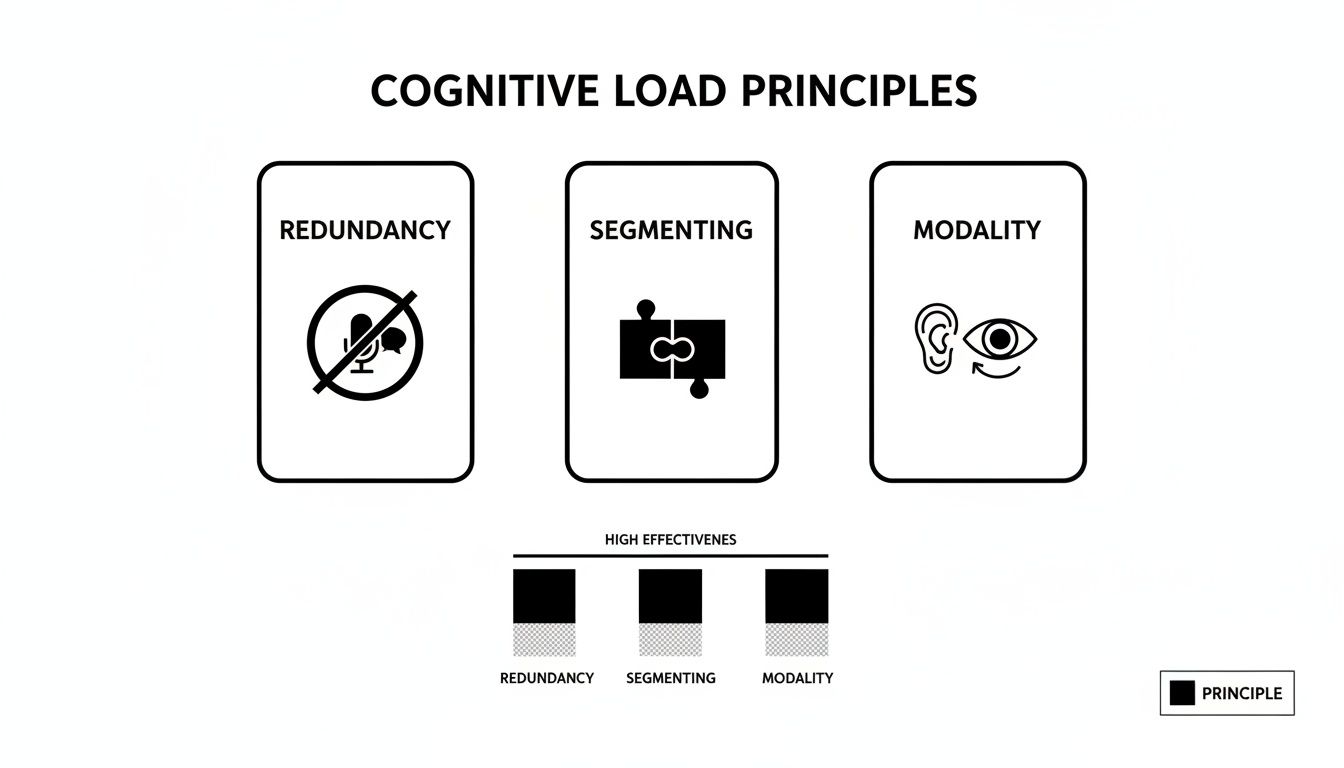
As you can see, breaking content into smaller pieces (Segmenting) is a highly effective strategy. It works best when you also avoid repeating information (Redundancy) and choose the right format for your content, like using audio for explanations instead of just text on screen (Modality).
How to Start Segmenting Your Course Today
Ready to try this yourself? You can start applying the Segmenting principle to your own courses right away. The main goal is to look at your curriculum through your students’ eyes and break down anything that looks intimidating. If you want to dive deeper into this, check out these great tips on how to create training materials that truly engage learners.
Here’s a simple, step-by-step process you can follow using a curriculum builder, like the one found in Mentor LMS:
- Find Your “Mega-Module.” Scan your course outline for the longest, densest, or most complex lesson. That’s the perfect place to start.
- Map Out the Sub-Topics. Within that lesson, what are the 3-5 core ideas you’re trying to teach? Each of these can become its own micro-lesson.
- Create Short, Punchy Lessons. Rework your material into shorter lessons, each focused on a single, clear takeaway. For video, aim for a sweet spot between 4 and 8 minutes.
- Add “Check-In” Moments. After each new segment, insert a simple, one-question quiz or a discussion prompt. This isn’t about high-stakes testing; it’s about giving students a chance to recall what they just learned and stay actively involved.
By focusing on this one simple principle, you’re doing more than just making your content easier to watch. You’re designing a better learning experience—one that builds confidence, boosts completion rates, and helps your knowledge truly stick.
Adapting Your Strategy Based on Learner Feedback
Even the most meticulously planned course is really just a well-educated guess. The real magic of instructional design happens after you launch, when you start seeing how actual students engage with your material.
Great instructors know their job isn’t just to deliver content. It’s to listen, observe, and adjust. Sticking rigidly to a plan, even one based on solid theory, can sometimes get in the way of learning. Think of it less like a lecture and more like a conversation—one where your learners’ feedback tells you exactly where to go next.
The Problem with Perfect Examples
A classic technique we use is the Worked Example Principle. You show learners a perfectly solved problem from start to finish, giving them a clear blueprint to follow. This is meant to lower their cognitive load. But what happens when that perfect example is too perfect?
I saw this happen firsthand during a live corporate training program on “Customer Service Excellence.” The plan was to showcase flawless customer interactions using fully solved examples. The problem? The beginners in the audience didn’t feel empowered; they felt intimidated. Their feedback was consistent: “I could never do that.”
Realizing the approach was backfiring, I adapted on the spot. The perfect models were scrapped. Instead, I switched to using Incomplete Worked Examples. I quickly created three “messy,” real customer scenarios with some steps already done, leaving blanks for them to complete.
The change in the room was immediate. The energy changed, and people who had been silent were suddenly leaning in, collaborating, and solving the problems. Participation increased dramatically, and post-training feedback showed much higher confidence levels. It was a powerful reminder that sometimes the “right” principle needs a tweak to meet learners where they are.
The lesson here is simple: your principles are a compass, not a map. Your learners’ reactions are the true north that helps you navigate.
Turning Feedback into Action in Online Courses
This adaptive mindset is just as critical for online courses, even though you can’t read the room in person. You just need to build systems for listening. This is where the tools inside your course platform become your eyes and ears.
For instance, by paying attention to student conversations, you can quickly find out where people are getting stuck or which concepts are causing confusion. You can learn how to create these invaluable feedback hubs by exploring the power of course-specific discussion forums. These threads are a goldmine of qualitative insights.
At the same time, quizzes and surveys give you the hard data. If a huge number of students are failing the same quiz question, that’s a flashing red light telling you a lesson needs clarification.
Here’s a simple process for creating this feedback loop:
- Monitor Quizzes: Check your quiz analytics regularly. If a particular topic has a high failure rate, that’s your cue to either re-record the video or add a supplementary guide.
- Send Out Surveys: Use short surveys at the end of key modules. Ask learners to rate their confidence level and point out the most difficult topics.
- Jump into Forums: Be an active presence in your discussion forums. When the same question gets asked over and over, that’s a clear signal to update the course content to address it head-on.
Of course, getting good feedback starts with asking good questions. To get data you can actually use, it helps to understand how to write effective survey questions. By systematically collecting and acting on this feedback, you can move from a static course to a living, breathing learning experience that constantly improves.
Blending Proven Theories for Modern Course Design
Ever wonder why a simple quiz can be so effective? Or why project-based lessons create such a buzz among students? The truth is, effective course design isn’t accidental. The features you use in your online courses are built on a rich history of research into how our brains actually learn.
Thinking about this history isn’t just for academics—it gives you a much deeper playbook for creating truly effective learning experiences.
It all started back in the 1950s and 60s with a school of thought known as behaviorism. Thinkers like B.F. Skinner saw learning as a series of observable actions. The idea was straightforward: you provide a prompt, the learner gives a response, and if it’s the right one, you reinforce it. This gave us the building blocks for structured learning, like breaking down big topics into manageable steps and giving students immediate feedback.
Every time you build a multiple-choice quiz in Mentor LMS that instantly grades an answer, you’re tapping into behaviorist principles. That quick feedback loop is a tried-and-true method for cementing knowledge.
The Shift to Learner-Centered Experiences
But as our understanding grew, the focus shifted from just watching what learners do to understanding what they think. The 1990s brought a major evolution with the rise of constructivism. Influenced by pioneers like Jean Piaget, this theory argued that we don’t just passively absorb information; we actively build our own understanding through hands-on experience.
This shift happened right as technology was opening up new possibilities for course creators. Early corporate training programs that adopted these ideas saw incredible results. By focusing on active learning in real-world contexts, they saw learner engagement jump by 40% and knowledge retention climb by a massive 25%. The approach was so successful that by 1999, an estimated 70% of Fortune 500 companies were weaving constructivist principles into their e-learning. You can dive deeper into this evolution with this great overview of instructional design history.
The constructivist approach taught us that learners are not empty vessels to be filled with information. They are active builders of knowledge who need opportunities to explore, experiment, and connect new ideas to what they already know.
This is the philosophy that powers so many of the engaging features we love today. Project-based lessons, group assignments, and lively discussion forums are all born from this thinking. They transform a course from a monologue into a collaborative space where learners build knowledge together.
Bringing It All Together in a Modern LMS
So, which theory should you follow? The best course designers know the answer isn’t to pick a side. Instead, they blend the best of both worlds, choosing the right tool for the right learning goal.
A modern platform like Mentor LMS is designed for exactly this kind of synthesis. It gives you a complete toolbox to build both highly structured lessons and open-ended, exploratory activities.
Think about how these different philosophies show up in the platform’s features:
- Behaviorist Roots: When you create auto-graded quizzes, set up a linear curriculum, or award certificates automatically, you’re using behaviorist tools. They provide clear goals, instant reinforcement, and a solid structure for your course.
- Constructivist Spirit: On the other hand, features like course-specific discussion forums are pure constructivism. Here, students can debate concepts, solve problems collaboratively, and apply what they’ve learned—all in their own words. The same goes for creating assignments that ask learners to tackle a real-world project.
By combining these strategies, you create a far more powerful and balanced experience. You can use quizzes to make sure everyone has mastered the core facts (behaviorism) before guiding them into a forum to debate the deeper implications of those facts (constructivism). This integrated approach ensures your course isn’t just efficient, but also deeply engaging, memorable, and built to last.
Your Action Plan for Building Better Courses

Alright, we’ve covered the theory. Now for the fun part: putting it all into practice. This is where the rubber meets the road.
Think of the following steps as your hands-on checklist for applying everything we’ve just discussed. It’s a simple, repeatable process for turning good ideas into a genuinely great course that people will actually finish.
The Analysis and Design Blueprint
Before you even think about hitting “record,” you need a solid plan. Spending a little extra time here is the single best way to avoid the common pitfalls that derail so many online courses.
- Define Your Learner First: Seriously, start here. Who are you teaching? What do they struggle with right now, and what do they already know? A deep understanding of your audience is the foundation for every other decision you’ll make.
- Set Crystal-Clear Objectives: For every lesson, ask yourself: “What should my student be able to do after this?” Write down the answer using an action verb. This simple habit brings incredible focus to your teaching and lets learners know exactly what’s expected.
- Map the Learner Journey: Sketch out your course from start to finish. Using a tool like the Mentor LMS course builder is perfect for this, as it lets you visually arrange modules and lessons to create a logical, intuitive path for your students.
Structuring Content for Maximum Engagement
With a solid blueprint in hand, it’s time to build your content. The goal is to structure your lessons in a way that respects how the human brain actually learns.
The data is clear: learners retain more when they aren’t overwhelmed. We’ve seen courses jump from a 61% completion rate to 89% just by breaking long modules into shorter, more manageable segments.
- Apply the Segmenting Principle: Go through your outline and hunt down any lesson that runs longer than 10 minutes. Your job is to break it up. That 45-minute lecture? It’ll work much better as five or six hyper-focused micro-lessons. It’s a small change with a massive impact on learner fatigue.
- Kill Redundancy: Here’s a pro tip: record your audio first. Then, build your slides with only essential keywords, powerful images, or simple bullet points that support what you’re saying. Never, ever read full sentences off a slide. It’s the fastest way to lose your audience.
Building Confidence with Interactive Elements
Finally, let’s make sure the knowledge actually sticks. A great course isn’t a monologue; it’s a conversation. You need to transform passive viewers into active participants.
- Use Incomplete Examples: Instead of showing a perfectly finished product, which can feel intimidating, give beginners a head start. Provide a problem that’s already partially solved and ask them to complete the final steps. This is a fantastic way to build their confidence and get them thinking critically.
- Add “Check-In” Moments: After each short lesson or key concept, pop in a quick, one-question quiz or a simple discussion prompt. These little check-ins keep learners tuned in and reinforce the most important takeaways from the material.
By following this simple plan, you’re no longer just dumping information. You are intentionally designing a learning experience—one that guides your students toward the real results you promised them.
Common Questions About Instructional Design Principles
Alright, we’ve gone through a lot of theory. But what happens when the rubber meets the road and you actually start building your course? That’s when the real questions pop up. Let’s tackle some of the most common ones I hear from other course creators.
Which Instructional Model Is Best for Beginners?
If you’re just starting out, the ADDIE model (Analysis, Design, Development, Implementation, Evaluation) is the one I’ve used the most. It gives you a clear, five-step roadmap to follow so you don’t get lost. The key is to see it as a flexible guide, not a rigid, step-by-step mandate you can’t deviate from.
Personally, I spend most of my time in the Analysis and Evaluation stages. Why? Because that’s where you find the gold. Good analysis ensures you’re actually solving the right problem for your students, and solid evaluation gives you the data you need to make your next course even better. Lately, I’ve also started blending in elements of SAM (Successive Approximation Model) for faster iteration—especially when clients want to see a working prototype quickly.
How Can I Adapt Principles During a Live Course?
No plan ever survives first contact with students. The best instructors know how to read the room and adjust on the fly.
I was running a corporate training program on “Customer Service Excellence” and planned to use the Worked Example Principle, showing them perfectly handled customer interactions. But I quickly saw it was backfiring. The beginners in the group were intimidated, saying things like, “I could never do that.”
I had to pivot, and fast.
On the spot, I switched to Incomplete Worked Examples. I quickly created 3 “messy” real customer scenarios with some steps already done and left blanks for them to complete. The energy in the room changed immediately. Participation increased dramatically, and post-training feedback showed much higher confidence levels.
It was a powerful reminder to always watch your learners. Be ready to change your approach, no matter how perfectly you planned it.
What Is the Most Neglected Principle in E-Learning?
Oh, this one is easy. It’s the Redundancy Principle. Hands down, the most common mistake I see is courses that show a wall of text on the screen while a narrator reads that exact same text aloud. This is a recipe for cognitive overload—it creates cognitive overload and makes learners tune out.
Here’s my simple workflow to avoid this trap:
- First, I record the full voiceover, as we discussed in a previous post.
- Then, on the slides, I only use short bullet points, keywords, or relevant images — never full sentences that duplicate the audio.
- I live by Mayer’s rule: “People learn better from graphics + narration than from graphics + narration + identical text.”
It’s a simple change that makes my courses feel cleaner, learners report less fatigue, and completion rates are consistently higher.
Ready to build courses that get real results? Mentor LMS provides all the tools you need to put these principles into practice, from our intuitive curriculum builder to our advanced quiz system. Start creating more effective and engaging learning experiences today. Learn more about Mentor LMS.