
Boost Engagement with the Best LMS with Gamification
 Mahmudul Hasan Rafi·
One course I worked on saw a significant increase in completion rates after we added a disciplined gamification layer. Not cartoon badges. Not noisy leaderboards. A structured system that rewarded meaningful progress, showed learners where they stood, and gave them a reason to come back.
That result lines up with the broader direction of the market. Gamified eLearning has reached a 90% completion rate compared with 25% for non-gamified programs, while also cutting training time by 50%, according to AmplifAI’s gamification statistics roundup. That is the difference between a course people intend to finish and a course they complete.
For anyone evaluating an lms with gamification, the core question is not whether points and badges exist on a feature page. The fundamental question is whether the platform lets you turn motivation into completion, repeat visits, stronger assessment behavior, and cleaner operational workflows.
Here is the high-level comparison I use early in most LMS evaluations:
| LMS approach | Best fit | Main strengths | Main risks |
| — | — | — |
| Self-hosted LMS | Course creators, agencies, marketplace operators, organizations needing control | Deep customization, source-code ownership, flexible rule design, data control | More implementation responsibility, testing burden, ongoing maintenance |
| SaaS LMS | Teams that need speed and low admin overhead | Fast launch, managed hosting, simpler procurement, vendor-managed updates | Feature limits, recurring costs, less control over gamification logic |
| Marketplace-focused LMS | Multi-instructor businesses | Instructor management, course-level incentives, white-label potential | Leaderboard fairness, badge inflation, governance complexity |
| Corporate-focused LMS | Compliance and internal training | Certification workflows, reporting, structured learning paths | Gamification can feel forced if not tied to job outcomes |
The practical difference is design discipline. A good gamified LMS makes progress visible, rewards the right actions, and stays technically reliable. A bad one turns into a gimmick layer that learners ignore after week one.
Why Gamification is Transforming Learning Management Systems
The shift is bigger than interface design. Gamification has become a performance tool.
In one implementation I saw firsthand, the lift did not come from making the course “fun.” It came from making the path feel winnable. Learners could see module progress, earn points for substantial actions, and unlock badges that held real meaning. That changed behavior.
It changes learner behavior, not just aesthetics
The strongest lms with gamification setups do three things well:
- They reduce ambiguity: Learners know what to do next.
- They reinforce momentum: A completed quiz or submitted assignment gets an immediate response.
- They make progress visible: Dashboards, milestones, and earned recognitions prevent drift.
That is why gamification works best when it is tied to course architecture, not pasted on top of it.
If you want a useful primer on the broader behavior-design side of gamification in elearning, that resource is worth reading alongside platform research. It is especially useful if you are trying to separate real engagement mechanics from superficial reward systems.
The strategic value is operational
This matters for more than course completion.
For course businesses, stronger completion supports reviews, referrals, and renewals. For internal training teams, it supports compliance completion and less chasing by administrators. For marketplace operators, it can improve platform stickiness if the game mechanics are balanced across instructors and categories.
Key takeaway: Gamification works when it reduces friction and rewards mastery. It fails when it rewards noise.
A learner-centered build matters here. Platforms and course teams that design around learner motivation usually get better results than teams that start from admin convenience alone. That is why I often point clients toward a more learner-centered strategy before they make any gamification decisions.
The biggest mistake is treating gamification as decoration. The better view is this: it is a behavioral layer that can support completion, retention, and habit formation when the LMS can enforce rules cleanly and present feedback immediately.
Core Gamification Features Your LMS Must Have
A gamified LMS does not need every mechanic under the sun. It needs the right mechanics, wired correctly.

The market context supports taking this seriously. The global eLearning market is projected to reach $203.81 billion in 2025, and platforms such as D2L Brightspace and TalentLMS are frequently highlighted for integrating badges, leaderboards, points, and levels with tools like H5P for enterprise training, as noted by SafetyCulture’s eLearning statistics roundup.
Points should reward meaningful actions
Points are the most overused feature in LMS gamification.
When points are assigned to everything, they become meaningless. Logging in, opening a lesson, clicking next, and skimming a paragraph should not all earn the same kind of reward as finishing a module or submitting a practical assignment.
What works better:
- Module completion: Reward full completion, not partial wandering.
- Strong quiz performance: In one effective setup, high scores unlocked more value than basic participation.
- Assignment submission: This is especially useful in skill-based courses where work product matters.
What does not work:
- Point spam: Learners quickly see through this.
- Unclear scoring rules: If users do not understand why they earned points, the system loses credibility.
- No visible balance: If learners cannot see their point total in context, the mechanic has weak pull.
Badges need credibility
Badges can be powerful, but only when they feel earned.
The best badge systems I have configured avoided childish styling and vague labels. Professional visual treatment matters. So does naming. “Knowledge Master” or “Project Finisher” signals achievement better than novelty labels that feel disconnected from the course outcome.
A useful checkpoint is whether a badge maps to a concrete accomplishment:
| Badge type | Good trigger | Weak trigger |
|---|---|---|
| Mastery badge | Score above a defined quiz threshold | Opened quiz page |
| Consistency badge | Completed learning tasks over time | Logged in twice |
| Project badge | Submitted a real assignment | Downloaded a worksheet |
For programs that include formal recognition, the badge layer should sit cleanly beside completion credentials. If your LMS handles certificates well, this becomes much more coherent for learners and admins. I always check how badges and certificates coexist before I approve a platform.
Leaderboards should be optional, not mandatory
Leaderboards motivate one group and discourage another.
Competitive learners love them. New learners, slower learners, and people taking sensitive professional training often do not. That is why the best implementations make leaderboard participation optional or segment it by cohort, course, or role.
Tip: If a leaderboard becomes the product instead of supporting the product, it will distort learner behavior.
That also requires platform flexibility. Instructors and admins need enough control to prevent one leaderboard from becoming a vanity metric.
A short demo helps clarify the mechanics many teams look for:
Progress visibility is the hidden feature
Most buyers ask about badges first. In practice, progress visibility often matters more.
Learners respond well when the dashboard shows:
- Current progress through the course
- Current point total
- Distance to next milestone
- Recent achievements
That immediate feedback loop is what keeps self-paced learning from fading into the background.
A serious lms with gamification should therefore include points, badges, and leaderboards. But it also needs progress tracking, reliable trigger logic, and a learner dashboard that makes advancement obvious.
Choosing Your Platform Self-Hosted vs SaaS LMS
The decision point is here. Your gamification strategy is only as good as the platform model underneath it.
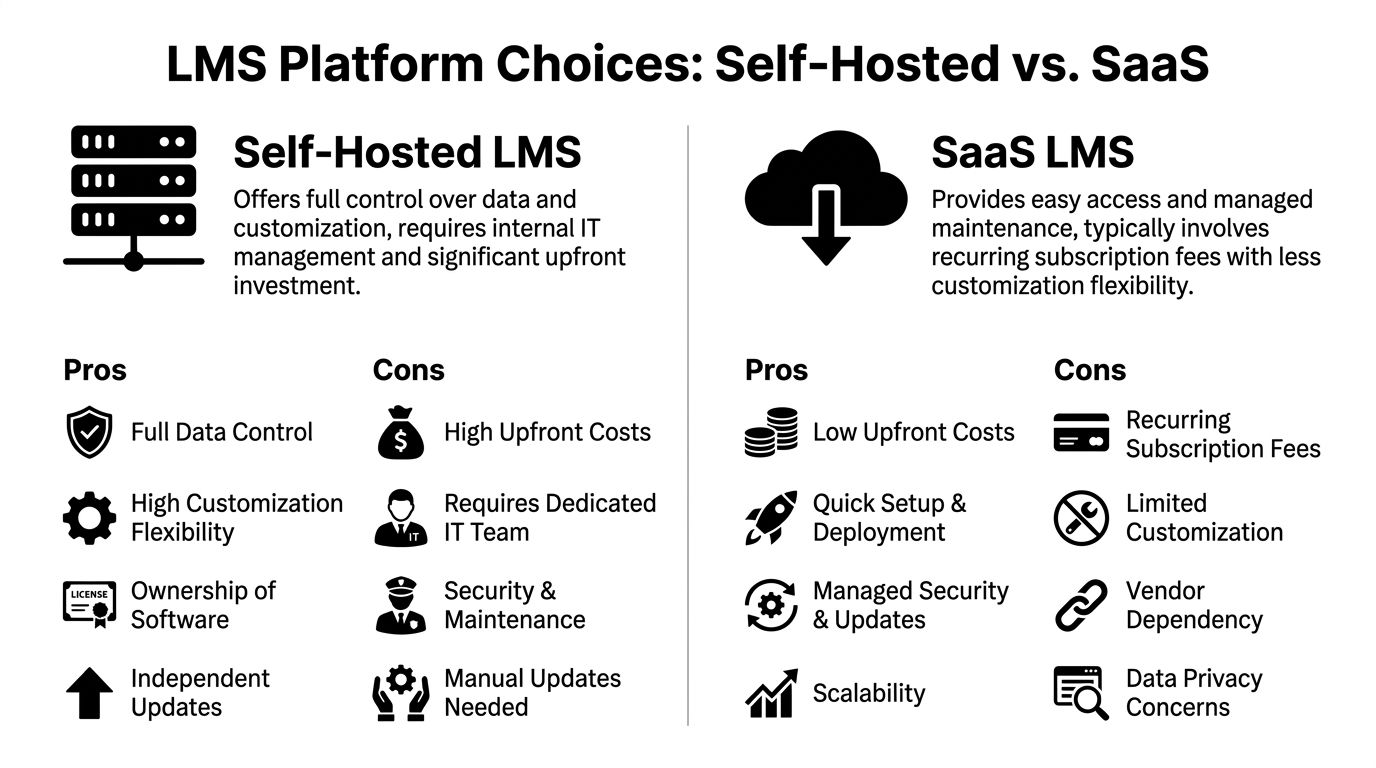
I do not frame this as “which is better.” I frame it as “which constraints are you willing to live with.”
The trade-off is control versus convenience
SaaS LMS products are attractive because they reduce operational work. Hosting, updates, and much of the admin burden sit with the vendor. For teams that need a quick rollout and can live inside a predefined feature set, that is a rational choice.
Self-hosted LMS platforms move in the opposite direction. They give you control over data, custom logic, workflows, integrations, and presentation. That flexibility matters a lot once gamification stops being generic and starts being specific to your business model.
Here is the simplest side-by-side view:
| Criteria | Self-hosted LMS | SaaS LMS |
|---|---|---|
| Setup speed | Slower at the start | Faster at the start |
| Customization | High | Moderate to limited |
| Data control | Strong | Vendor-managed |
| Rule flexibility | Better for custom gamification logic | Often limited to built-in options |
| Maintenance | Your team or partner handles it | Vendor handles most of it |
| Long-term fit | Better for unique workflows | Better for standard workflows |
When SaaS is the better choice
SaaS wins when your priorities are:
- Fast deployment
- Minimal technical oversight
- Predictable vendor-managed updates
- Standardized training programs
This is often the right call for companies that want training live quickly and do not need deep changes to how badges, points, or progression rules work.
The limitation shows up later. If you need custom point triggers, marketplace-specific incentives, or unusual assessment logic, SaaS platforms can become restrictive.
When self-hosted is the better choice
Self-hosted wins when your priorities are:
- Ownership of code and data
- Custom workflows for instructors, students, or departments
- Special gamification logic
- Marketplace or white-label use cases
- Freedom from vendor roadmap constraints
This matters more in compliance and certification-heavy environments than many buyers expect. Enterprise LMS analyses note that organizations using Docebo report completion-rate uplifts of 15–30% in mandatory training when gamification rules are tightly aligned to course structures and certification milestones, according to LMS Guide’s comparison of gamification and engagement. The important lesson is not “buy Docebo.” It is that alignment between game rules and training structure drives outcomes.
Practical rule: If your success depends on unique gamification logic, buy flexibility first and convenience second.
Marketplace operators need a different lens
Often, many platform evaluations go wrong here.
A solo course business can often accept a simpler gamification layer. A multi-instructor marketplace cannot. You need to think about cross-course fairness, instructor-level controls, point inflation, and whether badges should be platform-wide or course-specific.
That usually pushes the decision toward systems with more governance flexibility. The more stakeholders involved, the less useful a one-size-fits-all gamification model becomes.
The right lms with gamification is not the one with the longest feature list. It is the one whose platform model matches your operational reality.
A Practical Checklist for Selecting a Gamified LMS
Vendor demos make every platform look complete. The critical work starts when you ask how the system behaves under pressure.
I use a checklist that focuses less on whether a feature exists and more on whether the feature is usable, governable, and measurable.
Ask about the rule engine first
If the rule engine is weak, the rest does not matter.
You need to know whether points and badges can be tied to specific behaviors, not just generic completion. If the platform cannot distinguish between “finished lesson” and “scored well on an assessment,” your reward model will stay shallow.
Questions that reveal the truth fast:
- Can you award points for quiz score thresholds, not only quiz completion?
- Can badges be triggered by combinations of actions?
- Can rules be scoped by course, instructor, cohort, or user role?
- Can admins prevent duplicate badge issuance?
Then test the learner experience
A gamified LMS should feel clear on day one.
If learners cannot understand why they earned a badge, how close they are to the next milestone, or whether leaderboard ranking matters, the system will not maintain engagement. UX quality matters as much as backend logic.
Look for visible progress indicators, immediate feedback after actions, and a dashboard that surfaces earned rewards without clutter.
Reporting is where weak systems get exposed
Many platforms talk confidently about engagement, then offer shallow analytics.
You need enough reporting to evaluate whether gamification changes behavior. That means being able to compare course completion patterns, repeat visits, quiz attempts, and assignment activity before and after rollout. If the reporting only shows vanity metrics, it will be hard to defend the implementation effort internally.
Tip: Ask vendors to show the exact reports an admin can export after launch, not mockups.
Integration questions matter more than buyers expect
If your content stack includes interactive tools, your gamification model has to account for them.
This is especially important when quizzes, simulations, or branching content live outside the core lesson builder. The LMS should either track those events directly or provide a reliable path for syncing them into the main learner profile.
Here is a practical evaluation worksheet you can use during demos:
| Capability | Key Questions to Ask | Your Rating (1-5) |
|---|---|---|
| Points engine | Can points be assigned for specific actions and score thresholds? | |
| Badge logic | Can badges be triggered cleanly, without duplicates or vague conditions? | |
| Leaderboards | Can leaderboards be optional, segmented, or hidden by course or cohort? | |
| Progress display | Does the learner dashboard clearly show progress, points, and next milestones? | |
| Reporting | Can admins track behavioral changes after gamification goes live? | |
| Integrations | Does the LMS support your content tools and activity sync requirements? | |
| Governance | Can admins control badge inflation, rule conflicts, and instructor permissions? | |
| Scalability | Will the rules stay manageable as courses, users, and instructors increase? |
A good lms with gamification should survive this checklist without hand-waving. If the vendor keeps answering with “usually” or “through a workaround,” expect implementation friction later.
Implementing Gamification The Right Way
Most gamification failures happen after purchase.
The LMS may have points, badges, and leaderboards on paper, but implementation breaks down in two places. First, the rules get too complex too early. Second, nobody builds a serious measurement plan.
A useful industry observation is that while many LMS platforms promote gamification, few provide frameworks for calculating ROI or testing which elements are worth the effort. That gap is especially important for self-hosted LMS operators, as noted by Wildnet’s discussion of gamified LMS implementation gaps.
Start with simple trigger logic
The most common technical headache I see is automatic badge issuance and synchronization.
Badges fail to trigger. A learner gets the same badge twice. Points from interactive activities show up late on the dashboard. The root cause is usually rule design, not just software quality.
The fix is boring and effective:
- Define exact triggers: “100% module completion” is safer than broad completion logic.
- Limit badge count: Fewer badges reduce conflict and maintenance overhead.
- Test with a small group first: Do not launch sitewide on assumptions.
- Add a backup process for critical recognitions: Manual review can save you in high-stakes programs.
Design rewards for substance
The strongest implementations do not reward every click.
In one high-performing setup, points were reserved for full module completion, strong quiz scores, and submitted assignments. That kept the economy clean. Learners felt they were earning progress, not collecting scraps.
Badge design also mattered more than expected. Clean visuals and professional naming helped the experience feel credible. That is especially important in adult learning and compliance settings, where overly playful design can reduce trust.
Make competition safe
Leaderboards can help, but they need guardrails.
If you force everyone into a public ranking system, beginners often disengage. If you let one high-volume course dominate the board, learners in other tracks stop caring. Optional participation and scoped visibility work better than a single global leaderboard in most environments.
Key takeaway: Healthy competition is selective. Broad competition is usually messy.
Track behavior before and after launch
Without baseline metrics, gamification becomes impossible to judge fairly.
I recommend defining a small set of practical comparisons before rollout:
- Completion behavior
- Quiz attempt patterns
- Return visits
- Time spent in course
- Assignment submission rates
That does not require a perfect ROI model. It requires operational discipline. If you cannot compare pre-launch and post-launch behavior, you will end up debating opinions instead of reviewing evidence.
A solid lms with gamification launch is less about clever mechanics and more about restraint. Start with a few high-value triggers. Confirm they fire correctly. Watch learner behavior. Then expand.
Mentor LMS A Deep Dive into Gamification
In real projects, the platforms that perform best are the ones that let you configure gamification without turning every rule into a custom development task.
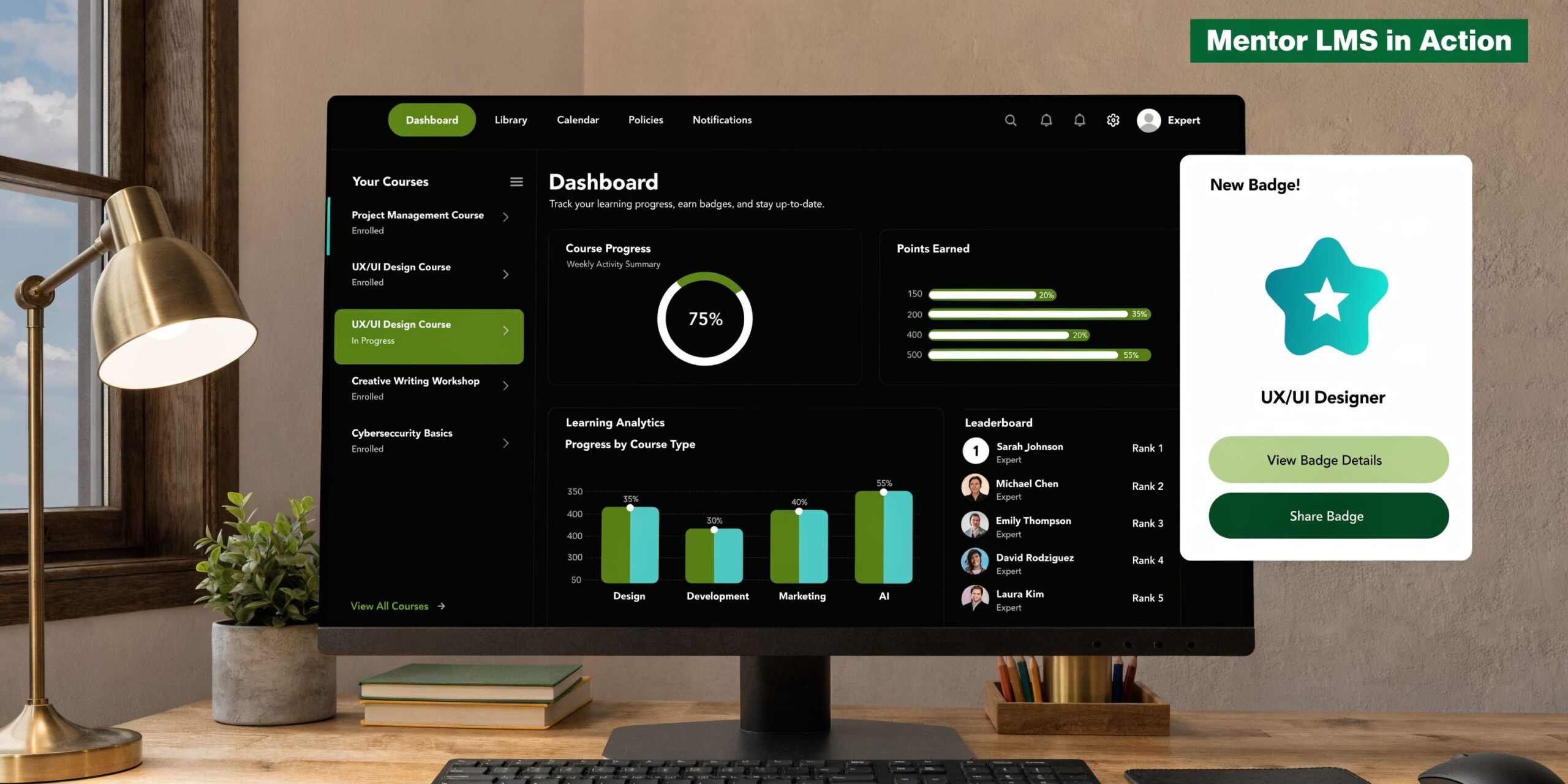
That is where Mentor LMS has worked well in practice, especially when combined with H5P and a small number of custom elements. It gives enough structure for straightforward deployment, but enough flexibility to support more specific reward logic when the course or business model needs it.
Where it performs well
The strongest use case I have seen is longer self-paced programs where motivation normally fades after the first few modules.
Using Mentor LMS progress tracking with custom badges, one “Digital Productivity” course experienced a substantial uplift in completion rates after gamification. Average time on site per learner increased. Quiz attempt rates improved, and a greater proportion of learners returned to the course multiple times per week during the program. In one cohort, users earned numerous total points and badges, demonstrating active engagement.
Those results came from a fairly disciplined setup:
- Points for meaningful milestones: module completion, strong quiz scores, assignment submission
- Custom badges with clear names: “Consistency Champion,” “Knowledge Master,” and “Project Finisher”
- Visible progress: dashboard progress bars and current point totals
- Optional leaderboard participation: competitive learners could opt in, others were not forced into public ranking
- Immediate feedback: points and badges appeared right after the qualifying action
This is the part many buyers miss. The platform features mattered, but the restraint mattered more.
Why it fits self-hosted operators
For self-hosted LMS projects, the appeal is not just badges and points. It is control.
Course creators can shape the reward rules around their own pedagogy. Agencies can tune the system for clients without waiting on a SaaS roadmap. Marketplace operators can decide whether recognition should be platform-wide, course-specific, or instructor-specific.
That flexibility matters because multi-instructor environments create problems that generic gamification guides rarely address. Issues like leaderboard monopolies, uneven course quality, and points inflation need governance, not just features. Industry commentary has noted that most gamification discussions ignore the operational complexity of multi-instructor marketplaces, which is exactly why platforms designed for those use cases deserve closer attention, as discussed in Moodle’s article on incorporating gamification into an LMS.
The technical headaches are real
Mentor LMS is not exempt from the usual implementation friction.
The most difficult area in practice was automatic badge issuance and synchronization across the LMS, especially when H5P activity data had to reflect correctly on the main dashboard. Early versions of the setup produced occasional trigger failures, duplicate badges, and delayed point sync.
The fixes were practical, not glamorous:
- Use narrow trigger definitions
- Keep total badge count limited
- Test every rule with a pilot group
- Add manual approval for critical badges
Once the rules were simplified, stability improved sharply.
It is particularly strong when the business model is not simple
Mentor LMS stands out more clearly in this regard.
A solo creator can use it for straightforward self-paced course gamification. But it is also usable for more demanding setups, including instructor marketplaces and structured assessment environments. The platform’s broader feature set supports that kind of design flexibility, and the product documentation gives a good overview of the available features.
For teams evaluating an lms with gamification, that combination matters. You want enough built-in structure to move quickly, but enough ownership and flexibility to avoid redesigning your business around the LMS.
The broader lesson is simple. Gamification works when the LMS lets you control rules, feedback, visibility, and governance without constant friction. Mentor LMS handles that balance better than many platforms that look stronger on a sales page than they do in production.
If you want a self-hosted platform that supports points, badges, leaderboards, exams, certificates, multi-instructor marketplaces, and full ownership of your LMS stack, take a closer look at Mentor LMS. It is a practical fit for course creators, agencies, and training teams that want control without vendor lock-in.