
A Practical Guide to Building a Learner Centered Strategy
 Mahmudul Hasan Rafi·
A learner-centered strategy flips the script on course design. Instead of building a course around what you, the instructor, want to teach, you start by focusing on how your students actually learn. It's about trading in the one-size-fits-all lecture for a flexible experience where learners have more autonomy, choice, and a reason to participate.
What a Learner-Centered Strategy Looks Like

Think of a traditional course as a train on a fixed track. Everyone gets on at the same station, travels at the same speed, and gets off at the same destination. A learner-centered course, on the other hand, is like handing your students a map and a compass in a vast national park. You provide the tools, set the boundaries, and point out the key landmarks, but they get to choose their own path and set their own pace.
This approach acknowledges a simple truth: your learners aren't empty vessels. They show up with their own experiences, unique goals, and different reasons for being there. When you put them at the heart of the learning experience, you empower them to take real ownership of their journey, which naturally boosts their engagement and helps them retain what they learn.
From Instructor-Led to Learner-First
The real difference between these two approaches comes down to control and flexibility. An instructor-centered model is all about the instructor's expertise and delivery, while a learner-centered strategy is shaped by the student’s own needs and aspirations.
The data backs this up. In formal education, schools that have adopted learner-centered practices have seen 15-30% improvements in academic achievement and graduation rates. But this isn't just for K-12. For adult learners, where motivation is the biggest hurdle, the results are even more striking. Courses built with a learner-centered focus consistently achieve higher completion rates (often 80–90%) and better satisfaction scores.
This isn't just a small tweak to your teaching style; it's a completely different philosophy. You can dig deeper into this idea by exploring the core instructional design principles that create truly effective learning environments.
Comparing the Two Educational Models
To really see the difference, it helps to compare the old-school, instructor-led model with the modern, learner-centered one side-by-side. The table below breaks down how this philosophical shift changes everything from course structure to student motivation.
| Aspect | Instructor-Centered Model (Traditional) | Learner-Centered Model (Modern) |
|---|---|---|
| Focus | On what the instructor teaches and covers. | On what the learner discovers and applies. |
| Pace | Fixed and uniform for all students. | Flexible and self-directed by the individual. |
| Content | Delivered in a linear, sequential order. | Organized in modules; accessible in various paths. |
| Activities | Standardized for everyone (e.g., same quiz). | Offers choice (e.g., quiz, project, or reflection). |
| Role of Instructor | "Sage on the stage"—the primary source of knowledge. | "Guide on the side"—a facilitator and resource. |
| Motivation | Often external, driven by grades or compliance. | Internal, driven by curiosity and personal goals. |
As you can see, a learner-centered strategy isn't about throwing structure out the window. It's about creating flexible structure. It’s about designing a course where your students feel empowered, not just lectured at. When you pull this off, you create an experience that feels more personal and relevant, which is the key to higher satisfaction and much better completion rates.
The Four Pillars of a Successful Learner Centered Course
If you want to build a course that truly puts learners first, you need more than good intentions. You need a solid foundation. Think of it like building a house; without strong pillars, the whole structure is wobbly. The same goes for your course. A learner-centered strategy rests on four key pillars that, when combined, shift the focus from the instructor to the student's actual experience.
When these pillars are firmly in place, you create an environment where your students feel motivated, engaged, and genuinely in control of their own learning. Each one taps into a core human need: the need for control, relevance, action, and support. Let's break down what they are and how they look in a well-built online course.
Pillar 1: Autonomy and Flexibility
First up is autonomy. At its heart, this is about giving learners control over the when and the how of their education. It's a departure from the old-school, rigid path where everyone marches in lockstep. Instead, you offer a flexible structure that respects that people have different schedules, lives, and learning speeds.
This pillar is all about respecting your learners' time and what they already know. It accepts that a seasoned pro might want to skip the basics, while a complete beginner needs to take it slow. In practice, this often looks like:
- Self-paced, bite-sized lessons: Breaking content into short, digestible modules (5-15 minutes is a great target) lets people make progress in small pockets of time.
- Flexible timelines: Ditching strict deadlines takes the pressure off. This allows students to binge-learn when they're on a roll or slow down during a busy week.
“I loved that I could learn at my own speed. Some weeks I binge-watched 4 modules when I had time, and other weeks I just did one. No pressure, but I still finished everything.”
That student was part of a cohort with an 87% completion rate—proof that flexibility drives results.
Pillar 2: Personalization and Choice
While autonomy gives learners control over their pace, personalization gives them control over their path. This pillar acknowledges a simple truth: not all of your students have the same goals, interests, or preferred ways of showing what they've learned.
Offering choices makes the experience feel less like a one-size-fits-all requirement and more like a personal journey. It’s a powerful motivator. To bring this pillar to life, you could:
- Create multiple learning paths: You might offer an "essentials" track for a quick overview and an "advanced" track with deeper dives for those who want to go further.
- Provide choice-based activities: Instead of a single, mandatory quiz, why not let learners choose how to prove they've mastered the material? They could pick between a quiz, a short reflective essay, or even a real-world project submission.
Pillar 3: Active and Applied Learning
A great learner-centered course turns students from passive spectators into active participants. This third pillar, active learning, is all about getting them to do, create, and apply what they’re learning. It’s the difference between watching a video about how to swim and actually jumping in the pool.
When learners have to actively engage with the material, they remember it so much better. This means designing your course with tasks that demand critical thinking, problem-solving, and a connection to the real world. For example, you could have students analyze a case study, participate in a debate on a discussion forum, or build a small project with their new skills.
Pillar 4: Guided Support
Giving learners freedom doesn't mean setting them adrift. The final pillar, guided support, is the crucial safety net. Too much choice with zero guidance can lead to "decision paralysis," where learners get so overwhelmed they just give up.
Effective support provides just enough structure without taking away that feeling of autonomy. Your role shifts from being the "sage on the stage" to the "guide on the side."
Here are a few ways to provide that guidance:
- A "Getting Started" module: A short orientation that explains how to use the course and suggests learning paths based on different goals.
- Milestone checkpoints: Simple self-checks or progress markers that help learners feel confident they're on the right track before moving on.
- Accessible help: A dedicated discussion board or Q&A forum where students can ask questions and get help from both you and their peers.
These four pillars—Autonomy, Personalization, Active Learning, and Guided Support—are the blueprint for any successful learner-centered course. As you build on these foundations, exploring the broader best practices for online courses can help you refine your approach and create truly engaging experiences.
Designing a Course That Champions Learner Autonomy
Putting the principles of a learner-centered strategy into practice is what separates a good course from a great one. It’s about shifting away from a rigid, one-size-fits-all curriculum and building a flexible experience that truly respects your learners' time, goals, and what they already know.
The key is to empower them without overwhelming them. A well-designed course acts like a map and a compass—it clearly marks the essential destinations but gives people the freedom to choose their own route. This whole philosophy starts with how you organize your lessons.
Create Modular, Bite-Sized Lessons
A great place to start is by breaking up the traditional, hour-long lecture format. Instead, design your course around short, self-contained modules, keeping them between 5 and 15 minutes long. This modular approach is a game-changer for modern learners juggling education with their careers and personal lives.
This has two huge advantages. First, it lets people dip in and out of the material whenever they have a spare moment, without feeling chained to their desks for an hour. Second, shorter lessons make the content feel much more approachable and less intimidating, which is a powerful way to keep motivation high.
Offer Multiple Learning Paths
Let's be honest: not everyone who signs up for your course has the same objective. A true learner-centered strategy acknowledges this by offering different pathways through the material. Instead of forcing everyone down a single, mandatory track, you can build optional routes that cater to different needs.
For example, you could create:
- An "essentials" path for those who need the core concepts quickly and efficiently.
- An "advanced" path that includes bonus resources, detailed case studies, and deeper dives for learners aiming for mastery.
This simple change puts the student back in the driver's seat. As one learner said, “The optional deeper dives made me feel in control. I skipped what I already knew and spent more time on the parts that actually helped my job.” That sense of agency led to a 9.5/10 satisfaction rating for the course.
As you can see in the diagram below, this idea of autonomy works hand-in-hand with personalization, active learning, and support. They are the foundational pillars of this approach.
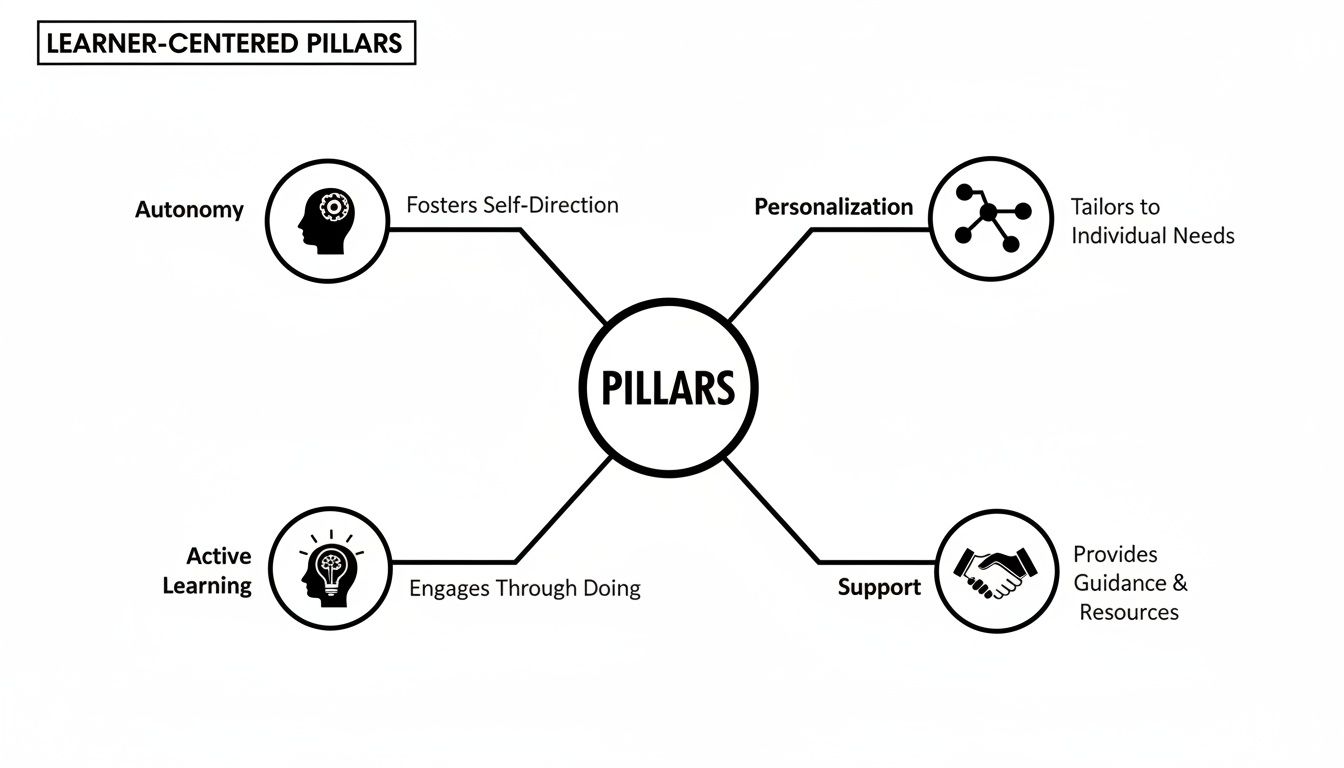
These four elements are interconnected; you can't have a truly learner-centered experience without all of them working together.
Implement Choice-Based Activities
Once your content is flexible, it’s time to rethink how you assess learning. Rather than making everyone take the same standardized quiz, why not offer a choice of activities? This allows learners to show what they've learned in a way that plays to their strengths.
You might let them choose between options like:
- Completing a multiple-choice quiz.
- Submitting a short, written reflection on the topic.
- Applying the concept in a practical, real-world mini-project.
Giving them this choice transforms assessment from a tedious requirement into a meaningful part of the learning journey. It respects different skill sets and makes the entire process feel more personal and relevant.
Empower Learners with Self-Directed Navigation
Finally, all these pieces need to come together in a clean, intuitive dashboard. This dashboard is the learner's command center, where they can see their progress at a glance, decide what to work on next, and easily jump back to review any module they choose.
This freedom to navigate is a massive motivator. Many self-paced courses effectively use asynchronous learning because it gives people total control over their schedule. When you combine that with clear progress tracking and a choose-your-own-adventure feel, engagement soars. You can boost that engagement even further by fostering a sense of community with tools like discussion forums right in your LMS.
The results speak for themselves. One student in a course built this way said, “For the first time in an online course, I didn’t feel like I was being babysat. The progress tracker and freedom to choose activities kept me engaged till the end.” This sentiment reflects why such courses see higher completion rates—because putting learners in charge pays off.
How to Avoid Learner Overwhelm

If there's one fear that keeps course creators from trying a learner-centered strategy, it's the thought of unleashing total chaos. We’ve all wondered: what happens if I give my students complete freedom? Will they feel empowered, or will they just get lost and give up?
That’s a perfectly reasonable concern. The biggest challenge when shifting to this model is learner overwhelm and decision paralysis. When you first give too much freedom, some students feel lost and don’t know where to start.
The answer isn’t to lock everything down again. Instead, we frame their autonomy with just enough structure. I call this approach Guided Autonomy, and it's all about finding that sweet spot between freedom and support. It’s the scaffolding that makes self-direction feel empowering, not just a confusing free-for-all.
Think of it this way: you’re still putting them in the driver’s seat, but you're also handing them a map and pointing out the major landmarks. This simple act of guidance prevents those early drop-offs and turns what could be confusion into confident exploration.
Create a "Getting Started" Module
Your first and most important step is to build a dedicated “Getting Started” module. This is your welcome mat—a short, friendly section to orient learners before they dive into the deep end. You're not telling them what to do, but rather how to find their own way through the course.
In this brief orientation, you should:
- Explain the course structure: Give them a quick tour of how the lessons are organized and where to find key resources.
- Suggest recommended paths: Offer a few potential learning tracks based on different goals, like a "quick essentials path" for busy learners or a "deep dive path" for experts.
- Set clear expectations: Show them how to track their progress and what they need to do to successfully finish the course.
This initial handshake builds confidence right away, making the freedom of your course feel exciting, not intimidating.
Use Milestone Checkpoints for Confidence
Another great technique is to sprinkle milestone checkpoints throughout your course. These aren't rigid gates, but friendly signposts where learners can pause and confirm they’re on the right track. After a few foundational modules, you could insert a simple self-assessment or a short reflection question.
These checkpoints do two things really well. First, they break the course into manageable chunks, giving students a real sense of accomplishment as they go. Second, they offer a low-stakes way for learners to check their own understanding, making them feel secure before tackling more advanced topics.
The biggest challenge was learner overwhelm and decision paralysis. When I first gave too much freedom, some students felt lost… I solved it by adding clear guidance without control — a short “Getting Started” module… and milestone checkpoints. This balanced approach gave learners autonomy while providing just enough structure to prevent confusion. The result? Fewer drop-offs in the first two weeks.
This gets right to the heart of it: structure isn't the enemy of autonomy. It's what makes true autonomy possible.
Add a Few Guardrails with Prerequisites and Discussion Areas
While open navigation is central to this approach, it's okay to use prerequisites for absolutely essential, foundational content. For example, you might require everyone to complete "Module 1: Core Concepts" before unlocking the rest of the course. The key is to use them lightly—only for foundational topics—while keeping most modules open for free exploration.
Finally, always have a dedicated “Need Help?” discussion area. A simple forum or Q&A section acts as a safety net. It’s a place where learners can ask questions, see what others are focusing on, and get support from you and their peers. This builds a sense of community and reassures them that help is always there if they get stuck.
Using an LMS to Personalize Learning at Scale
Putting a learner-centered strategy into practice can feel overwhelming, especially if you're a solo course creator. How are you supposed to manage custom learning paths, offer flexible content, and give regular feedback without a huge team behind you?
The secret isn't more work; it's smarter tools. A modern Learning Management System (LMS) is the engine that makes personalization at scale not just a lofty idea, but a practical reality.
A great LMS doesn't add to your workload—it automates the heavy lifting. Think of it as your silent partner, handling all the logistics so you can get back to what you do best: creating amazing content. By choosing an LMS built for learner autonomy, you can put these principles into action right from the start.
Building Flexible Courses with Ease
The very foundation of a learner-centered course is its modular design. This is where a good, intuitive course builder is non-negotiable. With a simple drag-and-drop interface, you can break your curriculum down into bite-sized lessons, set up different learning tracks, and tweak the content whenever you need to.
Mentor LMS makes scaling personalization surprisingly straightforward. The features I rely on most are the self-paced course structure with easy drag-and-drop lesson organization.
This structure allows you to mix and match all kinds of content—videos, PDFs, quizzes, downloadable worksheets, you name it. Learners can then engage with the material in the format that works best for them. You can see how a powerful course builder is designed specifically to support this modular approach.
Empowering Learners Through Ownership
A huge part of a learner-centered strategy is making students feel like they're in the driver's seat of their own education. An LMS brings this to life by giving them total visibility and control over their journey. Automated progress tracking is a perfect example of this in action.
When someone can see exactly what they’ve accomplished and what’s left to do, it gives them a powerful sense of ownership. This isn't about micromanagement; it's about empowerment. The features that make this happen are simple but effective:
- A Personalized Student Dashboard: This acts as the learner's command center, showing their progress at a glance and letting them decide where to go next.
- Automated Completion Certificates: These offer a tangible reward for their effort, reinforcing that feeling of accomplishment.
- Visual Progress Tracking: Cues like progress bars and checkmarks give learners a clear sense of momentum, which is a massive motivator.
These elements shift the whole dynamic. Students stop being passive followers and become active participants charting their own path forward.
Extending Personalization to Your Business Model
The benefits of a great LMS go beyond the course itself. You can also personalize how you package and sell your programs, which allows you to meet people where they are—not just educationally, but financially, too.
For example, using features like enrollment options and course bundles lets you create different entry points for your audience. You could offer a single, targeted course for someone with a specific problem to solve, or a complete program bundle for another person ready to master a whole new skill set.
This flexibility makes your business model as learner-centered as your teaching. It gives you the tools to grow your impact and your bottom line without getting stuck in a rigid, one-size-fits-all box.
Measuring the Success of Your Learner-Centered Approach
So, you’ve put in the work to build a learner-centered strategy. That’s a huge step. But how do you actually know it’s working? To really see the payoff and make smart improvements, you have to look past simple clicks and views and get to the data that shows genuine student progress and happiness.
Shifting to a learner-centered model isn’t just about creating a warmer, fuzzier experience. It directly and measurably impacts how well your students succeed. The trick is knowing which numbers—and which feedback—tell the real story of your course's impact.
Key Metrics That Matter
The best way to see the full picture is to pair hard numbers with human feedback. This approach doesn't just show you what's happening in your course; it tells you why it's happening.
Here are the essential metrics you should be watching:
- Course Completion Rates: This is the big one. Traditional online courses are notorious for dismal completion rates. But when you give learners control, those numbers climb. A lot.
- Net Promoter Score (NPS) or Satisfaction Ratings: How likely are your students to recommend your course? A high NPS is a powerful sign that you’re delivering real value.
- Qualitative Feedback: Student testimonials are absolute gold. They’re the stories behind the stats, revealing exactly which parts of your course are hitting the mark.
Nothing proves your point better than hearing directly from a student. Getting a comment like, "The optional deeper dives made me feel in control. I skipped what I already knew and spent more time on the parts that actually helped my job,” is undeniable proof that your approach is connecting. That same learner gave the course a 9.5/10 rating.
The Data Proves the Difference
When you set the results of a rigid, one-size-fits-all course next to a flexible, learner-centered one, the gap in performance is impossible to ignore. The data speaks for itself: giving learners autonomy creates incredible outcomes. It’s not uncommon for courses built on choice and flexibility to hit completion rates between 80–90% and Net Promoter Scores of 8.5 or higher.
Here's a look at how the key performance indicators stack up when you compare the two models.
Performance Metrics Traditional vs. Learner-Centered Courses
| Metric | Traditional Linear Course (Typical) | Learner-Centered Course (Achieved) |
|---|---|---|
| Completion Rate | 10–30% | 80–90% |
| Satisfaction (NPS) | 4.0–6.5 | 8.5+ |
| Student Engagement | Passive; completion-focused | Active; mastery-focused |
| Qualitative Feedback | "It was too rigid." "I lost motivation." | "I felt in control." "It fit my schedule." |
The difference is night and day. This provides a rock-solid case for building your courses around the learner. It’s not just a better teaching philosophy—it’s a data-backed method for creating courses that people actually finish and love. By tracking these key metrics, you can confidently measure your results and keep building experiences that truly work for your students.
Your Learner-Centered Strategy Questions, Answered
Shifting to a learner-centered approach is exciting, but it’s natural to have a few questions about how it works in the real world. Let’s tackle some of the most common concerns we hear from course creators making this change.
How Much Choice Is Too Much for My Students?
It’s a great question. Handing learners the keys to everything without any structure can cause “decision paralysis”—that feeling of being so overwhelmed with options that you don’t know where to begin. It’s like staring at a 50-item menu when you’re starving.
Here’s a simple guideline I always recommend: the “rule of three.” For any given activity or learning path, try to offer no more than three distinct choices. This gives learners a real sense of control without making them feel lost. It’s the sweet spot between true autonomy and gentle guidance.
Can This Really Work for Something Like Compliance Training?
Absolutely. Compliance training might have non-negotiable learning goals, but how learners get there is where you can introduce choice. The trick is to frame the mandatory material inside real-world scenarios.
For instance, you could offer different case studies, problem-solving simulations, or role-playing exercises that all lead to the same required knowledge. This lets people pick the context that feels most relevant to their job, which makes dry, mandatory training feel far more practical and engaging.
Is This Realistic for a Solo Creator to Manage?
Yes, it’s totally manageable, but you have to be smart about your tools. Trying to do this manually with spreadsheets and email would be a nightmare. A modern LMS, however, can automate almost all the heavy lifting.
Look for a system that can handle progress tracking, deliver content based on learner choices, and offer personalized dashboards. You put in the work upfront to design the course with different paths and modules. After that, the technology takes over, running the personalized experience for you while you focus on what you do best: creating amazing content.
How Do I Convert an Existing, Linear Course?
You don’t need to tear down your entire course and start from scratch. The best way is to start small and iterate.
- Chunk it Out: First, go through your existing course and break the content into smaller, standalone modules. Think short videos, individual articles, or single-topic lessons.
- Add Some “Go Deeper” Options: Next, create a few optional resources—like an expert interview, a detailed case study, or a downloadable checklist—for learners who want to explore a topic further.
- Introduce a Small Choice: Finally, try replacing one of your standard quizzes with a choice-based activity. Let learners choose between writing a short response, recording a quick video, or completing a small project to show what they’ve learned.
Ready to build courses that put learners first? Mentor LMS gives you all the tools you need—from a drag-and-drop course builder to automated progress tracking—to launch a successful learner-centered online course or marketplace. Own your platform forever with a single purchase. Learn more about Mentor LMS.