
Gamification in LMS: Boost Engagement & Completion
 Mahmudul Hasan Rafi·
Most online courses don’t fail because the content is weak. They fail because learners lose momentum halfway through.
That’s why gamification in lms deserves a serious look. Organizations that embed game mechanics into learning and operations report 7x higher profitability and a 50% reduction in training time, according to AmplifAI’s gamification statistics roundup. For course creators and marketplace operators, that changes the conversation. Gamification isn’t a decorative layer. It can shape completion, retention, repeat purchases, and the overall value of your learning business.
If you’ve ever watched students buy a course with good intentions, complete the first few lessons, then disappear, you already know the core problem. Content alone rarely creates consistency. People need progress they can see, small wins they can feel, and a reason to return tomorrow.
A good gamification learning platform helps clarify what that experience can look like in practice. The important part isn’t turning your course into a video game. It’s building a learning environment that rewards effort, signals progress, and makes the next step obvious.
Introduction Why Your Courses Need More Than Just Content
A standard course often asks learners to do something difficult in a very flat environment. Watch the lesson. Read the text. Take the quiz. Repeat. Even when the teaching is excellent, the experience can feel emotionally silent.
That silence matters. Learners want feedback. They want evidence that their effort is paying off. They want to know where they stand, what they’ve achieved, and what to do next. Gamification gives you those signals without requiring you to rebuild your course from scratch.
Engagement is a business issue, not just a teaching issue
When learners stop showing up, the damage isn’t only academic. Course creators lose repeat buyers. Corporate trainers struggle to get staff through required programs. Marketplace operators end up with inactive students and underperforming instructors.
Gamification addresses that by making participation visible and rewarding. A learner who sees progress is more likely to keep going. A student who earns recognition is more likely to remember the course. An instructor who can structure milestones tends to build more motivating learning paths.
Gamification works best when it supports learning behavior, not when it distracts from learning goals.
Ownership changes the implementation question
On a self-hosted platform, the question isn’t only “Should we gamify?” It’s also “How do we do it in a way that supports our business model?”
That’s a different challenge from using a closed SaaS tool. If you own your platform, you can shape certificates, assessments, release conditions, dashboards, instructor workflows, and marketplace incentives around your own teaching style and revenue model. That flexibility is where gamification becomes practical, not theoretical.
What Is Gamification in an LMS and What It Is Not
Think about a fitness app. It doesn’t turn jogging into a video game. You still have to run. What it does is add structure around the effort. You get streaks, milestones, badges, progress rings, and reminders that make your effort visible.
That’s the clearest way to understand gamification in lms. You are not replacing learning with play. You are adding game-like mechanics to make progress easier to notice and effort easier to sustain.
What gamification actually means
In an LMS, gamification usually includes elements like:
- Points: Learners earn credit for meaningful actions such as finishing a lesson, passing a quiz, or submitting an assignment.
- Badges: The system gives visual recognition for reaching a milestone or mastering a skill.
- Leaderboards: Learners can compare progress in a public or group-based view.
- Levels: New content becomes available after a learner completes required work.
- Challenges or quests: A set of tasks is framed as a clear mission with a goal and reward.
Each of these mechanics does one simple job. It answers the learner’s silent question: “Am I moving forward?”
What it is not
Gamification is often confused with game-based learning, but they’re different.
Simple distinction: Gamification adds game mechanics to learning. Game-based learning uses an actual game as the learning activity.
If you create a full simulation where a learner plays through a business scenario as the lesson itself, that leans toward game-based learning. If you add badges, progress bars, modules that become available, and timed assessments to an existing course, that’s gamification.
This distinction matters because many educators get stuck here. They assume gamification requires animation, story worlds, or expensive custom development. It doesn’t. In most cases, you can start with your existing lessons and improve the learner journey around them.
A practical mental model
Use this comparison when planning your course:
| Approach | What you change | Typical effort |
|---|---|---|
| Traditional LMS course | Content only | Lower setup |
| Gamified LMS course | Content plus motivation mechanics | Moderate setup |
| Game-based learning | The lesson itself becomes a game or simulation | Higher setup |
For most creators, the middle option is the sweet spot. You keep your curriculum, but present it in a way that feels active rather than passive.
How Gamification Drives Learner Engagement and Completion
People stay with difficult tasks when they can see movement. That’s one reason gamification works so well in learning environments. It gives learners immediate signs that their effort matters.
In a gamified learning environment, 89% of employees report feeling more productive and 88% feel happier on the job, according to BuildEmpire’s gamification statistics summary. In course settings, that same positive feeling supports voluntary completion and stronger long-term retention.

It taps into mastery, autonomy, and social connection
A learner rarely thinks in those exact words, but those are the underlying drivers.
Mastery means “I’m getting better.”
Autonomy means “I have control over my progress.”
Social connection means “My work is seen and shared with others.”
A progress bar supports mastery because it shows advancement. Optional challenges support autonomy because learners can choose to go further. Team activities or selected leaderboard views support social connection because they place learning in a shared environment.
Motivation needs visible feedback
Without feedback, online learning can feel like shouting into an empty room. A learner finishes a lesson, but nothing changes. No signal. No recognition. No next-step prompt.
Gamification fixes that by making response immediate. Pass the quiz and access the next module. Finish the unit and receive a badge. Complete a challenge and move up a level. These small signals reduce friction because learners don’t have to guess whether they’re progressing.
If your course uses assessments as part of the learning loop, well-structured online exams and quizzes can do much of this work. Timed attempts, visible scores, and milestone-based testing can turn passive consumption into active participation.
The real effect is momentum
The biggest gain is not novelty. It’s momentum.
- Early wins help learners start strong.
- Clear milestones help them avoid drift.
- Recognition helps them feel the course is worth finishing.
- Repeatable routines make return visits more likely.
A learner doesn’t need constant entertainment. They need a system that makes effort feel purposeful.
That’s why weak gamification fails. If all you add is decoration, learners ignore it. But if each mechanic answers a real motivational need, the course becomes easier to continue.
The Core Mechanics of LMS Gamification
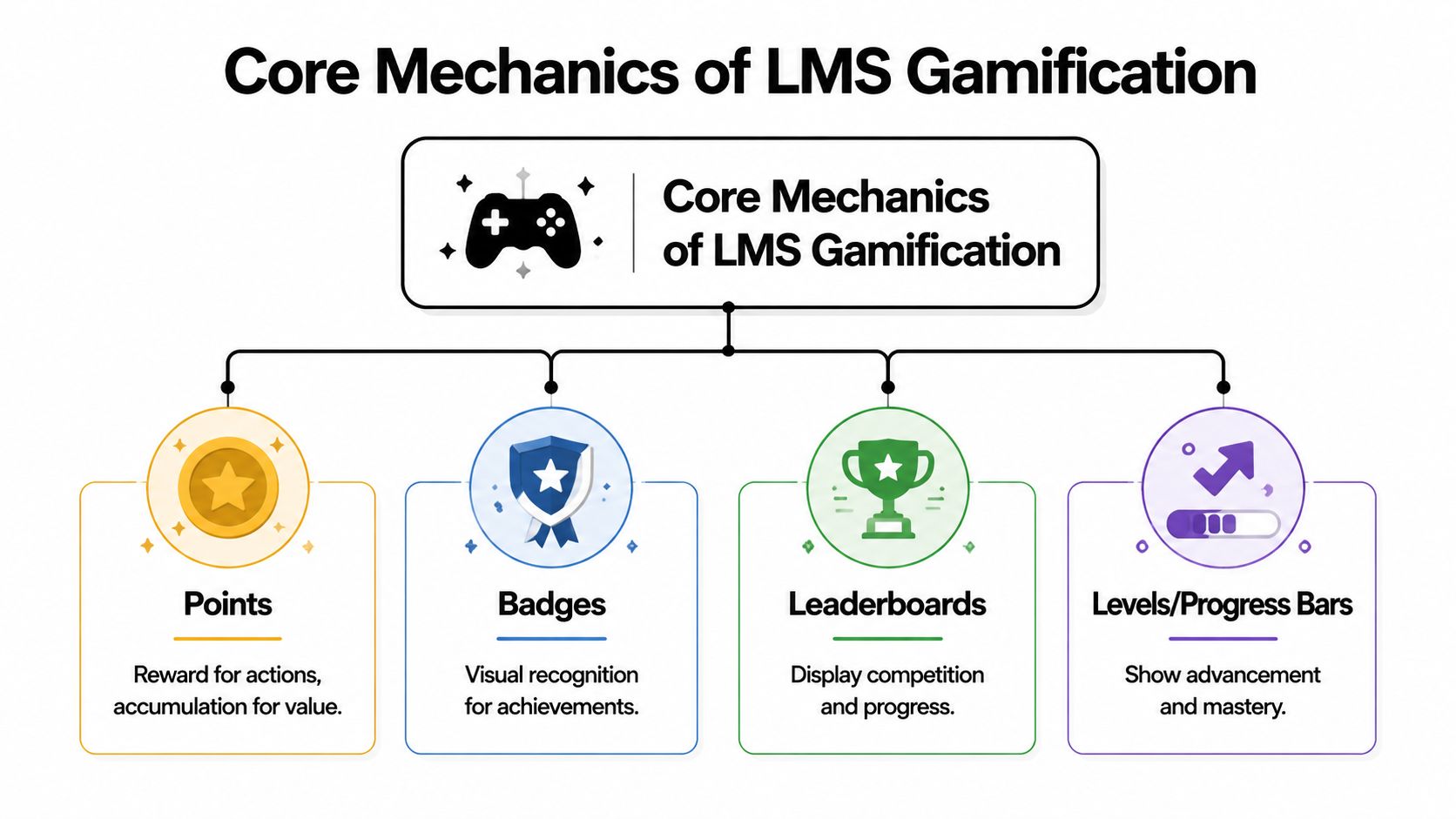
A strong gamified course doesn’t need dozens of moving parts. It needs a few mechanics that match the kind of behavior you want from learners. Most systems revolve around five building blocks.
Points create immediate feedback
Points are the simplest place to start because they turn invisible effort into visible progress. Finish a lesson, earn points. Pass a quiz, earn more. Submit an assignment, collect a reward.
According to CYPHER Learning’s discussion of LMS gamification, points systems can directly boost course completion rates by 47%. The reason is straightforward. Points create a tight cause-and-effect loop. The learner does something useful and sees the result immediately.
That matters because online learning often delays gratification. A course may be valuable in the long run, but points make progress feel tangible today.
Badges recognize milestones
Badges are less about counting and more about meaning. They say, “You reached something important.”
Use badges when an achievement deserves a label. Examples include:
- Skill completion: finishing a writing fundamentals track
- Consistency: completing a weekly challenge series
- Mastery: scoring strongly across multiple assessments
- Contribution: participating in peer discussion or reviews
Badges work best when they’re specific. “Completed course” is functional. “Client Communication Specialist” carries identity and status.
A shareable certificate can also play this role. If you want milestone recognition to feel formal, a certificate generator for course completion can help turn progress into something learners keep, share, and value.
Leaderboards add social energy
Leaderboards are the most visible mechanic, and also the easiest to misuse.
They can energize competitive learners by showing ranking, pace, and performance. In sales training, test prep, or team-based learning, that public comparison can create urgency. It can also make progress feel communal rather than solitary.
But leaderboards should never be your default setting for every audience. They work best when the culture supports competition and when the stakes feel fair.
Levels and progress bars reduce uncertainty
A progress bar is quiet, but powerful. It tells learners, “You are not lost. You are here.”
Levels serve a similar role with a stronger sense of advancement. Instead of moving through disconnected lessons, learners move from one stage to the next. Beginner. Practitioner. Advanced. Certified.
This structure helps because people persist longer when the path feels finite and organized.
Challenges and quests give context
A challenge turns a list of tasks into a mission. That small shift changes the emotional tone of the course.
Instead of saying “complete lessons 3 through 5 and take the quiz,” you can frame it as “finish the customer objection challenge and access the next scenario.” The work is still rigorous, but the experience feels purposeful.
Practical rule: Don’t add mechanics because they’re available. Add them because each one supports a specific learner behavior.
A quick selection guide
| Mechanic | Best for | Watch out for |
|---|---|---|
| Points | Frequent reinforcement and visible effort | Rewarding activity that doesn’t reflect learning |
| Badges | Milestones, identity, recognition | Badges that feel generic or meaningless |
| Leaderboards | Competitive groups and team energy | Discouraging lower-performing learners |
| Levels and progress bars | Clarity, pacing, progression | Too many stages with no clear difference |
| Challenges and quests | Narrative structure and motivation | Overcomplicating simple lessons |
A good design usually combines several mechanics, but not all at once. Start with the learner behavior you want. Then choose the lightest mechanic that can support it.
Designing an Effective Gamification Strategy
The easiest way to ruin gamification is to bolt points and badges onto a course that has no clear learning path. Learners may click more for a short time, but they won’t necessarily learn better.
Good design starts earlier. It begins with your course objective, your audience, and the kind of motivation your learners already respond to.
Start with the learning outcome
Ask one question before choosing any mechanic: what behavior should change?
If you want learners to complete a compliance program on time, visible progress and deadline-based challenges may be enough. If you want learners to practice decision-making, scenario-based advancements make more sense. If you want repeat visits in a course marketplace, staged rewards across multiple courses may work better than a single end-of-course badge.
A mechanic only works when it supports a real outcome.
Match the mechanic to the learner
Not every audience likes public competition. Not every learner cares about badges. Some students want status. Others want privacy. Some enjoy sprint challenges. Others need a calmer, more personal pace.
That’s especially important for struggling learners. According to the study on LMS gamification for slow learners, leaderboards can motivate high-performers but may demotivate learners who are already behind. More effective designs include personalized paths, private progress tracking, or team-based challenges that reduce public pressure.
Build a balanced rewards system
If every click earns points, points stop meaning anything. That’s the online learning version of inflation. Learners may chase rewards without focusing on mastery.
A healthier rewards system has three layers:
- Frequent signals for small actions, such as lesson completion.
- Meaningful milestones for completing units or demonstrating competence.
- Higher-value recognition for sustained performance, consistency, or applied skill.
This keeps rewards from feeling random. It also protects the course from becoming a checklist game.
Public competition should be optional when your audience includes beginners, anxious learners, or people returning to study after a long break.
Use narrative where it helps
You don’t need fantasy storytelling to make a course feel connected. A light narrative is often enough.
A cybersecurity course can use “missions.” A sales program can use “client scenarios.” A teacher training course can use “classroom challenges.” These labels create continuity. Learners feel they’re progressing through a journey rather than consuming disconnected files.
A simple design checklist
Before launch, review your course against these questions:
- Clear objective: Does each mechanic support a defined learning or business goal?
- Visible progress: Can learners tell where they are and what comes next?
- Inclusive design: Does the system support both confident and struggling learners?
- Meaningful rewards: Are you recognizing effort, mastery, or both?
- Low friction: Can learners understand the rules without extra explanation?
The strongest gamification feels natural. Learners don’t think about the mechanic first. They feel the momentum it creates.
Implementing Gamification with Mentor LMS Features
Turning theory into a working course is where many creators stall. They understand the idea, but they aren’t sure how to build it on a platform they own. The good news is that most gamification patterns don’t require a dedicated “game engine.” They can be assembled from practical LMS features you already use.
If you want visible progress, structure the course path
Start with the course builder itself. Break the curriculum into short, meaningful units instead of oversized modules. A long wall of content hides progress. Smaller milestones make completion feel achievable.
Use drip content to create stages that become available. That gives your course a level-based rhythm. Learners complete one section, then gain access to the next. This mimics the logic of levels without adding complexity.
For example:
- Onboarding course: enable week two after week one is completed
- Certification prep: release mock exams after core lessons are passed
- Skill academy: open advanced modules only after foundational assignments are submitted
This approach works especially well when you want students to move in sequence rather than skip to the end.
If you want challenges, build them with exams and quizzes
One of the most practical ways to create gamification in lms is through challenge-based assessment.
Timed exams, attempt history, fullscreen mode, and auto-grading can turn a standard test into a milestone event. Instead of treating quizzes as an afterthought, use them as gates, trials, or score-based missions. A learner doesn’t just “take quiz 4.” They complete a checkpoint that proves readiness for the next stage.
If you’re comparing broader tools for online teaching, it helps to prioritize platforms that let assessment do more than grading. In a gamified course, assessments become motivation tools as much as measurement tools.
A few practical patterns work well:
- Checkpoint challenge: require a passing score before the next lesson becomes available
- Speed round: use countdown timers for revision or test prep
- Practice ladder: let learners retake a challenge and improve their standing
- Independent exam product: sell a standalone exam as a skill validation step
If you want recognition, turn completion into a shareable reward
Certificates are one of the easiest ways to bring status and closure into an LMS. They work like badges with more formal weight. When a learner finishes a course, completes a track, or passes an assessment threshold, a certificate gives that accomplishment a clear endpoint.
Design matters here. A generic certificate has administrative value. A branded certificate with course-specific titles and visual hierarchy feels like an achievement. That difference influences whether learners ignore it or share it.
For marketplace operators, this also benefits instructors. A course that offers stronger milestone recognition often feels more premium than one that ends with a silent “completed” label.
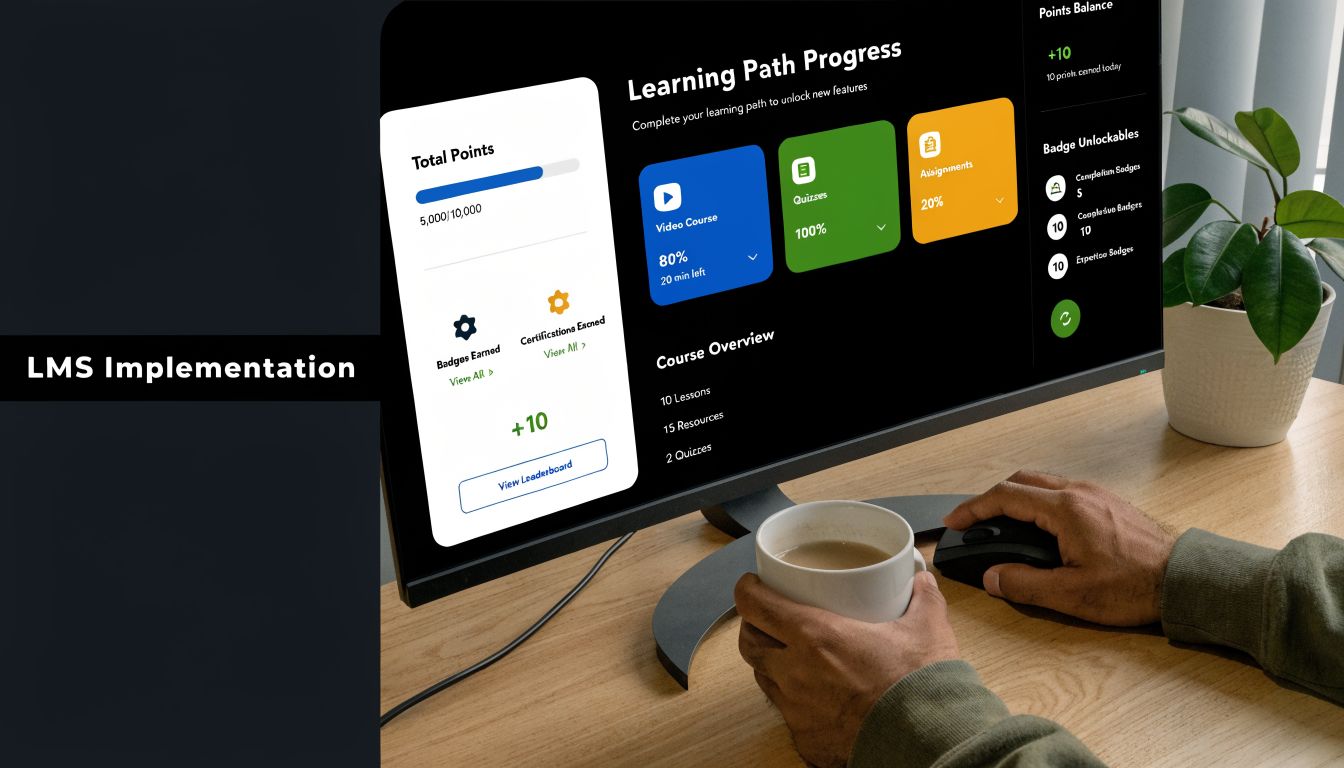
If you want continuity, use the dashboard as the game board
Gamification works when learners can see their status quickly. The student dashboard becomes the equivalent of a game’s home screen. It should answer basic questions at a glance:
- What have I completed?
- What’s next?
- What have I earned?
- How close am I to finishing?
That’s why progress tracking matters so much. A dashboard doesn’t need flashy design to be motivating. It needs clarity.
For multi-instructor marketplaces, the same principle applies to instructors and admins. Instructors should be able to see where students stall. Admins should be able to identify which course structures create repeat engagement.
A helpful reference on this broader topic is building an LMS with gamification, especially if you’re thinking beyond one course and looking at the platform experience as a whole.
Add richer interaction after the base loop works
Once the basic loop is in place, you can layer in extras without overwhelming the learner.
Use discussion forums for peer recognition. Use email notifications to celebrate milestones or remind learners about incomplete challenges. Use live classes for group quests, case discussions, or timed workshops. Use coupons or bundle offers to reward course completion with the next purchase opportunity.
This is also where marketplace strategy comes in. You can encourage instructors to build stronger learner journeys by promoting courses that use structured assessments, completion rewards, and staged content release.
Here’s a walkthrough video that can help you think about feature setup in a more concrete way:
A practical rollout order
Don’t launch every mechanic at once. A cleaner implementation sequence is:
- Break courses into clear milestones
- Add quizzes or exams as checkpoint challenges
- Issue certificates for meaningful completions
- Use drip content for conditional progression
- Review dashboard visibility and learner notifications
- Then add optional social or competitive layers
The best self-hosted gamification setups are modular. You add mechanics in layers, test learner response, and keep what improves progress.
That’s the advantage of ownership. You’re not waiting for a vendor roadmap. You can shape the experience around your content, your learners, and your business model.
Measuring Gamification ROI and Ensuring Fair Play
A gamified course can look busy and still underperform. More clicks do not automatically mean better learning or better business results. That’s why ROI matters.
According to Tovuti’s analysis of LMS gamification ROI, true ROI in a self-hosted LMS goes beyond completion rates. For edupreneurs, key measures include student lifetime value and higher conversion on multi-course bundles. The same source also warns that over-reliance on simple extrinsic rewards can create short-term boosts without sustained skill gains.
What to measure besides completion
Completion is useful, but it’s only the first layer. A stronger evaluation looks at whether gamification improves business and learning outcomes over time.
Use a scorecard like this:
| Metric | Why it matters |
|---|---|
| Repeat purchases | Shows whether the course experience builds trust and momentum |
| Bundle conversion | Indicates whether learners want the next step after finishing one offer |
| Assessment performance | Helps confirm that engagement is tied to mastery, not just activity |
| Return visits | Signals whether learners keep coming back between sessions |
| Instructor participation | Useful in marketplaces where course quality depends on creator effort |
Prevent learners from gaming the system
Any reward system can be exploited if it rewards activity without evidence of learning.
For example, if learners gain status only from logging in, clicking through pages, or posting low-value comments, they may optimize for points instead of competence. That weakens trust in the course and frustrates serious students.
A fair system usually includes these safeguards:
- Tie rewards to meaningful actions: passing quizzes, completing assignments, or finishing required lessons
- Set availability requirements: don’t release advanced content based on superficial activity
- Review attempt patterns: repeated guessing can reveal weak challenge design
- Balance public and private rewards: not every achievement needs ranking
- Keep rules clear: learners should know how progress is earned
If a learner can win without learning, the gamification design is broken.
The goal isn’t to police students aggressively. It’s to make sure rewards still reflect effort, skill, and persistence. That protects both ROI and course credibility.
Frequently Asked Questions about LMS Gamification
Many educators don’t need more theory. They need direct answers to practical setup questions. Here are the ones I hear most often.
Quick answers for common decisions
| Question | Answer |
|---|---|
| Can I add gamification to an existing course? | Yes. Start by restructuring lessons into smaller milestones, adding quizzes as checkpoints, and attaching certificates or unlock conditions to completion. You usually don’t need to rebuild the course from zero. |
| Do I need a dedicated gamification module to do this well? | Not always. Many strong gamified experiences come from combining existing LMS features such as quizzes, drip content, dashboards, certificates, and discussion tools in a deliberate way. |
| What’s the best first mechanic to add? | Start with visible progress and one meaningful checkpoint. That usually gives better results than launching badges, rankings, and challenges all at once. |
| Are leaderboards necessary? | No. They work for some audiences, especially competitive groups, but they can discourage learners who are already struggling. Private progress and team-based goals are often safer starting points. |
| Can gamification work in a multi-instructor marketplace? | Yes. It can motivate students through course paths and milestone rewards, and it can also encourage instructors to design clearer lessons, better assessments, and stronger completion experiences. |
| How do I know if my gamification is helping? | Look beyond completion. Track repeat purchases, return visits, bundle uptake, and assessment quality. If learners are active but not improving or buying again, refine the design. |
A final rule of thumb
If you’re unsure whether a mechanic belongs in your course, ask a simple question: does it help the learner act, continue, or improve?
If the answer is yes, it probably belongs. If it only decorates the interface, leave it out.
If you want a self-hosted platform where you can build these learning experiences without monthly platform fees or vendor lock-in, take a look at Mentor LMS. It gives course creators, training teams, and marketplace operators the tools to structure courses, assessments, certificates, drip content, and dashboards in ways that support practical gamification and long-term ownership.